
Temporary string lights
This selection is also available in our French store: Guirlande de chantier
No products in this selection.
- Tracked delivery to your country Tracked delivery
- Secure payment at checkout Multiple payment methods
- 14 days to change your mind 14-day returns
- Secure payment Secure payment
Not sure of your style? Find it in 30 seconds
A few questions, and we will show you the pieces made for you.
Frequently asked questions
How do I choose the right product?
What are the delivery times?
Can I return an item?
Can I pay in instalments?
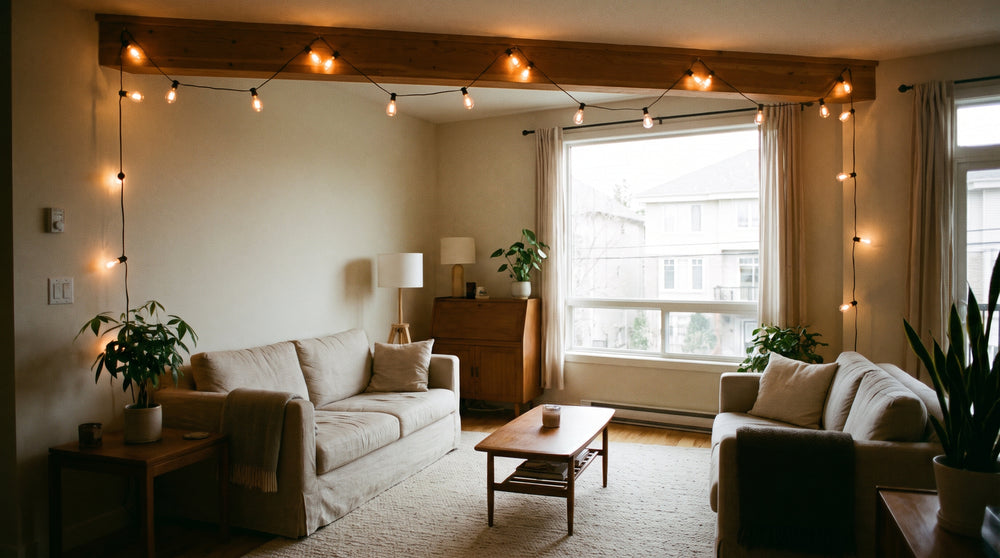
An interior that reflects who you are
Carefully selected pieces, shipped from our warehouses. Our team advises you before you buy, so you choose with confidence.
- Tracked delivery
- Pay in instalments, where available
- 14 days to change your mind
- Advice & showroom in Lyon, France
First measure the actual distance between the socket and the furthest point to be lit, then base the protection rating on the wettest exposure on site, never on the average. A site light string is chosen on these two measurements, plus colour temperature: 4000 K for working, 3000 K for finishing.
What is a site light string and what is it for?
A site light string is a flexible lighting cord fitted with sockets or LEDs spread along its full length, fixed along a wall, scaffolding or ceiling to light a work area continuously. It differs from a floodlight, which concentrates light in a single direction.
LED site light string: what changes compared with a classic light string
On an LED model there is no longer a bulb to replace one by one: the light points are soldered in and last as long as the string. Power consumption drops at comparable brightness, which matters when the extension lead runs several dozen metres and the consumer unit is already loaded. Light comes on instantly, with no warm-up time, and a failed light point does not switch off the rest of the cord on parallel-wired models. These formats are in LED light strings, with an overview in all our light strings.
Site light string: uses on the ground
It marks out a walkway, lights a workshop or garage as background light, keeps a basement under renovation company, highlights a facade being rendered. On a temporary staircase it makes the steps readable without fitting a bulkhead light: see lighting a site staircase. For wall-mounted runs along a corridor, the wall light string format fixes faster than a batten. A floodlight remains better for throwing light far onto a precise point; a light string covers a line, not a point.
What length of site light string should you choose, 10 m or 50 m?
Length is chosen according to the area and the number of points to light: a short model suits an isolated workstation, a garage or a corridor, while a long length covers a facade, scaffolding or a whole workshop. It is better to measure the actual distance between the socket and the furthest area.
| Length | Lit area | Typical use | Point to watch |
|---|---|---|---|
| 10 m | One workstation, a corridor, a staircase | Workshop, garage, plant room, basement | Plan for a socket nearby |
| 25 m | One room or a small facade | Indoor renovation, courtyard, landing | Spread out the fixing points |
| 50 m | A facade, scaffolding, a deck | Structural work, outdoors, long walkway | Plan several ties and a clear cable path |
10 m site light string: for what kind of workstation?
Ten metres is enough when the source and the socket are in the same room: a workbench, a garage, a plant room, a two-level staircase. The cord unrolls without loops, unhooks at the end of the day and stows in one movement. This is the format to favour if you change workstation often, or if you need to light an area without running out a thirty-metre extension lead.
50 m site light string: when length becomes useful
Long lengths make sense on a continuous line: foot of a facade, scaffolding, a deck crossed by a walkway. Twenty-five metres is often the compromise on a full renovation. Before mounting, count the attachment points and check that no doorway cuts the line. For an outdoor area with no socket, look to solar light strings or rechargeable models with no socket.
What is the difference between 3000 K and 4000 K?
3000 K is a warm white light, close to domestic lighting, comfortable but low in contrast. 4000 K gives a neutral white light, which renders shades better and tires the eye less over time. On a site, 4000 K is the most common compromise for distinguishing details.
Neutral white light for working long hours
Around 4000 K, a conductor, a red cable and a blue cable are told apart without hesitation, and plan lines stay sharp. This is the range to choose for a workshop, a plan-reading area or a meticulous finishing station. Colour temperature says nothing about power: two 4000 K light strings can light very differently depending on their output and mounting height.
When a warmer light remains preferable
A warm white at 3000 K sits better in a living room being finished, in a cellar converted into an office or on a terrace used in the evening. It tires the eye less at the end of the day when work runs on. If you are lighting an area that is both technical and sociable, compare the two temperatures in guinguette-style light strings, which offer these moods.
Which quality outdoor light string should you choose?
Quality is judged on the protection rating, cable cross-section, how well the seals hold and how connections stay dry. A light string intended for outdoors must withstand water spray and frost: IP65 covers most real exposures on a site.
The details that make a difference over time
A flexible cable of sufficient cross-section does not heat up and unrolls without coil memory. The seals of each socket must stay in place when refitting, and male/female connectors clip firmly, with a cap on the unused connector. A cord that kinks, whose sockets turn or whose connections take in water within two weeks is spotted at assembly. Models treated for outdoor use are grouped in outdoor light strings and IP65-treated models.
Exposed outdoor area or only sheltered area
Under a canopy, in an open garage or on a covered landing, protection against spray is enough. On a facade, on scaffolding or on a mast, aim for dust-tightness and resistance to water jets, and think about winter frost: a cable left taut under ice is under stress. For a garden or courtyard with no power supply, solar LED light strings avoid running a line.
How do you choose a site floodlight?
A site floodlight is chosen on three criteria: the output needed for the task, the beam angle, wide to cover an area or narrow to throw far, and the protection rating. The stand, battery life and mounting matter as much as the power stated on the packaging.
How many lumens are needed for good site lighting?
There is no single value: it all depends on the area, the mounting height and the fineness of the work. Think in illuminance on the ground, not raw lumens. Two moderate, well-aimed sources are better than one badly placed source, and a light string as background light often complements a floodlight aimed at a workstation very well. Compare the two approaches in our lighting catalogue.
Site floodlight on a stand or fixed light string?
The light string format covers a line and can be left in place; a floodlight on a stand moves and adjusts, with the bonus of battery life when no socket is available. On a deck, the two complement each other: the stand for the work point, the light string for the walkway. A 24 V low-voltage setup simplifies cable routing in damp areas.
IP44 or IP65: what protection for a site light string?
IP44 protects against solid bodies over 1 mm and water spray, which is enough under a canopy or in a workshop. IP65 adds dust-tightness and resistance to water jets: it is the minimum for a light string left outdoors, exposed to rain.
| Rating | Dust | Water | Where to use it |
|---|---|---|---|
| IP20 | Unprotected | None | Dry interior, sheltered room |
| IP44 | Solid bodies over 1 mm | Water spray | Workshop, canopy, garage |
| IP65 | Dust-tight | Water jets | Outdoors, facade, scaffolding |
IP44 site light string: indoors and sheltered areas
The first digit 4 blocks solid bodies over one millimetre, the second 4 withstands spray from all directions. This is the consistent level for a workshop, a garage, a basement or a covered terrace. An IP44-protected light string stays in place for the whole site without special precautions, provided it is not left in pouring rain.
IP65 site light string: dust and water spray
The 6 closes the entry to dust, the 5 withstands water jets. This is the default choice on a facade, on scaffolding or on an exposed mast. The simple rule: choose the rating according to the wettest exposure of the year, not the weather on the day of installation. A sealed model connects to a protected socket, with a 220 V supply if the length requires it.
How do you install and hang a site light string?
The light string is fixed high up, out of reach and out of walkways, with hooks or clamps suited to the surface. The cable must never serve as a suspension tie or rub against an edge. The power supply stays protected and away from water spray.
230 V or 24 V site light string: what power supply?
230 V plugs directly into a socket protected by an RCD, with no transformer to house: this is the usual setup on a dry site. 24 V requires a power supply unit but lowers the risk in case of contact, which counts in damp areas, basements or on an installation left accessible. The two families are separated into a 24 V low-voltage supply and the 220 V side.
Fixing, height and people passing through
Screwed hooks or pipe clamps hold the cord without pinching it, and leave it free to slide a little. The cable never serves as a load-bearing tie: a steel wire is tensioned or the intended ties are used. The cord is kept above shoulder height, clear of wheelbarrow and doorways, and a slack loop is left before each connector. For a living room at the end of a site, the finish of a wall light string for a living room is worked out from installation onwards.
Site light string or site LED strip: which to choose?
A site light string moves and hangs quickly, with spaced light points that mark out a work area. An LED strip or tape gives more continuous light but stays on a fixed surface. The choice therefore depends on the mobility required, the area and the duration of the installation.
What the light string does better on a site
It unhooks, rolls up and changes room in a few minutes, which a glued strip does not allow. The spaced light points create readable marking without glare, and the cord accepts temporary ties on a pipe, wall or handrail. On a short renovation or a workstation that moves, it is the most flexible format, and it pairs with a selection of light strings already in place.
When a site LED strip remains more suitable
On a fixed surface and a final length, the LED tape gives a continuous line of light with no shadow between two points, useful above a workbench or in a technical corridor. It is glued or screwed, cut to length and disappears visually. It becomes the logical choice when the lighting stays in place after the site, alongside a classic LED light string set.
Frequently asked questions about the site light string
What is the price of a site lighting balloon?
The price depends on the power, the type of socket and the protection rating chosen: it therefore varies from one reference to another. The collection grid shows the up-to-date price of each model, with the corresponding data sheet, which remains the only reliable basis for comparing two solutions.
What power for a site floodlight?
The useful power is deduced from the area to cover and the lighting distance, not from the wattage alone. A large deck needs several sources rather than a single very powerful unit. The product sheet states the actual power and the protection rating, two figures to compare before choosing. See also solar LED light strings.
Is 1000 lumens good lighting?
It depends on what needs to be seen. An output of this order is enough to walk around, mark out a corridor or light a workstation up close, but becomes tight for reading a detailed plan or working at height. The distance between the source and the area matters as much as the stated output.
What is the best brand of LED floodlight?
The brand matters less than three verifiable elements: a protection rating suited to the exposure, a solid fixing and a data sheet consistent between power, output and colour temperature. A stated output inconsistent with the power is a warning sign, whatever the name on the box.
Can a site light string be hung on scaffolding?
Yes, provided the cable is never used as a load-bearing tie and hooks or clamps fixed to the pipe are used. The cable must stay free, without rubbing on an edge, and the power supply protected from water spray. A sealed model avoids being put out of service after a shower.
A well-lit site is prepared before installation
Measure, choose the rating for the wettest exposure, plan the ties: the rest follows. Browse our selection of light strings and the Designix lighting collection to complete the installation. Secure payment, tracked delivery, returns and Designix customer service accompany every order.




