
Scandinavian floor lamps
This selection is also available in our French store: Lampes à poser sur pied scandinave
No products in this selection.
- Tracked delivery to your country Tracked delivery
- Secure payment at checkout Multiple payment methods
- 14 days to change your mind 14-day returns
- Secure payment Secure payment
Not sure of your style? Find it in 30 seconds
A few questions, and we will show you the pieces made for you.
Frequently asked questions
How do I choose the right product?
What are the delivery times?
Can I return an item?
Can I pay in instalments?
An interior that reflects who you are
Carefully selected pieces, shipped from our warehouses. Our team advises you before you buy, so you choose with confidence.
- Tracked delivery
- Pay in instalments, where available
- 14 days to change your mind
- Advice & showroom in Lyon, France
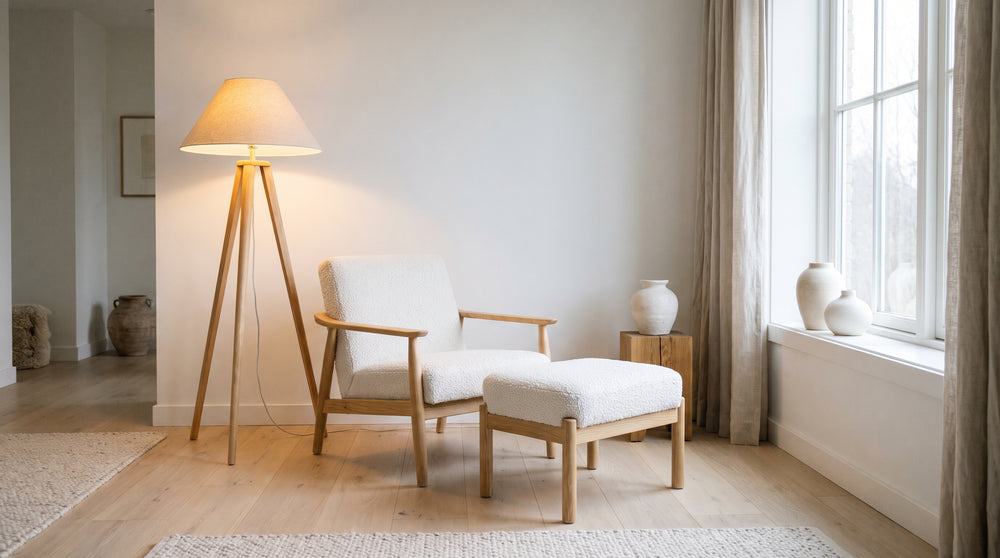
Start by choosing the height of the shade relative to your sofa, then the material of that shade, which determines how the light looks. A scandinavian floor lamp pairs a slim stem, in light wood or metal, with a linen or cotton shade that diffuses a soft light upwards and downwards.
What is a scandinavian floor lamp and what light does it give?
A scandinavian floor lamp pairs a simple stem, in light wood or slim metal, with a linen or cotton shade that diffuses light upwards and downwards. It lights without dazzling, stands on the floor near a sofa or armchair, and takes over from the ceiling light in the evening.
Scandinavian floor lamps: soft light, never dazzling
The linen or cotton shade filters the beam before it reaches the eye: the light travels up the wall and falls back in a wash across the floor, with no bright point. In the evening it lets you see faces and furniture instead of cutting them out. It is this effect, more than the bulb wattage, that sets lamps in the scandinavian spirit apart.
What sets the nordic style apart from a classic floor lamp
A classic floor lamp aims to light the whole room: thick stem, large shade, light directed downwards. The nordic model lights a specific use: slim stem, narrow shade, light escaping from both sides. It fades away once switched off and stands beside a piece of furniture rather than in the centre. Browse the lighting catalogue by room to compare proportions.
Where to place a floor lamp in the living room?
In a living room, a floor lamp goes at the shoulder of the sofa or in a corner that stays dark, never in the middle of the walkway. Leave a little distance from the wall to avoid a double shadow, and point the shade upwards to light the wall rather than faces.
Beside the sofa rather than in the centre of the room
At the shoulder of the sofa, the shade sits above the backrest: you read, you talk, and the light does not fall into the eyes of the person sitting opposite. Allow about thirty centimetres between the shade and the wall, otherwise the shadow doubles and the wall picks up marks. Design floor lamps for the living room are designed for this side use.
The reading corner and the corner that stays dark
A poorly lit corner works very well with an opaque shade that sends light upwards: the wall becomes the source. Behind a reading armchair, the goal changes: the shade drops to shoulder level and lights only the pages. Adjustable lamps sort this out without moving the furniture.
Which floor lamp height for which use?
A floor lamp is chosen first by the height of its shade: above the sofa backrest for reading seated, higher to wash a wall with light. A compact format suits a bedside or a desk. Measure the seat height and the floor space before ordering.
Floor lamp: measure before ordering
Take three measurements: the height of the sofa backrest, the seat height of the reading armchair, and the free floor space between the furniture and the wall. The shade should rise a few centimetres above the backrest, otherwise the page stays in shadow. Take the readings with a tape measure, not by eye. Then compare with the design wooden floor lamps from the same family.
Compact floor lamp or large floor lamp?
The compact version fits in a bedroom corner or near a desk: it lights a zone, not a room. The large floor lamp washes a whole section of wall and almost replaces a ceiling light in the evening. For a bedside, look at the lamps designed for the bedroom, lower and more stable.
| Format | Floor footprint | Room and use | Type of light |
|---|---|---|---|
| Large floor lamp | Wide base, tall stem | Living room, at the shoulder of the sofa | Indirect light towards the wall and ceiling |
| Compact floor lamp | Small footprint | Bedroom, desk, hallway | Localised accent light |
| Tripod | Three legs, can be dismantled | Living room and reading corner | Diffuse light under the shade |
| Light wood stem | Straight or tapered column | Living room, bedroom, wooden furniture | Warm light directed downwards |
| Slim metal column | Slim, discreet | Contemporary living room, desk | Directed, more contrasted light |
Tripod, wooden stem or metal column: which structure to choose?
A tripod offers good stability and is easy to dismantle, a light wood stem warms the room, a metal column is visually more discreet. In a home with children or pets, choose a wide base and a weighted stem. Check the floor footprint before deciding.
Scandinavian wooden floor lamps
Light ash and oak bring a visual warmth that metal lacks, without darkening a white interior. Wood is also easier to match with a coffee table or a shelf in the same tone. Find these finishes in the wooden floor lamps for the living room.
Scandinavian tripod floor lamps
Three legs on the floor beat a round base on an uneven parquet: the lamp does not tip. A tripod folds or dismantles for a move, which a one-piece column cannot do. For a desk where the lamp sits next to a wheeled chair, a slim column takes up less space: see the metal floor lamps for the desk.
How to match the floor lamp with the rest of the living room?
A floor lamp is matched by picking up a material already present in the living room: light wood with an oak piece, linen with a fabric sofa, matt black with a metal frame. Italian design brings a more sculptural silhouette. Two materials maximum per room, otherwise the whole becomes muddled.
Linen, ceramic, light wood or matt black: the materials that match
Start from the heaviest piece of furniture in the room and pick up its family: a greige velvet sofa calls for a textile shade, a glass table supports a metal stem. Matt ceramic in a floor lamp adds a muted note that breaks up a living room that is too smooth. A matt black model for the living room draws the line without weighing it down.
| Material | How the light looks | Ideal room | Care |
|---|---|---|---|
| Linen or cotton | Diffuse, warm, no harsh reflection | Living room, bedroom | Dust dry, avoid moisture |
| Light wood | Visual warmth, light unchanged | Living room, bedroom, desk | Soft cloth, no abrasive product |
| Matt ceramic | Contained light, muted material | Bedside, desk, hallway | Damp sponge, dry immediately |
| Matt black metal | Contrast, more directed light | Living room, desk | Microfibre cloth, avoid scouring sponge |
| Glass or crystal | Light passing through, glints | Living room, reception room | Soapy water, dry without streaks |
Italian design, when the lamp becomes an object
An Italian design floor lamp is recognisable by a sculptural base, a pronounced curve or a sharp contrast between the stem and the shade. It takes up space like a piece of furniture and needs clear space around it. Best kept for a fairly large living room, away from the walkway.
How to connect several lamps to a single power supply?
Several lamps can share one supply through a switched extension lead, provided you add up the wattage of the sources and do not exceed what the socket can take. Avoid stacking extension leads and never trap a cable under a rug. Connecting to the consumer unit is a job for an electrician.
Extension lead, cable reel and combined wattage
Note the wattage printed on each bulb, add it up, and keep a margin below the maximum the wall socket accepts. One extension lead per wall socket, never two in a row. Run the cable along the skirting board and switch off in the evening. For a bedside, bedside ceramics need only a single socket.
LED connection on 220 V: the useful checks
An LED bulb designed for 230 V screws into a standard socket, with no transformer. Check the voltage on the packaging, the cap (E27 or E14) and the maximum wattage the luminaire accepts. A luminaire with integrated LED cannot be repaired, it is replaced entirely. Design LED lamps often state their colour temperature, from 2700 K for a warm white to 4000 K for a more neutral white.
How to arrange ceiling spotlights to complement the floor lamp?
Spotlights are spread in a regular grid rather than in a line along a wall, with enough distance to avoid a bright patch. Above a table, a direct point hits the bare wood and sends a reflection back to the guests: better to light the table at an angle or from the wall.
Spread the light points rather than lining them up
A ceiling reads like a grid: regular spacing between points, and a distance of about 40 to 50 cm from the wall so the light falls on the surface instead of grazing it. The number is calculated by surface area, not by the symmetry of the room. The floor lamp takes over where the grid leaves a gap. For low ceilings, see modern models for the living room.
Avoiding reflections on a bare wooden table
Bare wood reflects light: a source that is too direct above the top creates a white patch facing the guests. Offset the point, light from a wall or place a side floor lamp that sends light upwards. To find your way around the lighting families, see our design lighting ranges.
How to choose between a small budget, second-hand and an exceptional piece?
The gap between a small-budget lamp and an exceptional piece comes down to the shade material, the stability of the stem and the finish of the base, rarely to the style. Second-hand, check the cable, the socket and the floor stability. A well-chosen affordable model lights as well as an expensive one.
Cheap scandinavian floor lamps: where the real difference lies
This collection currently has no products: so there is no shade diameter, stem height or socket reference to compare here. Also look at the socket and the cable grommet: these are the parts that fail first. The design white floor lamps show these finish differences well in close-up photos.
Bargain hunting at a car boot sale: what to hope for
At a car boot sale, check the cable sheath (no cracks), the socket and the stability of the base before paying. A cable and a socket are easy to replace; a split stem or a warped base are not. The black wood versions age well and develop a patina without marking.
Secure payment, tracked delivery, returns and Designix customer service: you order with someone you can reach, and a model that does not suit once placed on the floor can be returned.
Work out the shade height you need, then browse the selection of nordic floor lamps to find the finish that fits your room.
Frequently asked questions
What is meant by an original floor lamp?
An original floor lamp is recognisable by a silhouette that does not follow the classic straight stem: slanted tripod, offset shade, sculptural base, unexpected material such as ceramic or raw linen. Originality is judged on the overall line, not on the accumulation of details.
How to choose a living room floor lamp?
Start from the use: reading near the sofa, corner ambience or lighting a wall. Then choose the height of the shade relative to the seat, the stability of the base and the shade material, which determines how the light looks. Style comes last, once these three points are settled.
What are the most beautiful living room lamps?
There is no hierarchy of beauty, but criteria that hold: right proportions between the stem and the shade, material consistent with the rest of the furniture, stable base, light that does not send a glare back to the eyes. A well-proportioned lamp stays beautiful once switched off, in the room.
An Italian design floor lamp, what sets it apart?
Italian design is recognisable by a silhouette treated as an object: pronounced curve, sculptural base, contrast of materials between the stem and the shade, sometimes a coloured detail. The lamp stays functional, but it takes up space like a piece of furniture. It needs room around it to be seen.
Eating at a bare wooden table, which lighting should you favour?
Bare wood reflects light: a source that is too direct above the table creates a reflection towards the guests. Better to light at an angle, from a wall or a side floor lamp, and keep a soft point above the table. Also protect the top from hot plates.




