
LED rope lights
This selection is also available in our French store: Guirlandes LED en corde
No products in this selection.
- Tracked delivery to your country Tracked delivery
- Secure payment at checkout Multiple payment methods
- 14 days to change your mind 14-day returns
- Secure payment Secure payment
Not sure of your style? Find it in 30 seconds
A few questions, and we will show you the pieces made for you.
Frequently asked questions
How do I choose the right product?
What are the delivery times?
Can I return an item?
Can I pay in instalments?
An interior that reflects who you are
Carefully selected pieces, shipped from our warehouses. Our team advises you before you buy, so you choose with confidence.
- Tracked delivery
- Pay in instalments, where available
- 14 days to change your mind
- Advice & showroom in Lyon, France
First count the distance to cover, then decide on the power supply and the protection rating: that is the order in which to choose a rope fairy lights. With a jute, cotton or PVC cord and warm white light points, it remains a decorative accent light that highlights a wall, a railing or a headboard without replacing the ceiling light.
What is a rope fairy lights and what kind of light does it give?
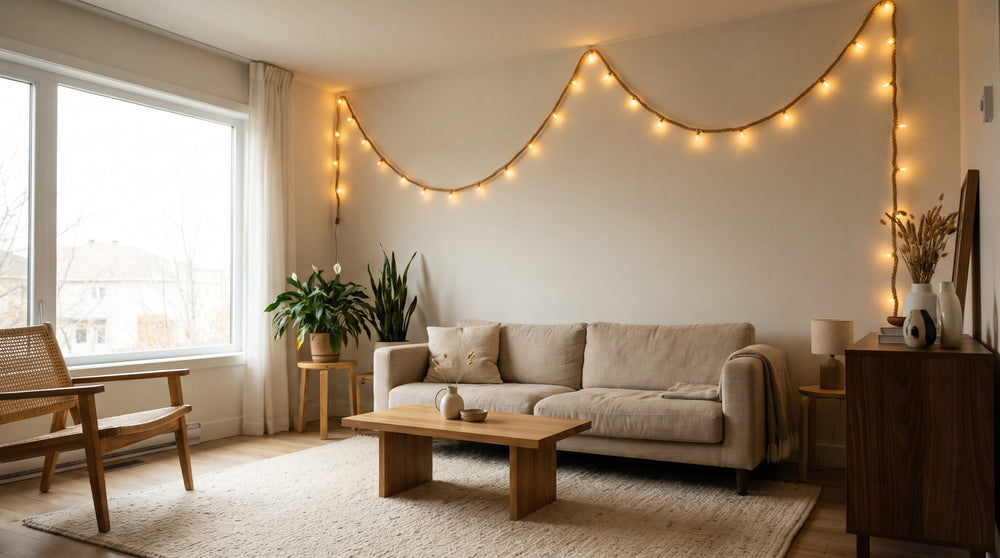
A rope fairy lights is a flexible cord, often in jute or cotton, with LED light points distributed along it. It gives a warm white, diffuse and decorative light that highlights a wall, a railing or a headboard without lighting an entire room.
Rope fairy lights: a warm white light, not a spotlight
The shade is generally around 2700 to 3000 K, that slightly amber white that warms a wall without straining the eye in the evening. The light comes out in small points spaced along the cord: it draws a line, it does not project a wide beam. Plan it as an accent, never as the only source in a room. It is the natural complement to decorative string lights in an interior that is already lit.
Rope fairy lights: what it changes in a room
On a living room wall, it creates a horizontal line that structures an empty panel. At the head of a bed, it replaces a night light and lets you read for a few minutes without switching on the ceiling light. On a railing or a banister, it marks the edge of the stairs. On a dining table, stretched between two supports above the plates, it sets the tone for the evening. To place this type of product in the wider range, browse all our light fixtures.
Outdoor rope fairy lights: which protection rating should you choose?
Outdoors, a rope fairy lights is chosen according to its protection rating: IP44 suits sheltered outdoor use, under an awning or on a covered terrace, while IP65 withstands rain and water splashes. An indoor model, without protection, must never stay outside.
IP44 or IP65: the difference on a terrace
The IP rating is read in two digits: the first concerns solids, the second water. IP44 stands up to small solids and water splashes from all directions, which is enough under an awning, on a sheltered balcony or a covered terrace. IP65 blocks dust and resists water jets: that is the level to aim for on a fence, a pergola or an exposed garden. See the IP44 string lights for sheltered outdoor use and the IP65 waterproof string lights.
What a rope fairy lights cannot withstand outdoors
It does not withstand immersion, even in IP65: a cord soaking in a puddle or a garden basin will be damaged. It also does not withstand an unprotected socket, or a connector laid on the ground. And a soaked plant-fibre cord holds moisture, which makes it dull and then mouldy: in an exposed outdoor setting, it is better to bring it in after the warm season or choose a model designed to stay in place.
Mains, solar or rechargeable rope fairy lights: which power supply?
On mains power, the rope fairy lights plugs into a socket and stays lit as long as it is powered. 24V versions run with a transformer, rechargeable models can be placed without a socket for an evening, and solar models need no cable but depend on sunshine.
Mains rope fairy lights: the socket to plan for
220V is the simplest solution when a socket exists where you stretch the string light: no transformer to hide, no risk of electric shock to watch for. 24V, on the other hand, requires a transformer, which is often easier to tuck behind a piece of furniture than a plug block. Compare the 220V plug-in string lights and the 24V low-voltage models.
Solar and rechargeable rope fairy lights
The rechargeable one can be placed on a table, a shelf or a balcony without a socket, provided you remember to recharge it between evenings. The solar one forgets the cable but depends on the panel: well exposed to daylight, it recharges the battery for nightfall. See the rechargeable string lights to place anywhere and the solar string lights for the garden.
| Power supply | Where to place it | What to plan for | Point to watch |
|---|---|---|---|
| 220V mains | Covered terrace, living room, conservatory | A socket nearby | The power cable must stay away from water |
| 24V low voltage | Indoor decor, furniture, framing | A suitable transformer | Check the transformer compatibility |
| Rechargeable | Table, shelf, balcony without a socket | A recharge before the evening | Recharging needed between two uses |
| Solar | Garden, fence, pergola | A panel well exposed to daylight | Operation depends on sunshine |
Jute, cotton or PVC rope fairy lights: which material for which decor?
A jute cord gives a natural, matt finish, suited to a terrace or a relaxed tavern-style look. Cotton is softer and gentler to the touch for a living room or a bedroom. PVC, smooth, can be wiped with a sponge and suits damp rooms as well as sheltered outdoor areas.
The jute cord for a relaxed tavern-style look
Jute has a visible, matt fibre that absorbs light instead of reflecting it: the string light blends into a decor of wood, rattan or plants. It is the material for dining tables, pergolas and terraces. It dislikes prolonged damp, so bring it in during lasting rain, and dust it dry with a cloth or a soft brush. For a balcony or a terrace, also see the string lights for balcony and terrace.
Cotton and PVC: care and durability
Cotton is the most flexible: it knots, coils and stretches without stiffness, which makes it suited to a headboard or a living room wall. It dislikes prolonged damp and is dusted dry. PVC, smooth and even, takes a wipe with a slightly damp sponge and keeps its look in a kitchen or a sheltered outdoor area. The choice therefore comes down to the desired finish as much as the care you are willing to give.
| Material | Finish | Room or use | Care |
|---|---|---|---|
| Jute | Natural, matt, relaxed tavern style | Terrace, living room, dining table | Dust dry |
| Cotton | Soft, gentle, more intimate | Bedroom, headboard, living room wall | Dust, keep away from prolonged damp |
| PVC | Smooth and even | Kitchen, sheltered outdoor area | Slightly damp sponge |
Where to install an indoor rope fairy lights: living room, bedroom, kitchen, stairs?
In the living room, the rope fairy lights is placed across a wall or behind a sofa. In the bedroom, it serves as a night light. In the kitchen, it highlights a worktop or a shelf and complements the ceiling LED lighting without replacing it. On the stairs, it follows the banister.
Indoor rope fairy lights: living room and bedroom
In the living room, stretch it across a bare panel, between two shelves or along a high skirting board: it fills a gap without cluttering the floor. In the bedroom, fix it behind the headboard or along a post, and keep it on a low light point so it does not dazzle you when you wake up. It complements choosing a light fixture for the home without replacing it.
Kitchen and stairs: where the rope light finds its place
In the kitchen, the cord highlights the edge of a shelf or the underside of a wall unit: it guides the eye, it does not light the worktop. On the stairs, it follows the banister or the handrail and makes the steps readable in the evening. In both cases, keep it out of hand-traffic areas and check that the surface accepts the fixing you choose.
Which light fixture should you pair with a rope fairy lights in a living room?
The rope fairy lights remains an accent light: an LED ceiling light for the living room, an LED chandelier or a modern LED ceiling light provide the main light. An LED wall light, in a hallway or a living room, takes over for reading. The string light brings the decor, not the working light. To tell a powerful LED ceiling light or a powerful LED wall light from a simple accent, remember that a living room often needs 1500 to 3000 lumens, while an accent model makes do with 300 to 500 lumens.
LED living room ceiling light and LED chandelier: keeping a main light
A modern LED ceiling light in the centre of the room covers the surface when the string light only draws. An LED chandelier, lower and more striking, takes the lead over a dining table. In the evening, you can switch off the LED living room ceiling light and keep only the cord for a soft atmosphere. The plug-in LED string lights combine with these sources without competing with them.
LED wall light: the complement on the wall
An LED living room wall light gives a directed light, useful for reading or moving along a hallway. It is placed where the string light is not enough to see clearly, at about shoulder height depending on the room. The wall light carries the use, the cord carries the atmosphere: the two coexist well if their shades of white stay close. To put it all together, see the Designix lighting range.
How do you install and care for a rope fairy lights?
A rope fairy lights is fixed with hooks, clips or adhesive fasteners depending on the surface. It is dusted dry and stored coiled. It cannot be cut: unlike a cuttable LED strip, the cord keeps the length and light points of the chosen model.
How to fix a rope fairy lights without drilling
On a smooth wall, a lintel or a railing, adhesive hooks or clips are enough. On a fragile surface, prefer a thin screw eye or a wire stretched between two attachment points. Stretch the cord without deforming it: a cord pulled too tight warps and the light points fall out of line. Always leave a little slack at the ends, and keep the power block accessible. More ideas in the string lights to hang.
Cuttable LED strip: how it works
A cuttable LED strip is cut at the printed marks along the tape, at marked intervals; the portion after the cut no longer lights up. A rope fairy lights cannot be cut: its length and light points remain those of the chosen model. Before buying, therefore measure the surface, not just the room, to avoid an improvised connection.
What budget should you plan for and how do you order a rope fairy lights?
Rope fairy lights are mainly in the decorative entry-level range, with affordable models for a first installation and more refined jute finishes. At Designix, payment is secure, delivery is tracked, returns are possible and customer service is available to help you choose.
What budget should you plan for a rope fairy lights
The budget follows three factors: the length of the cord, the material and the power supply. A simple PVC cord for indoor use stays in the entry-level range; a more elaborate jute, a solar version with a panel or a more refined finish move up a notch. The right reflex is to compare at equal length and check the protection rating before looking at the rest.
Designix payment, delivery and returns
Once your power supply and protection rating are chosen, all that remains is to decide on the material and the location. To finish composing the room, browse the lighting catalogue.
Frequently asked questions
Can an outdoor rope fairy lights be left outside all year round?
It all depends on the protection rating. An IP44 string light holds up under an awning or on a covered terrace, away from direct splashes. An IP65 string light withstands rain and splashes. Below that, an indoor model must be brought in after use.
Does a solar rope fairy lights give enough light?
A solar string light gives decorative light, not working lighting. It switches on at nightfall depending on the charge accumulated by its panel. Well exposed to the sun during the day, it suits a garden or a pergola, not a passage where you need to see clearly.
Where should you hang a jute rope fairy lights?
Jute has a matt, natural finish that suits a terrace, a pergola, a living room wall or a dining table. It dislikes prolonged damp: in the rain, it is better to bring it in or choose a protected version. It is dusted dry.
LED wall light or rope fairy lights for lighting a hallway?
An LED wall light, in a living room or a hallway, gives a directed light for moving around or reading. The rope fairy lights, on the other hand, highlights a wall and guides without lighting clearly. The two complement each other: the wall light for use, the string light for atmosphere.
How do you fix a rope fairy lights without drilling?
Adhesive hooks, clips or velcro fasteners are enough on a smooth wall, a lintel or a railing. On a fragile surface, a thin screw eye or a stretched wire is preferred. Avoid stretching the cord to the point of deforming it.




