
Rope and wood chandeliers
This selection is also available in our French store: Lustres en corde et bois
No products in this selection.
- Tracked delivery to your country Tracked delivery
- Secure payment at checkout Multiple payment methods
- 14 days to change your mind 14-day returns
- Secure payment Secure payment
Not sure of your style? Find it in 30 seconds
A few questions, and we will show you the pieces made for you.
Frequently asked questions
How do I choose the right product?
What are the delivery times?
Can I return an item?
Can I pay in instalments?
An interior that reflects who you are
Carefully selected pieces, shipped from our warehouses. Our team advises you before you buy, so you choose with confidence.
- Tracked delivery
- Pay in instalments, where available
- 14 days to change your mind
- Advice & showroom in Lyon, France
Aim for one pendant centred over the table, about 75 cm above the surface, in light wood with an ecru rope: this setting suits most dining rooms. A rope and wood chandelier gives a warm, filtered light, very far from the hard glare of crystal. To place each step, the summary below follows the order of the page.
- What a rope and wood chandelier is
- Where to install it
- Which size to choose
- Materials and styles
- Socket and bulb
- Make or buy
- Install and maintain
- Complete the room
What is a rope and wood chandelier and what light does it give?
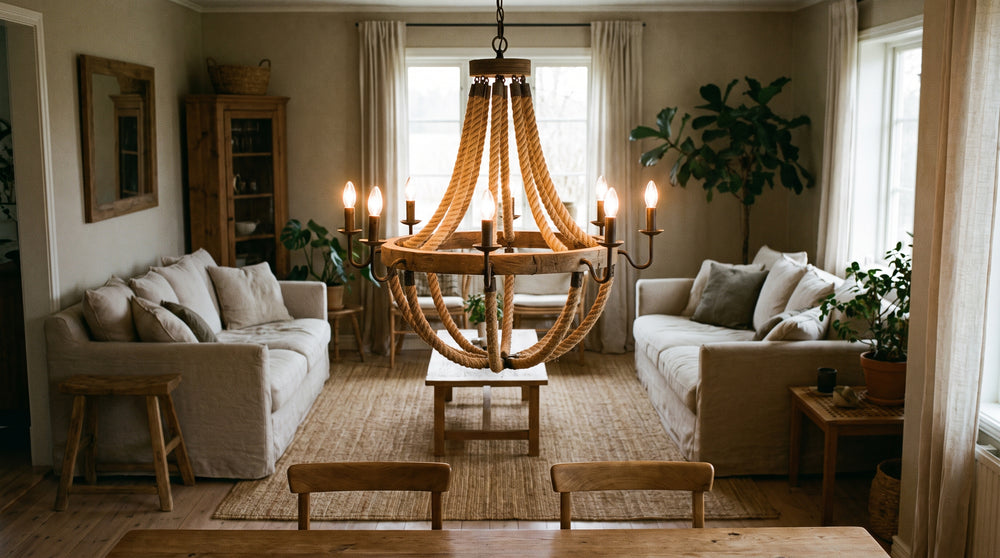
A rope and wood chandelier combines a wooden frame, often light, with ropes that dress the structure or hold the shade. Light passes through the rope and spreads upwards and downwards, giving a warm glow with no hard glare, very different from crystal.
Rope and wood light: what atmosphere in the room?
The rope acts as a filter: it breaks the direct light, sends part of it back towards the ceiling and softens shadows on faces. In a living room, this translates into an end-of-day mood, warm without being dark. The wood warms the overall tone and matches floors and furniture. To compare with other product families, browse all our lighting.
Rope and wood ceiling light or rope and wood pendant?
A ceiling light sits flush against the ceiling: it suits hallways, low rooms or circulation areas. A pendant hangs from a cable and is adjusted in height: it is used above a table or in a tall space. The choice therefore depends on the distance between ceiling and use, not on style. For a more current design, see more contemporary models. Note: a "cord of wood" for heating is a unit of volume and has nothing to do with the rope of a light fixture.
Where to install a rope and wood chandelier: living room, dining room or bedroom?
A rope and wood pendant finds its place above a table, an island or a reading corner. In a dining room, centre it over the surface; in a living room, align it with the coffee table; in a bedroom, prefer a ceiling light or a high pendant so as not to dazzle.
What height above a dining table?
Generally allow 70 to 80 cm between the bottom of the fixture and the surface: high enough to see your neighbour, low enough for the light to fall on the plates. With a high table or a large chandelier, go up to about 85 cm. An adjustable cable makes it easier to fine-tune after installation. For this type of room, hanging above the dining table mainly means checking the cable length before drilling.
How to match the chandelier to a wooden table without a tablecloth?
Without a tablecloth, the surface stays visible and talks directly with the fixture: a rope and wood pendant extends the material instead of contrasting with it. Avoid a wood that is too orange on an already honey-toned surface, and look for a close or clearly lighter shade. In a living room, a wooden chandelier for the living room aligns with the axis of the coffee table. In a bedroom, it is better to light a bedroom with a wooden chandelier without a direct source in line with the bed.
Which size to choose for the room and the number of light points?
Size is chosen in relation to the volume of the room and the length of the table. A pendant wider than the table top overwhelms the room; too small, it disappears. Also check the ceiling height, the weight to be supported and the number of light points needed.
| Room | Suitable size | What to check | Desired atmosphere |
|---|---|---|---|
| Living room | Wide pendant or several light points | Ceiling height and central fixing point | Warm, natural light |
| Dining room | Round or elongated pendant centred over the table | Distance to the surface, cable length | Meals without glare |
| Bedroom | Ceiling light or small pendant | No direct source in line with the bed | Softness, light wood |
| Kitchen | Compact ceiling light or adjustable pendant | Grease and moisture, easy cleaning | Clear, crisp light |
| Hallway or mezzanine | Long vertical pendant | Available volume and passage | Sculptural effect |
How to calculate the size of a chandelier in relation to the table?
Take the width of the table and remove about a third: the pendant then stays within the surface, with air on each side. On a 180 cm table, aim for around 110 to 120 cm wide. For a whole room, the trade rule is to add the width and length of the room in metres and convert the result into centimetres of diameter, with a ceiling of about 2.50 m.
How many light points to light a living room?
A chandelier with several sockets distributes light better than a compact model, but everything depends on the size of the living room and the additional sources. Beyond three or four points, you mainly gain regularity, not power. For a brighter result, LED living room lighting remains the simplest route, and pieces with a crafted design add relief when light must also decorate.
Which materials and styles to combine with wood and rope?
Wood sets the tone, rope sets the warmth. Light wood and ecru rope for a Scandinavian interior, raw wood and dark rope for an industrial feel, irregular wood and twisted rope for a bohemian look. The wood tone should respond to that of the floor and furniture.
| Style | Wood | Rope | To avoid |
|---|---|---|---|
| Scandinavian | Light wood, ash, birch | Ecru cotton or jute | Too contrasting tones |
| Industrial | Raw wood and black metal | Thick dark rope | Glossy varnished wood |
| Bohemian | Irregular natural wood | Twisted rope with knots | Lines that are too geometric |
| Modern | Tinted or lacquered wood | Fine taut rope | Layering of materials |
| Seaside | Driftwood | Greyed rope | Varnished exotic wood |
Solid wood, plywood or MDF?
Solid wood is recognised by its continuous grain and its weight; it can be sanded and repaired. Plywood, with crossed layers, stays stable and lighter. MDF, denser and more homogeneous, accepts curved shapes and lacquers. None is better in absolute terms: solid wood reassures over time, plywood on suspended weight. In terms of style, the Scandinavian line works with light wood, an industrial feel combines raw wood and black metal.
Jute, cotton or synthetic rope?
Jute is rustic, matte and a little rough: it suits bohemian and seaside styles. Cotton is softer to the eye, more regular, ideal for Scandinavian. Synthetic ropes hold up better in a damp room and are dusted with a cloth. For a very luminous result, a bohemian crystal chandelier remains the alternative when you want transparency rather than fibre.
Which socket and bulb for a rope and wood chandelier?
The socket is stated on each product page: E14 for small sockets, E27 for wider ones. A bulb at 2700 or 3000 K gives the warm light that suits wood. LEDs are preferred, as they give off little heat, so as not to mark the rope or the wood.
E14 or E27: how to check before buying?
The product page mentions the socket, sometimes socket by socket when the chandelier has several. E14, narrower, is used for small globes and narrow arms; E27, wider, accepts larger bulbs. Also check the number of sockets and compatibility with a smart bulb if you already have one. A doubt is cleared in one line on the page: better to do it before ordering. For a living room or a meal, LED pendants for the dining room and wood combined with metal show the two socket approaches.
Which colour temperature for a warm light?
Around 2700 K, the light leans towards amber: this is the evening reference, the one that warms wood without yellowing it. At 3000 K, white becomes more neutral, more readable for a meal or a worktop. Above 4000 K, the result cools the rope and hardens the shadows. Near a rope, an LED gives off little heat: a point not to be neglected when the socket is close to the fibre.
Rope chandeliers: make a wooden pendant light yourself or buy it?
Making a wooden and rope pendant light requires a socket, a cable, a solid support and compliance with electrical rules. A shop-bought model comes with its fixings, its warranty and a checked assembly, which weighs more than a prototype when the pendant hangs above a table.
What homemade wooden and rope light ideas are there?
A drilled plank crossed by a textile cable, a socket dressed in coiled rope, a shade stretched over a wooden hoop, a driftwood branch fitted with a socket: ideas are not lacking. What successful projects have in common is the support, not the decoration. For a more crafted result without going through the workshop, the black version for the living room gives an idea of the result with tinted wood.
What a homemade light does not guarantee
A personal assembly provides neither a ceiling fixing suited to the surface, nor instructions, nor recourse in case of a defect. Connection to the mains remains a step to entrust to someone competent. A shop-bought model arrives complete and can be replaced if there is a problem. Homemade suits a secondary room or an experiment; above a dining table, the shop-bought version remains the reasonable choice.
How to install and maintain a rope and wood chandelier?
Fix the pendant to the ceiling point intended for lighting, with a plug suited to the surface. Switch off the power first. Maintenance is limited to regular dusting and a slightly damp cloth on the wood; the rope is brushed dry.
How to fix a pendant to the ceiling?
Locate the junction box or the existing light point, switch off the breaker, then choose the plug according to the surface: plaster, concrete or joist. The weight of a wooden chandelier requires a firm anchor, not a simple plasterboard plug in a hollow area. A hook or a suspension bar takes the load. For a wet room or a kitchen, a kitchen light is also chosen for ease of cleaning.
How to clean varnished wood without stripping it?
A soft, slightly damp cloth is enough for greasy dust, then dry. A product that is too aggressive dulls the varnish and then requires a complete renovation. Stripping only concerns bare or damaged wood: on a protected frame, it has no place in routine maintenance. Rope tolerates neither stripper nor water: use a dry brush or the vacuum cleaner on a gentle setting. Check the varnish visually once a year.
Rope and wood chandelier or other lights: how to complete the room?
A rope and wood chandelier is well complemented by a floor lamp or a bedside lamp in the same material. In a bedroom or a kitchen, a more compact ceiling light is preferred to keep circulation clear. The important thing is to repeat the rope or the wood tone, never both at once.
Driftwood floor lamp or bedside lamp: which complement?
A driftwood floor lamp brings low light near the sofa, where the pendant lights the centre. A light wood bedside lamp accompanies reading without competing with the ceiling light. Keep a single dominant material so as not to pile up references. To compare shapes, black wood in the kitchen and black wood and metal show what a dark shade changes in the same room.
Which chandelier for a bedroom or a kitchen?
In a bedroom, a diffused ceiling light or a high pendant avoids glare from the pillow; LED bedroom lighting settles the question of heat near fabrics. In a kitchen, the pendant is placed above the island or the table, away from cooking and greasy areas. To broaden the comparison, Scandinavian white wood brightens a small room, and our lighting catalogue gives an overview of the available families.
Before ordering, check three points on the product page: the width of the fixture in relation to your table, the socket type and the weight to be suspended. This is what avoids a return. Secure payment, tracked delivery, returns and Designix customer service: your order is followed from dispatch to installation.
Living room chandeliers: which model to choose?
In a living room, choose a rope and wood chandelier wide enough to occupy the volume without hindering circulation, centred on the coffee table or on the axis of the room. A pendant with several light points distributes light better than a compact model.
How to make a wooden pendant light?
You need a socket, an electrical cable, a drilled wooden support and a solid fixing point on the ceiling. Wood is easy to drill and sand, but the electrical connection must be done according to the rules. A shop-bought model avoids this step.
What are some homemade light ideas?
A drilled wooden plank crossed by a textile cable, a rope ring around a socket, a rope shade stretched over a hoop, or a driftwood branch fitted with a socket. These projects mainly require a solid support and safe electrical installation.
Eating at a wooden table without a tablecloth: how to match the chandelier?
Without a tablecloth, the raw surface stays visible: a rope and wood pendant naturally extends this material. Raise the fixture high enough not to dazzle guests and prefer a warm light that warms the wood without yellowing it.
How to remove varnish from wood?
A chemical stripper or sanding removes old varnish, with protection for hands and air. On a rope and wood chandelier, this operation only concerns the frame: rope tolerates neither stripper nor sanding and is cleaned dry.




