
Vintage orange lampshades
This selection is also available in our French store: Abat jours coloris orange vintage
No products in this selection.
- Tracked delivery to your country Tracked delivery
- Secure payment at checkout Multiple payment methods
- 14 days to change your mind 14-day returns
- Secure payment Secure payment
Not sure of your style? Find it in 30 seconds
A few questions, and we will show you the pieces made for you.
Frequently asked questions
How do I choose the right product?
What are the delivery times?
Can I return an item?
Can I pay in instalments?
An interior that reflects who you are
Carefully selected pieces, shipped from our warehouses. Our team advises you before you buy, so you choose with confidence.
- Tracked delivery
- Pay in instalments, where available
- 14 days to change your mind
- Advice & showroom in Lyon, France
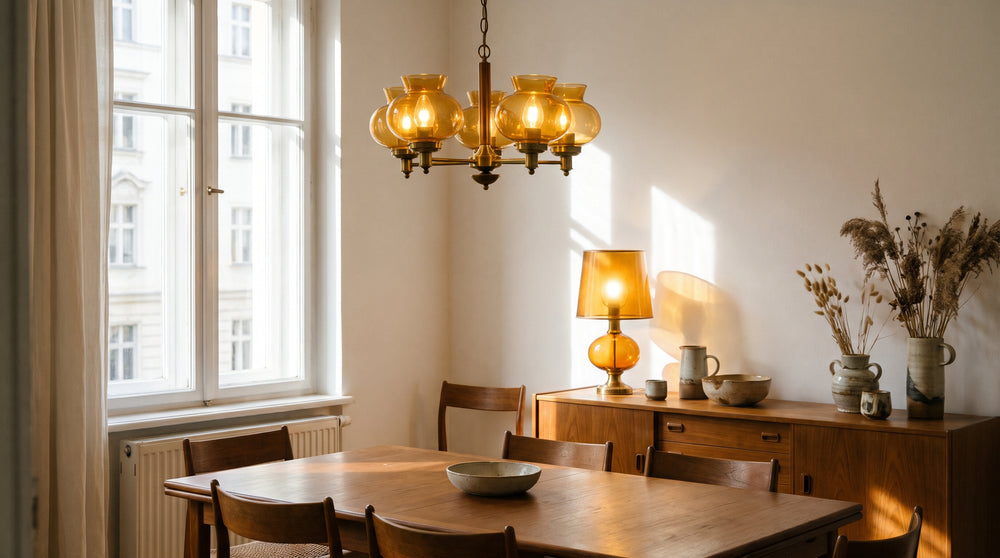
A retro orange lampshade filters light and sends it back as a warm halo: walls, wood and fabrics take on an amber tint, softer than with a white lampshade. First choose the format to suit the fixture you are dressing, then the shade of orange to suit the room's natural light. The collection currently has no models online: this guide therefore gathers the reference points for choosing well, whether here or elsewhere.
What light does a retro orange lampshade give in a room?
An orange lampshade filters light and sends it back as a warm halo: walls, wood and fabrics take on an amber tint, softer than with a white lampshade. Depending on the density of the fabric, the light stays diffuse and localised or spreads further. Orange colours the atmosphere without dazzling when the bulb holder stays covered.
What changes in the evening
In the evening, the difference shows most on pale surfaces: an off-white wall turns honey-coloured, an oak floor becomes deeper. That is what sets a coloured lampshade apart from a plain white diffuser, which lights without colouring. To compare the results, browse the white lampshades: the same fixture looks more neutral there, almost cold by comparison.
The warmth of filtered light
A thick fabric keeps a dense colour and concentrates light downwards: good for a reading corner. A thin fabric or linen lets more light through and widens the halo. In both cases, orange acts as a filter: it does not replace a warm white bulb, it colours it a little more. To widen the search to other shades, see the black versions, which give a graphic, more contrasted result.
What colour does orange go with?
Orange goes first with its complementary colour, blue, then with warm neutrals: off-white, ecru, beige, light wood. For a softer result, pair a retro orange with sage green or terracotta. Bright orange stays occasional, on a single light fixture per room.
What is the complementary colour of orange?
On the colour wheel, blue faces orange: it is the complementary. In decoration, use it in teal, midnight blue or greyed blue rather than bright blue, which is too harsh in lighting. A teal wall with an orange lamp beside it creates a clean contrast without clutter. Conversely, an off-white or ecru softens the orange and keeps a clear reading, useful in a bedroom.
Pairings that age well in a living room
Sage green, terracotta, patinated wood and black metal stand the test of time because they belong to the same family of warm, matt tones. Avoid piling orange up with bright reds, fuchsias or a second saturated orange: the whole becomes unreadable. A single visible orange object is enough to warm the room. To balance it, look at the lampshades designed for the living room.
| Matching colour or material | Result | Where to use it |
|---|---|---|
| Teal or deep blue | Strong complementary contrast | Living room, hallway |
| Off-white, ecru | Softens the orange, clear reading | Bedroom, nursery |
| Sage green | Calmer, plant-like pairing | Living room, reading corner |
| Terracotta and wood | Warm, matt pairing | Living area |
| Black and metal | Graphic result | Study, open kitchen |
Retro orange lampshade in red, yellow or lighter: which tone to choose?
An orange leaning towards red gives a deeper light, suited to dark rooms or interiors heavy with wood. A more yellow orange lights more and warms a reading corner. The tone is chosen according to the wall colour and the natural light already present.
Red-orange for dark rooms
In a poorly exposed room, a deep orange makes up for the lack of perceived brightness in the evening, without lighting harshly. It pairs with dark woods, taupe walls and thick fabrics. It is the tone that gives the most character to a corner floor lamp.
Yellow-orange for a more sunny light
Lighter, it genuinely lights the surface under the lampshade and suits a desk or a reading armchair. In a room that is already very bright by day, it can look washed out in the evening: then prefer a denser shade. For a more contemporary result, look at the lampshades with a modern design.
How to choose the size of a retro orange lampshade?
The size of the lampshade follows that of the fixture: a small format for a bedside lamp, a medium format for a table lamp, a large diameter for a floor lamp. The lampshade should cover the bulb holder without hiding the stem or exceeding the width of the base.
The large format and its uses
On a floor lamp, a large diameter creates a mood piece: light goes up and down, the room is bathed without direct lighting. Check the stability of the base and the bulb holder diameter before ordering. A large format on a small base gives a visible imbalance.
Table lamp or floor lamp: the proportions
A simple guide: the lampshade covers the bulb holder and lets the stem show for a few centimetres. Too tall, it hides the switch; too narrow, it lets the bulb show. For bedside lamps, see the bedroom models and for pendants, the full lampshade collection.
| Fixture to dress | Lampshade format | Effect in the room | To check |
|---|---|---|---|
| Bedside lamp | Small format | Localised halo near the bed | Bulb holder and base width |
| Table or desk lamp | Medium format | Corner light, reading | Stem height under the lampshade |
| Floor lamp | Large format | Mood piece, indirect light | Stability and bulb holder diameter |
| Pendant | Medium to large | Pool of light above a table | Cable and hanging height |
| Wall light | Small format | Extra wall lighting | Fixing and direction of light |
Retro orange lampshade in fabric or glass: which material for which lamp?
Fabric softens the light and keeps a dense colour: it suits table lamps and floor lamps. Glass, brighter, lets light through downwards and wipes clean in one go: practical for a bedside lamp. Linen gives a soft texture and a slightly matt result.
Glass for a bedside lamp
A glass lampshade suits a bedside lamp: it lets light through downwards and is easy to clean. It lights more directly than fabric, so choose a low-power bulb for reading in bed. Check the bulb holder diameter before buying.
How light looks through fabric and linen
Fabric keeps a dense colour and concentrates light; linen shows its weave and diffuses more softly. Compare the fabric lampshades and the natural linen models: the first gives a clean halo, the second a slightly textured result. In a nursery, prefer indirect diffusion and never a light source within reach; see the selection for nurseries.
| Material | Light result | Recommended use |
|---|---|---|
| Fabric | Softened light, dense colour | Table lamp, floor lamp |
| Linen | Soft diffusion, visible texture | Living room, bedroom |
| Glass | More direct light, transparent effect | Bedside lamp, desk lamp |
How to install and care for a retro orange lampshade?
Before buying, check the bulb holder diameter, the stem height and the fixing method: clips, screw-on holder or frame. For care, dust dry with a soft brush or microfibre cloth, and avoid water on fabric so as not to mark the colour.
Bulb holder, stem and fixing before buying
This collection contains no lampshades to date, so there is no bulb holder, material or dimension to check here. To compare the available bases and stems, the Designix lighting department gathers the home's light fixtures.
Cleaning without dulling the colour
Dust dry with a soft brush or a microfibre cloth, without rubbing the fabric. Avoid water and products that can dull or mark the colour. If the lampshade comes apart, clean the outer surface only and let it dry away from a heat source.
Retro lighting: which furniture to pair an orange lampshade with?
An orange lampshade works well with a vintage leather armchair, a wrought iron bench or patinated wooden furniture: orange brings out tawny leathers and warms black metal. Keep a single visible orange object per room to avoid clutter.
With a vintage leather armchair
On tawny or camel leather, orange light accentuates warm reflections and erases the cold look of new leather. Place the lamp beside the armchair, not in front: raking light brings out the material. For other rooms, see the light fixtures by room of the house.
With a wrought iron bench and raw materials
Black metal reacts well to warm light: it takes on coppery reflections and loses its severe look. A wrought iron bench, a solid wood console or a brick wall all work with a retro orange. To go further on placement, see how to choose your lampshade.
Ordering from Designix
This collection contains no lampshades for the moment. To find an available model, the Designix lighting department brings together bases, pendants and wall lights.
Frequently asked questions
What colour does orange go with?
Orange goes with its complementary colour, blue, in a strong pairing, and with warm neutrals: off-white, ecru, beige, light wood. Sage green, terracotta and warm grey also work. A single orange object is enough to warm the room.
What is the complementary colour of orange?
The complementary colour of orange is blue, positioned opposite it on the colour wheel. In decoration, use it in teal, midnight blue or greyed blue rather than bright blue. The pairing creates a clean contrast that brings out the orange lampshade.
Orange colour pairing: which shades to avoid?
Avoid piling orange up with bright reds, fuchsias or other saturated oranges on the same surface: the whole becomes hard to read. Very bright yellows next to orange also lose the contrast. Better to have orange alone, surrounded by neutrals.
Is a glass lampshade suitable for a bedside lamp?
Yes, a glass lampshade suits a bedside lamp: it lets light through downwards and is easy to clean. It lights more directly than fabric, so choose a low-power bulb for reading in bed. Check the bulb holder diameter first.
Lampshade for a floor lamp: how to choose it?
For a floor lamp, choose a large diameter, consistent with the height of the base, and a material that softens the light if the lamp lights a living room. The lampshade should cover the bulb holder and stay stable. A retro orange becomes a mood piece there.
Retro orange fabric lampshade: how to care for it?
Dust dry with a soft brush or a microfibre cloth, without rubbing the fabric. Avoid water and products that can dull or mark the colour. If the lampshade comes apart, clean the outer surface only and let it dry away from a heat source.
Retro lighting: how to pair an orange lampshade with a vintage leather armchair?
A vintage leather armchair, tawny or camel, pairs naturally with an orange lampshade: the warm light brings out the leather. Place the lamp beside the armchair, not in front, and keep the other light sources more neutral. A wrought iron bench works the same way.




