
Retro orange floor lamps
This selection is also available in our French store: Lampadaires coloris orange rétro
No products in this selection.
- Tracked delivery to your country Tracked delivery
- Secure payment at checkout Multiple payment methods
- 14 days to change your mind 14-day returns
- Secure payment Secure payment
Not sure of your style? Find it in 30 seconds
A few questions, and we will show you the pieces made for you.
Frequently asked questions
How do I choose the right product?
What are the delivery times?
Can I return an item?
Can I pay in instalments?
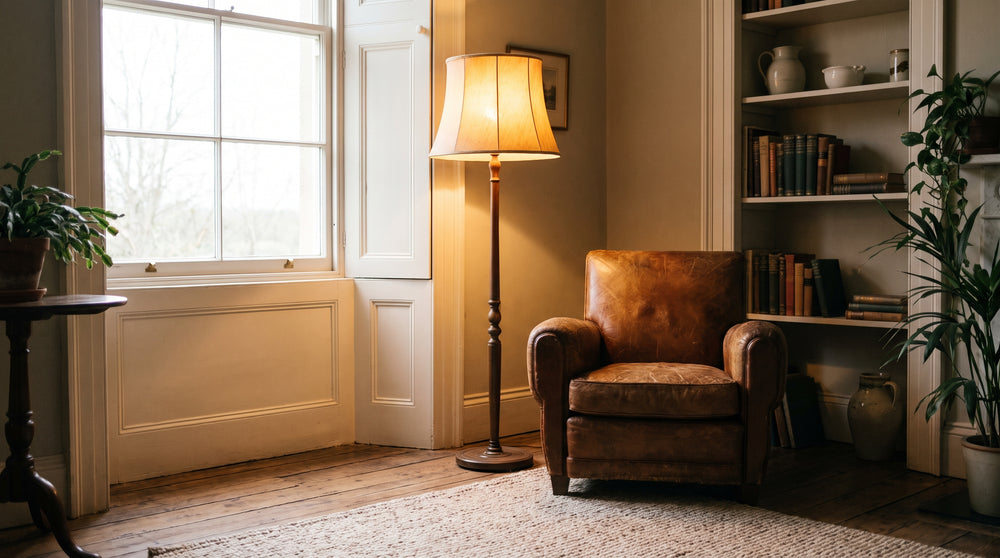
An interior that reflects who you are
Carefully selected pieces, shipped from our warehouses. Our team advises you before you buy, so you choose with confidence.
- Tracked delivery
- Pay in instalments, where available
- 14 days to change your mind
- Advice & showroom in Lyon, France
A retro orange floor lamp is chosen first for the warm light it casts into a corner: a golden halo around the sofa, never a ceiling spotlight. Look for a stable base, a shade that filters the hue and a bulb with a warm colour temperature, then pair the orange with a neutral or a blue rather than a second bright colour.
What light does a retro orange floor lamp give in a living room?
A retro orange floor lamp gives a warm light, tinted by the shade, that warms whites and softens the evening. Switched on as accent lighting, it creates a halo around the sofa or armchair without lighting the whole room. Switched off, it remains a piece of colour that structures the decor.
Retro orange floor lamp: the light it gives, on and off
The halo depends on two things: the inner colour of the shade and the temperature of the bulb. An ivory, linen or beige fabric shade returns a softened orange and soft shadows on the walls. A white interior, or a lacquered metal base that bounces the light, gives a sharper, more contrasted result. Switched off, the orange base becomes the most colourful element of the living corner, which matters in a room with neutral walls. Orange floor lamps in every shade are best compared on this point.
How do you avoid harsh light in a small living room?
Three settings are enough: a bulb with a warm colour temperature (around 2700 K, a common reference), a shade that diffuses rather than directs, and an orientation towards the wall or corner, never towards the face. In a small living room, keep the base away from the white wall to avoid a harsh bright patch, and leave the ceiling light off in the evening. To place the model within the whole home, compare with our selection of lighting for the home.
Which colour goes with orange in an interior?
Orange goes with the neutrals that calm it, off-white, greige or anthracite grey, and with the blues that energise it, from petrol blue to midnight blue. Deep greens and woody browns make it softer. Better to avoid stacking three bright shades in the same room.
Which colour with orange: the pairings that work
Choose one dominant pairing, then keep the others as small touches: that is what separates a controlled retro living room from a cluttered corner. A greige sofa, a petrol blue rug and an orange base are enough to hold the room. If you hesitate between two warm accents, look at green in its living room version, which plays the same role without shouting.
| Associated colour | Desired effect | Where to use it |
|---|---|---|
| Off-white, greige | Calms the orange, soft light | Living room, bedroom, hallway |
| Midnight blue, petrol blue | Strong contrast, orange highlighted | Corner wall, rug, armchair |
| Sage green, deep green | Natural and soft pairing | Living room with plants, conservatory |
| Terracotta, burgundy | Warm 1970s atmosphere | Reading corner, study |
| Anthracite grey, black | More graphic orange | Contemporary, industrial interior |
| Light wood, rattan | Warm result, vintage spirit | Retro-style living room |
Orange colour pairing: what is best avoided
Three bright shades in the same room make the orange lose its role as an accent. A wall already saturated with red or fuchsia absorbs it and makes the light confusing. One strong contrast is enough, the rest in neutrals. In a very graphic interior, orange pairs well with black: see the black metal bases to keep the principle without the colour.
What is the complementary colour of orange?
The complementary colour of orange is blue, its opposite hue on the colour wheel. An orange floor lamp placed near a midnight blue wall, a petrol blue rug or a blue armchair gains intensity without becoming garish. Blue tempers the orange and makes it stand out.
Complementary colour of orange: how to use it without shouting
Play with proportion, not quantity: a large blue surface and a small orange patch, or the reverse. Place the floor lamp in front of a midnight blue section of wall and keep the sofa neutral, the contrast stays readable. If blue already takes up a lot of space, limit the orange to the base and choose a light shade. Complementary lighting is set with living room LED lighting.
Which colour with orange in a bedroom or hallway?
In a bedroom, pair orange with off-white, linen or light wood to keep a soft light in the evening. In a hallway, anthracite grey and midnight blue work well: the floor lamp becomes a colour marker visible as soon as you arrive, even switched off. For a bright hallway, look instead at the modern white versions.
Where to install a vintage orange floor lamp?
A vintage orange floor lamp goes in a corner of the living room, next to the sofa or behind a reading armchair, within reach of the switch. In a hallway, it serves as a light marker. In a bedroom, prefer a model with soft light, directed towards the wall.
Which spot for a vintage orange floor lamp in a living room?
The free corner between the sofa and the window is the most useful place: the light comes from the side, lights the book without dazzling. A base behind the reading armchair also works, provided the switch stays accessible when seated. Avoid the passage between two doors, where the base becomes an obstacle. Green and orange respond well to each other in a planted living room: see an orange floor lamp designed for the living room.
Can a retro orange floor lamp be placed in a hallway or bedroom?
Yes, provided the format is adapted. In a hallway, a slim base and a cable kept clear along the skirting board avoid cluttering the passage. In a bedroom, a small accent model placed away from the bed gives indirect light, more restful than a ceiling light. For a work corner rather than a bedroom, an LED floor lamp for the study will be more suitable.
How to choose a retro orange floor lamp according to the room and format?
The format is chosen first according to floor space and furniture height: a tall straight base for a living room corner, a more compact model near an armchair or in a hallway. Then check the shade diameter, the base material and the socket indicated on the product sheet.
Retro orange floor lamp: straight base, tripod or gooseneck?
The straight base holds the corner and carries a large shade. The tripod, more stable on uneven floors, directly evokes the 1950s and 1960s. The gooseneck or adjustable stem suits when the light must come down towards a book or a worktop. A vintage orange floor lamp is recognised by its warm colour, its slim line and its understated shade. Compare the proportions with the black wood floor lamps, of equivalent volume.
What size of floor lamp for a small living room?
A simple guide: the shade should reach around the height of the sofa back, a little above, to light without dominating the room. Below that line, the floor lamp looks low and lights the knees. Above it, it overwhelms the furniture. Measure the clear height under the window and the width of the corner before choosing. For a brighter and finer result, modern LED models offer other silhouettes.
Which shade and bulb to choose for a vintage orange floor lamp?
The shade decides the tint: an ivory or linen fabric lets a warm orange through, a shade with a light interior returns a sharper light. For the bulb, check the socket on the model sheet and choose an LED with a warm colour temperature to stay in the retro spirit.
E27 or E14 socket: how to check before buying?
The socket is the only information that decides the bulb. The E27, a large screw socket, equips most floor lamps. The E14, smaller, appears on secondary sockets or compact models. Read the model sheet before ordering the bulb, otherwise the lamp remains unusable. A plain metal base pairs well with gold finishes.
Which colour temperature for an orange shade?
Stay in warm temperatures: around 2700 K for an amber result in the evening, up to 3000 K if you often read beside it. A bulb at 4000 K or more, called neutral or cool, cools the orange and breaks the retro atmosphere. Wattage matters less than the tint: prefer a low-power bulb that diffuses well. For contrast, the white and black duos show the opposite effect.
How to install and care for a retro orange floor lamp?
Assembly is done on the floor, base laid flat, cable kept clear of the passage: that is what prevents a wobbly floor lamp. For care, dust the shade dry and clean the base with a soft cloth, without abrasive products that would dull the orange lacquer.
How to clean an orange shade without damaging the tint?
Dust dry with a soft brush or a microfibre cloth, without wetting the fabric. A stubborn stain is treated locally, without rubbing hard, and without soaking the material. On a lacquered base, a slightly damp cloth is enough, then dry immediately. No solvent, no abrasive sponge.
How to stabilise a floor lamp?
Tighten the base elements fully, screw the base flat on a level floor, then run the cable along the wall rather than across the room. A thick rug under a narrow base makes the whole thing lean. Keep the base away from walkways and pets. A model with a wide base remains safer near a sofa, like the white wood floor lamps.
How to order a retro orange floor lamp and be delivered with peace of mind?
At Designix, orders are placed with secure payment, delivery is tracked and returns are provided for. Customer service answers before and after purchase to check the socket, the floor footprint or the compatibility of the model with your room.
Before confirming, note three things: the available floor space, the clear height above the base and the socket expected by the fitting. These three pieces of information prevent most returns. Then browse the retro orange range and, if the orange seems too strong, compare with gold and black pairings or the industrial style. The whole catalogue remains visible from all Designix lighting.
Frequently asked questions
Which colour does orange go with?
Orange goes with neutrals, off-white, greige and anthracite grey, which calm it, and with blues, from petrol blue to midnight blue, which make it stand out. Deep greens, woody browns and terracotta extend a warm atmosphere without violent contrast. Choose one dominant pairing and keep the others as small touches.
Complementary colour of orange: how to use it in a living room?
The complementary of orange is blue. In a living room, place the orange floor lamp in front of a midnight blue wall or near a petrol blue rug: the contrast stays readable without tiring the eye. If blue already takes up a lot of space, limit the orange to the base and keep a neutral shade.
Which colour with orange in a bedroom or hallway?
In a bedroom, pair orange with off-white, linen or light wood to keep a soft light in the evening. In a hallway, anthracite grey and midnight blue work well: the orange floor lamp becomes a colour marker visible as soon as you arrive, even switched off.
Orange colour pairing: which mistakes to avoid?
Avoid stacking three bright shades in the same room, the orange loses its role as an accent. Also avoid placing it on a wall already saturated with red or fuchsia: the floor lamp blends in and the light becomes confusing. One strong contrast is enough, the rest in neutrals.
What is called a retro orange floor lamp?
It is a floor lamp whose orange colour and shapes evoke the 1960s and 1970s: straight base or tripod, simple shade, lacquered material, wood or metal. The term retro refers to the style, not a precise manufacturing period, and it combines with vintage in common searches.




