
Rattan and wicker chandeliers
This selection is also available in our French store: Lustres en rotin et osier
No products in this selection.
- Tracked delivery to your country Tracked delivery
- Secure payment at checkout Multiple payment methods
- 14 days to change your mind 14-day returns
- Secure payment Secure payment
Not sure of your style? Find it in 30 seconds
A few questions, and we will show you the pieces made for you.
Frequently asked questions
How do I choose the right product?
What are the delivery times?
Can I return an item?
Can I pay in instalments?
An interior that reflects who you are
Carefully selected pieces, shipped from our warehouses. Our team advises you before you buy, so you choose with confidence.
- Tracked delivery
- Pay in instalments, where available
- 14 days to change your mind
- Advice & showroom in Lyon, France
All it takes is a warm-toned bulb and a weave that lets the beam through: the rattan wicker chandelier does the rest, casting shadows on the walls and warming the room. The choice then comes down to three concrete points: the room to furnish, the size above the table, and the density of the weave.
What light does a rattan or wicker chandelier give?
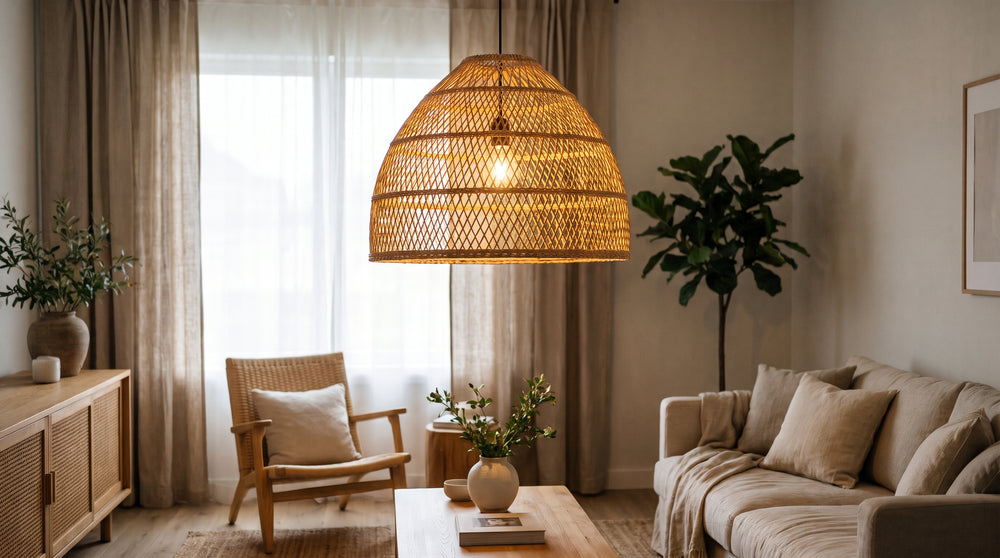
The weave of rattan and wicker filters the light from the bulb: the room receives a warm glow, with shadows drawn on the walls and ceiling. The tighter the weave, the more diffuse the light; the more open it is, the more pronounced the projected patterns. It is the density of the fibre, not the size of the fixture, that decides the effect.
Rattan wicker chandelier: the light you get
With an open weave, the bulb remains visible in places and projects a network of bright lines around the fixture. The effect is lively in the evening, discreet by day. With a tight weave, the bulb disappears behind the fibre and the light becomes more enveloping, with no sharp pattern on the ceiling. In both cases, a warm-toned bulb extends the natural colour of the rattan, whereas a very white light hardens the fibre and breaks the mood. This rule applies to every piece in the complete lighting catalogue.
Rattan or wicker ceiling light: the same warmth, set closer to the ceiling
A wicker ceiling light uses the same principle, but the source sits flush against the ceiling: the beam goes downwards and the cast shadow is reduced. The room gains warmth without gaining contrast. This is the solution when you want the material without the pattern, or when the ceiling height does not allow a fixture to hang down into the space.
Which rooms to install a rattan or wicker chandelier in?
Rattan and wicker find their place wherever you want warm light: above the sofa corner or the dining table, in a small size in a bedroom, as a ceiling light in a hallway. The room dictates the size and height, not the other way round.
| Room | Size to favour | Lighting effect sought | Point to check |
|---|---|---|---|
| Living room | Large hanging size or low ceiling light | Warm light and strong shadows above the sofa | Clearance beneath the fixture |
| Dining room | Wide and low, centred on the table | Table lighting without dazzling the guests | Height above the tabletop |
| Bedroom | Small size or rattan lamp | Soft light, away from the bed axis | Dimmable bulb |
| Hallway | Ceiling light or small pendant | Warm welcome, little shadow on the floor | Bulk in the walkway |
| Conservatory or covered terrace | Tightly woven fibres | Natural feel by day | Exposure to humidity |
Living room chandeliers: above the coffee table or the sofa
In a living room, the fixture marks out a zone. Hung above the coffee table, it creates an island of low light for conversation; moved towards the sofa, it serves for reading. A large rattan volume takes on this role without competing with the furniture, provided it lets the eye pass through. If you are looking for a contrast of materials rather than a match, compare with a contemporary living room chandelier.
Dining room chandeliers: centred on the tabletop, wide and low
Above a table, the fixture lights the plates and not the faces: it comes down, it widens, it centres. A tall, narrow model leaves the table in shadow and tires the eye. For a room where the table is the centre, also look at designer dining room chandeliers. In a bedroom, favour the small size, away from the bed axis, or a bedroom LED fixture to control the intensity. In a hallway, a ceiling light is often enough, such as hallway chandeliers in a compact size. In a conservatory, rattan remains possible but prolonged humidity slackens the fibre: a tight weave limits water intake, without eliminating it.
What size to choose for a chandelier above a table?
A chandelier above a table must stay in proportion to the tabletop: its visible width does not exceed that of the table, and you need to keep enough clearance to see the guests and set down the dishes. A large tabletop supports a wide, low volume, a small round table prefers a small size.
Wicker chandelier above a small round table or a bistro table
On a narrow round table, a large diameter overwhelms the room and hides the person opposite. A small volume, tightly woven, gives close-range light. The practical rule: you should be able to see the hands and faces on the other side of the table, not just the plates.
Large table: a wide, low model rather than a tall, narrow one
On a long tabletop, width is what counts: a low model covers the whole usable surface, whereas a narrow model creates a pool of light in the centre and leaves the ends dark. Check the clear height between the bottom of the fixture and the tabletop before ordering, and go by the real dimensions rather than an impression from a photo. Other proportions can be compared in modern models above the table.
How to choose between a chandelier, a ceiling light and a rattan lamp?
The chandelier hangs down into the space and lights a zone, the table or the sofa corner. The ceiling light stays flush with the ceiling and frees up the walkway. The rattan lamp, placed on a piece of furniture, provides low ambient light. Three different roles, often complementary in the same room.
Rattan or wicker ceiling light: when it replaces the chandelier
It is essential in circulation areas and under a modest ceiling height, where a pendant would get in the way. It spreads light more widely and loses the pattern effect in favour of ambient lighting. A wicker ceiling light is enough to warm a hallway or corridor without creating a shadow zone on the floor.
Rattan lamp: the extra light that complements the pendant
Placed on a console or a small round table, it adds a low source beside the main fixture and lets you light a reading corner without turning on the whole room. For the kitchen or a desk, the equivalent in directional lighting can be found in LED dining room lighting, easier to direct than a weave.
Rattan or wicker: what are the differences for a chandelier?
Rattan is a solid stem, stiffer, which holds regular shapes and keeps a light tone. Wicker is a supple stem, with a finer and more rustic weave, and a tone that varies more. The choice is made on the desired look, not on a hierarchy of quality.
| Criterion | Rattan | Wicker |
|---|---|---|
| Origin of the fibre | Climbing palm, solid stem | Willow, supple stem |
| Flexibility | Stiffer, holds its shape | Very supple, finer weave |
| Look | Regular surfaces, light tone | Rustic appearance, variable tone |
| Associated style | Bohemian, contemporary, seaside | Country, family home |
| Care | Dry dusting | Dry dusting, avoid prolonged humidity |
Recognising a regular weave and clean finishes
Look at the regularity of the mesh, the absence of broken or protruding strands, and clean joins where the fibre folds back. A well-tensioned weave keeps its shape; a loose weave distorts and projects uneven light. These three points can be checked on a close-up photo before purchase.
Natural tone, patina or coloured finish: what it changes
A natural tone ages by darkening slightly and stays consistent with wood and linen. A coloured or lacquered finish fixes the tone and suits a more structured interior. If you are unsure about the register, a look at modern metal light fixtures helps to gauge the level of contrast acceptable in the room.
How to coordinate a rattan chandelier with the rest of the room?
A rattan chandelier naturally coordinates with wood, linen, cotton and matte ceramic, which share its material and its light. In a contemporary interior, it warms up an all-white scheme or a black base. To move away from the bohemian register, play with shape, not colour.
With wood, linen and natural fibres
Rattan works when the material returns in two or three places: a rug, a lampshade, a basket. Beyond that, the room closes in on itself. A finely woven wicker chandelier can also dialogue with more dressed pieces, such as bohemian crystal chandeliers, provided you keep the same family of warm tones.
In a white and black metal interior
Against a white background and black lines, rattan brings exactly what is missing: a warm material and a shadow. One piece is enough. If you are looking for a stronger match, gold-coloured metal light fixtures play the same warming role with another material.
Affordable rattan chandeliers: what drives the budget?
The price of a rattan chandelier depends on the size, the density and regularity of the weave, the finishes and the number of light points. You compromise on a smaller size or a simpler weave, never on the fixing or the quality of the bulb.
What pushes up the price of a wicker chandelier
A large diameter requires more fibre and more weaving time, especially if the mesh is tight and regular. Finishes, clean joins and multiple light points also add to it. Conversely, a compact size with an open weave remains affordable. To gauge the top of the range, compare with exceptional pieces: the difference shows in the work of the fibre, not in the light produced.
Buying online: check the real dimensions and the weight
Check the diameter, the total height and the weight before confirming, because these three figures decide the installation. Also check the type of bulb accepted and the number of sockets. A photo without a scale is systematically misleading about volume.
At Designix, payment is secure, delivery is tracked and returns are possible. Customer service answers dimension questions before ordering: it is the moment to have your clearance measurement checked.
How to install and care for a wicker chandelier?
A wicker chandelier is light, but it needs a solid anchoring point in the ceiling and a check of the stated weight before drilling. For care, dry dusting is enough: avoid prolonged humidity and products that slacken or discolour the fibre.
Ceiling fixing: check the weight and the anchoring point
A large fixture remains light, but its overhang pulls on the fixing. Locate a solid slab or a structural point, check the weight stated on the product sheet, and have it installed by a professional if the ceiling is hollow. For a large volume at height, as in a stairwell, the question of the anchoring point comes before that of style: see a pendant for the stairwell.
Dusting a rattan lampshade without damaging it
A feather duster or a vacuum cleaner with a brush attachment, on low power, is enough once a month. Rub in the direction of the strands, without water, and avoid sprays that leave a film in the mesh. A slackened fibre is difficult to restore: prevention is better than correction. To complete the equipment for a room, browse all our lighting families and spot the models that share the same warm tone.
Frequently asked questions
What is a wicker ceiling light and where should it be installed?
A wicker ceiling light is a fixture fixed directly against the ceiling, without a pendant, which spreads light through a woven fibre. It suits rooms where people move around, a hallway, corridor or bedroom with a low ceiling height, because it does not hang down into the space and does not get in the way.
How to use a rattan lamp in the living room?
A rattan lamp serves as extra light: placed on a console or a small round table, it adds a low, warm light beside the main pendant. It lets you light a reading corner without turning on the whole living room and echoes the material of the chandelier. Choose a soft bulb to avoid too harsh a point of light.
How to find original rattan chandeliers?
Look for shape before colour: asymmetrical volumes, layered weaves, a mix of rattan and other fibres. Then check the real dimensions, the weight and the type of bulb accepted, because these are the points that make the difference in use, not the look alone in a photo.
What is a cantilever rattan chair?
A cantilever chair rests on a curved metal base in overhang, without rear legs: the seat holds thanks to the rigidity of the tube. In rattan, it echoes the weave of the light fixtures and pairs well with a natural fibre chandelier in a dining room, provided you keep a single dominant material.
Rattan wicker chandelier: how to recognise a quality weave?
Look at the regularity of the mesh, the absence of broken or protruding strands, and clean joins where the fibre folds back. A well-tensioned weave keeps its shape; a loose weave distorts over time and projects uneven light. These signs are visible in a close-up photo.




