
Rattan lampshades
This selection is also available in our French store: Abat jours en rotin
No products in this selection.
- Tracked delivery to your country Tracked delivery
- Secure payment at checkout Multiple payment methods
- 14 days to change your mind 14-day returns
- Secure payment Secure payment
Not sure of your style? Find it in 30 seconds
A few questions, and we will show you the pieces made for you.
Frequently asked questions
How do I choose the right product?
What are the delivery times?
Can I return an item?
Can I pay in instalments?
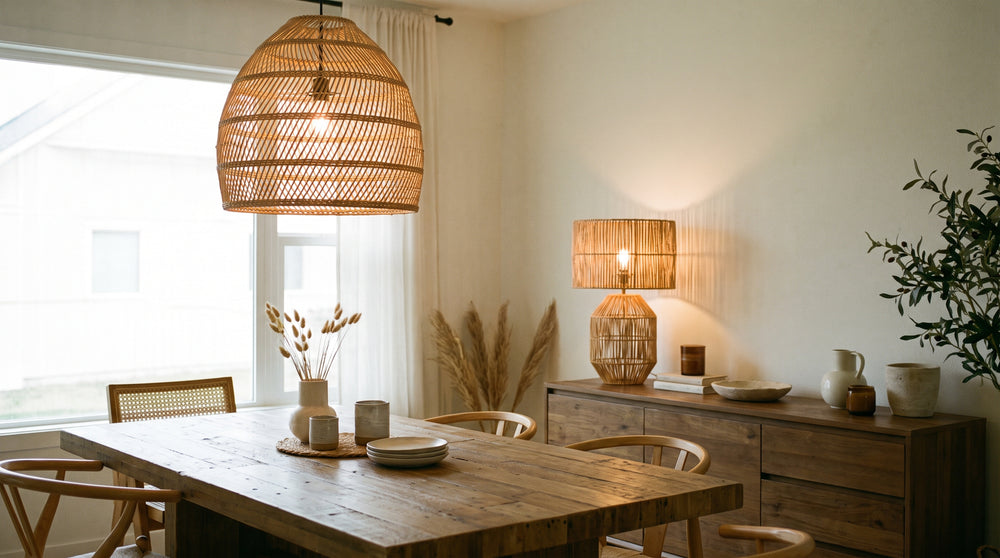
An interior that reflects who you are
Carefully selected pieces, shipped from our warehouses. Our team advises you before you buy, so you choose with confidence.
- Tracked delivery
- Pay in instalments, where available
- 14 days to change your mind
- Advice & showroom in Lyon, France
To dress a lamp, first measure the diameter of the socket and the width of the base, then choose a rattan lamp shade whose bottom extends beyond the base and whose height covers the bulb. The weave then warms the light and draws regular shadows on the walls.
- What light does a rattan lamp shade give
- Bedside, floor lamp or pendant
- Finding the right size
- Rattan, fabric, linen or glass
- Installing the lamp shade
- Rattan and the outdoors
- Care and reviving
- Where rattan and wicker come from
What light does a rattan lamp shade give?
The rattan weave filters the bulb: the light becomes warm and soft, and the weave casts regular shadows on the walls that are the signature of the material. A tight weave contains the halo around the lamp, an open weave lets it spread and lights the room more widely.
The difference between these two effects shows most in the evening, when the bulb is the only light source in the room. A tight weave keeps the light close to the book or the seat; a more open weave travels up and down the wall, and the room breathes without turning up the wattage.
The tone matters too: a natural fibre gives a golden halo, a patinated or darker tone pulls the halo toward amber. Before ordering, check the socket base (E27 or E14) on your lamp, and choose an LED bulb that gives off little heat: the weave should never stay in contact with a hot source. This is the only technical point that really matters; the rest is judged by eye, across all our light fittings.
Which rattan lamp shade for a bedside lamp, a floor lamp or a pendant?
The support decides the shape. On a bedside lamp, the rattan lamp shade stays compact and closed to frame the reading light; on a floor lamp, it rises and flares toward the bottom; as a pendant, it opens wide above the table.
Rattan lamp shade for a bedside lamp
A narrow format, slightly tall, set on a bedside table that is not too cluttered: the light falls toward the book, not into the eyes of the person sleeping next to it. A rattan lamp shade for a bedside lamp is chosen narrower than the top of the furniture.
Rattan lamp shade for a table lamp or a floor lamp
On a floor lamp, the shade flares toward the bottom and its height covers the socket and the bulb. A floor lamp shade that is too short shows the socket as soon as you sit down, which is immediately noticeable in a reading corner.
Rattan lamp shade for a pendant and a table lamp
As a pendant, the wide opening above a table spreads the light downward and marks the dining area; for a table lamp, a low, flared shade lights the area around the furniture. The details of the formats are set out in the choice of lamp shades for pendants, table lamps and floor lamps, and for a living room, see how to light a living room with several sources.
How do you find the size of a rattan lamp shade?
You measure the lamp before the shade: socket diameter for the fitting, base width and stem height for proportion. The bottom of the shade must extend beyond the base, and its height must cover the socket and the bulb without leaving them visible.
Measuring the socket and the base before choosing
Three measurements are enough: the socket diameter, the width of the base at its widest point, the height between the base and the socket. Also note the type of fitting, a screw ring or a clip. A shade whose fitting opening is smaller than the socket will not go on, even if the overall diameter is right.
The proportion between the base and the shade
In general, the width of the shade is one to two times that of the base: below that, the lamp looks spindly; above it, it looks visually top-heavy. Height is judged on the spot, bulb in hand, checking that the socket cannot be seen from the sofa. In a lamp shade for a baby's room, choose an enveloping model that keeps the light low, and keep the lamp out of reach of the bed.
| Support | Recommended shape | Relation to the base or socket | Light effect |
|---|---|---|---|
| Bedside lamp | Narrow, fairly tall shade | Bottom slightly wider than the base, ring on the socket | Light contained toward the book |
| Table lamp | Flared, low shade | Bottom extends beyond the base | Diffuse light around the lamp |
| Floor lamp | Tall shade, flared toward the bottom | Height covering socket and bulb | Light upward and downward |
| Pendant | Wide shade, open toward the bottom | Fitted on the socket or the cable spider | Pool of light above the table |
Once you have the measurements, the choice comes down to the weave. Check above all the socket diameter, the fitting method and the care: gentle dusting is enough to preserve the fibre.
Rattan, fabric, linen or glass lamp shade: which to choose?
Rattan lets the weave show and casts shadows, linen and fabric spread an even light with no pattern, glass gives direct light and wipes clean in one go. The choice comes down to the effect you want and the care you accept, before style.
Rattan versus linen and fabric
The weave draws a pattern on the wall and lets air through, which suits lamps that warm up a little. Linen and fabric smooth out the bulb's texture and give a smooth, calmer halo with no cast shadow. Fabric lamp shades dust easily; the linen versions need gentle washing and mark more quickly when touched.
Glass lamp shade for a bedside lamp: when to prefer it
Glass gives a clean light and wipes with a cloth, which counts in a child's room or a room where cooking fumes linger. It does not filter the weave and casts no shadows: you choose it for reading, not for creating an atmosphere.
| Material | Light given | Care | Where it works best |
|---|---|---|---|
| Woven rattan | Warm light filtered by the weave, cast shadows | Duster and barely damp cloth, air drying | Living room, bedroom, covered terrace |
| Linen | Soft, even light, no pattern | Regular dusting, gentle washing | Bedroom and quiet rooms |
| Fabric | Softened light, tone that colours the halo | Dusting, sometimes a removable cover | Bedside, hallway, cosy atmosphere |
| Glass | Direct light, clean halo | Cloth and glass cleaner | Reading bedside, desk, modern rooms |
If you like the warm effect and the shadows, all that remains is to choose the shape: browsing the lamp shade collection lets you compare diameters before deciding.
How do you install a rattan lamp shade on its lamp or on the ceiling?
Switch off the power, remove the old shade by unscrewing the ring or the clip, check that the new fitting matches the socket, then screw it back without forcing before restoring the power. A pendant is fitted back onto the cable or the spider provided.
How to install a lamp shade on a table lamp
You come across three fittings: the screw ring that grips the socket, the clip that hooks onto the bulb neck, the metal spider for large formats. Check that the bulb stays free inside and that no strand touches the glass of the bulb. Fitting is done with the lamp unplugged, never live.
What changes on a floor lamp
On a floor lamp, the shade screws on higher and its weight counts: a wide model on a light base makes the whole thing unstable at the slightest touch. Keep access to the socket to change the bulb without taking everything apart. If the base is struggling, it is better to move to a complete light fitting rather than a shade alone, and to compare fittings, see all the lamp shades.
Can rattan stay outside?
Natural rattan suffers from standing water and lasting damp: it holds up under an awning, a covered terrace or a pergola, not in the rain or full wind. Outdoors, what matters most is the protection rating of the light fitting, which concerns the electrical part.
Rattan and damp: what really damages the weave
It is not humid air that dulls the fibre, it is water that settles in the hollows of the weave and does not dry. A covered terrace, an overhanging roof, a porch: these situations are suitable. Direct exposure to showers blackens the weave and loosens the ties.
Outdoors, it is the protection rating of the light fitting that you check
The fibre has no protection rating, the electrical part does. The IP rating appears on the light fitting's data sheet, not on the shade: it is what tells you whether the socket can withstand the outdoors. For a terrace, start from a light fitting for terrace and outdoor use already designed for the purpose; the shade will not provide that protection for you.
How do you care for and revive a rattan lamp shade?
Dust comes off with a duster or a soft brush, without water. To revive a dull weave, a barely damp cloth is enough, then leave it to dry in the air away from a radiator; abrasive products and soaking dull the fibre instead of nourishing it.
Dusting without wetting the weave
Once a month, a duster or the vacuum cleaner on a gentle setting with a brush nozzle is enough to remove the dust that greys the fibre. Work into the hollows of the weave, where it collects. No wet sponge over the whole thing: water gets into the weave and takes hours to come out.
Reviving a dull fibre without weakening it
A barely damp cloth, dabbed rather than rubbed, then air drying in the shade. Avoid alcohol, multi-surface cleaners and soaking. On a light tone, dust shows more: white lamp shades need this regular pass to keep their crispness.
Where does rattan grow and how does it differ from wicker?
Rattan is a palm vine that grows in the tropical forests of Southeast Asia; wicker is a willow from temperate zones. Rattan bends with heat and weaves finely, wicker gives stiffer strands: two different effects for a lamp shade.
Rattan or wicker: two weaving techniques
Rattan softens with heat and bends without breaking, which allows tight, regular curves. Wicker is worked in thicker strands, with a more rustic relief and more contrasted shadows. On a lamp shade, this means a fine weave and even light for rattan, a more pronounced weave for wicker.
The rattan cantilever chair, the same weave elsewhere in the home
The rattan cantilever chair shows the same fibre in furniture, and reminds us that a weave is judged by its regularity, not its colour. That is no decorating coincidence: the weave ages like that of a seat. To stay in that register, see the lamp shades with a modern design, the black models that stand out on a pale wall, or what dresses a living room.
To choose, compare the diameter of the shade with that of the socket, check the fitting method and plan for gentle dusting to care for the rattan. For a handmade shade or a hanging rattan ceiling light with a rustic shade, check the socket diameter and the weight supported before fitting.
Frequently asked questions
How do you hang a lamp shade from the ceiling?
A pendant is fitted onto the cable or the spider around the socket: switch off the power, pass the cable through the opening, place the shade on the socket and screw on the ring. The shade must stay stable and never touch the bulb.
How can I replace my lamp shade?
Measure the socket and the width of the base, note the type of fitting (screw ring or clip), then choose a shade with the same measurements or slightly wider, which leaves the bulb free.
What is the difference between a rattan lamp and a rattan lamp shade?
A rattan lamp is a complete light fitting, with its base, cable and socket; a rattan lamp shade is only the part that covers the bulb and can be changed. The shade adapts to an existing lamp; the complete lamp imposes its format and height.
Are there inexpensive rattan lamp shades?
The most affordable models are standard formats with a simple weave; the price rises with the fineness of the weave, the diameter and patinated finishes. It is better to compare at equal measurements, because a shade that is too small does not do the same job.
How do you change the fabric of a lamp shade?
You do not replace the weave of a rattan lamp shade with fabric: the structure is made of fibres. On a shade with a metal frame, the fabric can be removed and refitted glued or sewn; on rattan, you simply change the whole shade.




