
Rattan floor lamps
This selection is also available in our French store: Abat jours sur pied en rotin
No products in this selection.
- Tracked delivery to your country Tracked delivery
- Secure payment at checkout Multiple payment methods
- 14 days to change your mind 14-day returns
- Secure payment Secure payment
Not sure of your style? Find it in 30 seconds
A few questions, and we will show you the pieces made for you.
Frequently asked questions
How do I choose the right product?
What are the delivery times?
Can I return an item?
Can I pay in instalments?
An interior that reflects who you are
Carefully selected pieces, shipped from our warehouses. Our team advises you before you buy, so you choose with confidence.
- Tracked delivery
- Pay in instalments, where available
- 14 days to change your mind
- Advice & showroom in Lyon, France
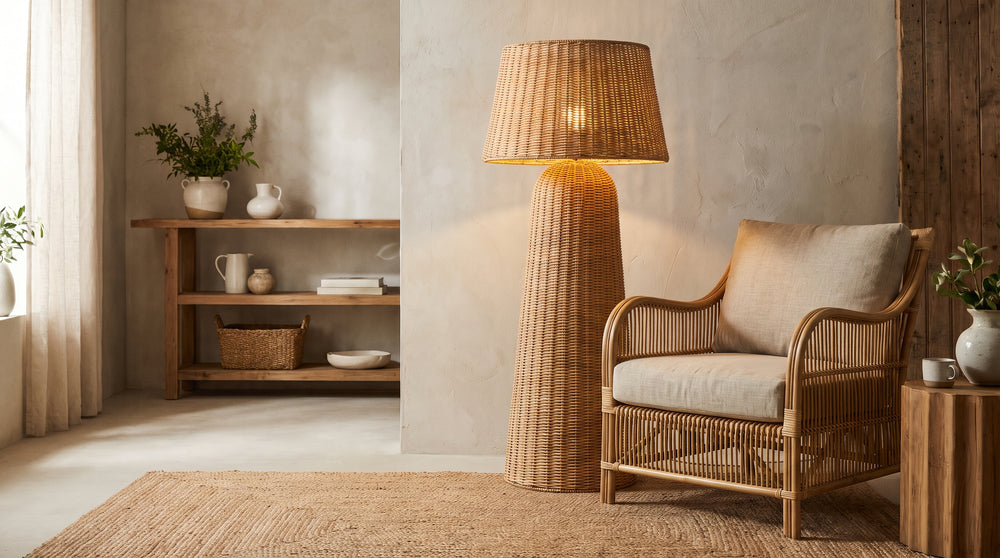
Allow for a shade whose weave filters the bulb and whose bottom edge sits at eye level once you are seated: that is what decides comfort, far more than the shape. Woven rattan casts regular shadows on the walls and keeps the light warm in the evening, without glare. You usually find rounded or square shapes, in rattan or wicker, designed for the living room corner as well as the bedroom, and this type of floor lamp shade is part of our full lighting collection. The ceiling-hung version, in rattan or wicker, is chosen according to the same weave and the same height.
What light does a rattan floor lamp shade give?
Woven rattan filters the bulb without hiding it: the light comes out through the mesh and casts a regular pattern on the walls. The result stays warm and low on glare, more contrasted than a fabric shade. A warm-white bulb strengthens that effect in the evening.
Rattan floor lamp shade: what the weave changes
A tight weave cuts more light and draws fine shadows; a loose weave lets more brightness through and projects broader patterns, sometimes up to the ceiling. Next to a sofa, a fairly closed weave is better. Also leave space between the bulb and the wall of the shade: a source too close to the fibre eventually hardens and yellows the rattan. An E27 or E14 socket depending on the model, wired to the 230 V mains, and a filament LED give a beautiful weave pattern without heating the braid.
Wicker floor lamp shade: the look and how it holds up over time
Wicker is more supple and finer than rattan: more light passes through, the shadows are lighter, the look more artisanal. On the other hand, the fibre compacts if you squeeze it and marks more quickly. Compare the two before deciding with choosing a shade according to the support, then take a look at our floor lamps to match base and shade.
Where should a living room floor lamp go?
In the living room, the floor lamp goes in the corner of the sofa or behind a seat, within reach without blocking the way. The shade should sit at eye level when you are seated, to light the book or the cup without glare. A gap from the wall lets the shadows breathe.
Living room floor lamp: the sofa corner rather than the centre of the room
In the centre, a floor lamp isolates itself and gets in the way of movement; in the corner, it closes off the reading nook and doubles the ceiling light without competing with it. Put the base at the shoulder of the seat, not in front, and keep the cable flat against the skirting board. The eye then goes to the book, not the bulb. Find the models designed for the living room if you want a wide shape, and the most compact ones for a narrow corner.
Living room floor lamp: keep some distance from the wall
Less than ten centimetres from a wall, the weave casts a flattened, concentrated pattern; at thirty or forty centimetres, the shadows open up and dress the wall. Shift the base slightly towards the room, even if it means moving it back half a step. The light becomes a pattern rather than a point.
| Room | Role of the light | Shade shape | What to avoid |
|---|---|---|---|
| Living room, sofa corner | Reading and atmosphere | Rounded, wide enough to cover the seat | A base that blocks the way to the table |
| Bedroom, near the bed | Low reading light | Compact, fairly closed weave | A shade at eye level when seated |
| Hallway or corridor | Welcome, visual marker | Cylindrical, light tone | Light aimed too much at the floor |
| Conservatory or covered terrace | Evening light | Rattan or wicker, simple structure | Direct exposure to rain |
| Baby's room | Indirect night light | Small format, tight weave | An accessible bulb that is hot to the touch |
Which rattan shade for a bedroom floor lamp?
In a bedroom, the floor lamp provides low light, near the bed or in the corner, for reading or getting up at night without switching on the ceiling light. A compact rattan shade, whose weave drops below the eye level of a seated person, avoids glare and keeps the room calm.
Bedroom floor lamp: low light near the bed
Place the base on the free side of the bed, at bedside table height, so you can reach the switch while lying down. The bottom of the shade should stay below the eye line once you are sitting on the mattress. A low-power bulb is enough: the weave does the rest by diffusing. See the bedroom ones for short formats.
Rattan shade for a floor lamp: which diameter to choose
A diameter that is too wide on a slim base unbalances the silhouette; too narrow, and it leaves the bulb visible as soon as you come close. Aim for a diameter close to half the width of the seat it lights. For a night light, a small tight-weave format works, as in the baby's room, provided you keep all fabric and objects away from the bulb.
Rattan, wicker, linen or fabric: which shade to choose?
Rattan and wicker let light through the weave: the result is contrasted, with visible shadows. Linen and fabric diffuse a softer, more even light, with no pattern on the walls. The choice therefore depends on the atmosphere you want, not on a level of quality.
Linen or fabric shade: the softest light
A linen shade softens outlines and erases shadows: the room feels more hushed, calmer. Stretched fabric gives an even more uniform result, appreciated above a table. These materials need regular dusting and do not take washing well. Compare with a linen shade and the fabric versions.
Rattan and wicker: more relief, more regular care
The woven fibre draws on the walls, which neither linen nor fabric does. In exchange, dust clings to the mesh and humidity makes the braid work. A feather duster every two weeks is enough to keep the pattern crisp.
| Material | Light given | Style | Care |
|---|---|---|---|
| Woven rattan | Filtered, marked shadows | Natural, boho, seaside | Feather duster, soft brush, avoid humidity |
| Wicker | Finer, brighter light | Artisanal, more supple | Compacts and warps if squeezed |
| Linen | Diffused, no sharp shadow | Soft, Scandinavian | Light vacuuming, no washing |
| Stretched fabric | Very even | Classic, hushed interior | Regular dusting, watch the bulb heat |
How to match a rattan shade with the decor?
Rattan goes with light wood, raw canvas and natural fibres, and works as a warm note in a white or black interior. The main thing is to align the weave and the tones of the base: a dark base and a light shade create a sharp contrast, the opposite softens it.
Rattan and wood: stay in the same family of tones
A light wood base with a honey braid gives a continuous whole, with no break. If the wood is dark, a natural rattan shade lightens the silhouette. Avoid stacking three different woods in the same room: keep rattan as the only pattern. Sober lines can be found among the modern shapes.
Rattan and white or black: balance the contrast
On a black base, a light shade stands out and becomes the focal point; on a light base, a dark braid weighs down the base. In a white interior, the natural fibre brings the only warm touch. Look at the white finishes and a black colourway before fixing your contrast.
How do you install and care for a rattan floor lamp shade?
Most floor lamps take the shade with a spider or clip fitting, around an E27 or E14 socket wired to the 230 V mains. For care, a feather duster or a soft brush is enough: rattan dislikes standing water and products that leave a film.
Wiring several lamps to a single power supply
Start from a junction box connected to the supply, then distribute each lamp with connectors suited to the wire gauge, after switching off the power. Add up the bulb wattages to stay within the limits of the circuit and have an electrician approve the installation. An LED bulb in an E27 or E14 socket needs no special wiring: it simply screws in, just check the voltage on the packaging.
Dusting rattan without stripping or varnishing it
Run the feather duster or the brush nozzle of the vacuum over it without pressing, mesh by mesh. For a stain, a barely damp cloth then dry immediately. Varnish and film-forming products dull the fibre and hold dust. Find all shade shapes to check the fitting method before ordering.
- Secure payment on the Designix site.
- Tracked delivery, parcel handed over against signature depending on the carrier.
- Returns possible according to the shop's conditions.
- Designix customer service to check socket, diameter and fitting before purchase.
Before you confirm, measure the height of your base and the diameter of the shade holder: that is the only way to be sure the braid falls at the right level. To furnish a whole room, start from see all Designix lighting and complete with a living room light.
Frequently asked questions
What is the difference between a rattan and a wicker shade?
Rattan is a stiffer stem that holds its shape and is woven into regular meshes. Wicker is more supple and finer: more light passes through, the shadows are lighter, but the fibre compacts if you squeeze it. Choose according to the look you want.
How do you clean a rattan shade?
Dust dry with a feather duster or the brush nozzle of a vacuum, without pressing. For a stain, use a barely damp cloth then dry at once: rattan must not stay wet. Avoid products that leave a film, they dull the fibre and hold dust.
Can you fit a rattan shade on any floor lamp?
No, you need to check three things: the type of socket, the diameter of the shade holder and the fitting method, spider or clip. The height of the base also matters, so that the shade sits at the right level once the lamp is in place. This information is on the light's product page.
How do you connect an LED bulb to 220 V?
An LED bulb with an E27 or E14 socket simply screws into the lamp's socket, which is itself connected to the 230 V mains. There is no specific wiring to do. Check the voltage printed on the bulb packaging and switch off the power before touching the cable.
What diameter and height should you choose for a rattan floor lamp shade?
Yes, provided you protect the tabletop: a hot dish or a wet glass marks the wood, especially if it is oiled. A placemat or a side table is enough. Also keep the floor lamp out of the walkway: splashes and the heat of a bulb that is too close damage rattan as well as wood.
How do you remove varnish from wood?
For the fitting, check the weight of the shade and choose a hook suited to the support; for the diameter and height, measure the base and the available space before choosing.
How do you fix a pendant light to a sloping ceiling?
The fixing must bite into the structure, not just the plasterboard, with a plug suited to the support. An adjustable ceiling rose or a tilting bracket brings the light back level, and an adjustable cable compensates for the slope on a pendant. If in doubt about the support, have an electrician install the point.




