
Rattan and wicker wall lamps
This selection is also available in our French store: Appliques murales en rotin et osier
No products in this selection.
- Tracked delivery to your country Tracked delivery
- Secure payment at checkout Multiple payment methods
- 14 days to change your mind 14-day returns
- Secure payment Secure payment
Not sure of your style? Find it in 30 seconds
A few questions, and we will show you the pieces made for you.
Frequently asked questions
How do I choose the right product?
What are the delivery times?
Can I return an item?
Can I pay in instalments?
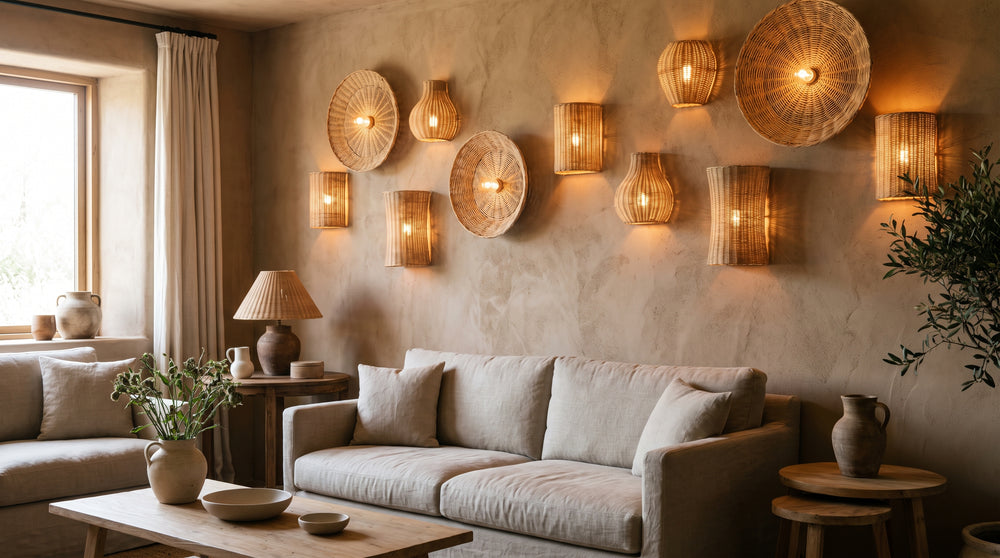
An interior that reflects who you are
Carefully selected pieces, shipped from our warehouses. Our team advises you before you buy, so you choose with confidence.
- Tracked delivery
- Pay in instalments, where available
- 14 days to change your mind
- Advice & showroom in Lyon, France
Choose a rattan or wicker wall light first by its weave: a tight weave for a soft light that does not hurt the eye, a wider weave for a more graphic wall. Plan for one on each side of a bed or sofa, at shoulder height in a hallway and at reading height next to a bed: this is the placement that works in most interiors.
What is a rattan and wicker wall light?
A rattan or wicker wall light is a fixture mounted on the wall whose shade is a weave of natural fibre. The light passes through the strands and is projected in patterns onto the wall, giving a warm, shifting glow rather than a direct beam. The electrical block is hidden behind the weave, and only the socket remains accessible for changing the bulb.
Rattan wall lights
Rattan is woven fine and regular. On the wall, it produces a tight mesh that diffuses a soft light without glare, and that suits a bohemian interior as well as an off-white painted wall. It is the easiest weave to pair with existing furniture, and the one that takes up the least visual space in a small living room. Find these models in our full range of lighting.
Wicker wall lights
Wicker shows thicker strands, irregular meshes and a tone that varies from one piece to the next. The result is more rustic, more present on the wall: it embraces the material instead of smoothing it. It is often reserved for an entrance or a room where the wall is bare, so that the weave itself becomes the decoration.
What is the difference between rattan and wicker?
Rattan is a supple palm fibre, tightly woven, which gives a smooth and regular appearance. Wicker comes from willow: its thicker strands produce a rustic weave with visible meshes. Both filter light and need dry air; bamboo, for its part, brings straighter lines and a more graphic result.
Rattan, wicker or bamboo wall light
The choice comes down to the fineness of the mesh rather than durability, since all three fibres behave the same way in a dry interior. If you want a discreet look, go for rattan. For a stronger presence, wicker. For a contemporary wall, bamboo, whose canes give clean lines. Compare the three in the bamboo and wicker wall lights.
What the fineness of the weave changes
A tight mesh filters more: the light stays close to the wall and the mood is cosy. A wide mesh lets through more marked streaks of light, with visible shadows cast on the paint. In a room where you read or look at a screen, a tight mesh remains the most comfortable choice.
| Material | Origin | Look of the weave | Recommended use |
|---|---|---|---|
| Rattan | Palm fibre | Fine, regular mesh | Dry interior, living room and bedroom |
| Wicker | Willow | Thick strands, rustic look | Dry interior, bohemian style |
| Bamboo | Canes | Straight lines, wide meshes | Dry interior, more graphic result |
Which wall lights for a living room?
In a living room, a rattan wall light serves as supplementary lighting: it is placed on either side of a bookcase, a sofa or a room entrance. A tight weave filters the beam and prevents glare. Choose a warm bulb, around 2700 K, and if possible a dimmable model.
Supplementary light rather than main lighting
The wall light does not replace the ceiling light: it creates a zone. Two wall lights framing a sofa define a reading corner without lighting the whole room. For a living room already fitted with LED ceiling lighting, LED wall lights for the living room complete the setup without adding more switches.
Matching the wall light to the living room materials
A natural weave goes well with wood, linen, terracotta and the fibres of a rug. It clashes, however, with brushed steel and black glass, unless you deliberately play on contrast. Look at the wall tone: on a dark wall, a pale rattan stands out and becomes an object; on a light wall, it is the shadow cast that does the work.
How to choose a wall light for an adult bedroom?
In an adult bedroom, a rattan wall light replaces the bedside lamp and frees up the nightstand. Place it at reading height, on each side of the bed, with a weave that diffuses a soft light. A warm bulb and a dimmer let you lower the intensity in the evening without switching the ceiling light back on.
On each side of the bed, at what height?
Aim for a height that puts the shade at shoulder level when you are sitting, roughly halfway between the mattress and the top of your head. It is better to mount it slightly too high than too low: you can always read below it, never above it. The rattan wall lights for the bedroom gather the small formats suited to this use.
Warm bulb and dimmer for the evening
An exposed filament bulb or a warm-white LED gives that orange light that helps you wind down before sleep. A dimmer avoids the harsh on-off effect. The dimmable wall lights and the LED versions for the bedroom cover this need, provided you check that the bulb is compatible with the dimmer.
Which wall lights for a staircase and a hallway?
In a staircase or a hallway, the wall light illuminates the circulation without blocking the passage. Place it at shoulder height, at the top and bottom of the flight, and offset from the handrail. A tight weave and a low-power bulb prevent glare for the person climbing.
The right height on a staircase
The useful reference is the hand: the handrail runs roughly at hip height, so the wall light should stay above it so as not to get in the way of your grip. A model repeated on each flight, offset on one side then the other, lights the steps without creating a dark zone. See the designer staircase lighting and the modern hallway wall lights.
Lighting without glare in a hallway
A narrow hallway copes badly with a direct source at eye level. Aim the weave towards the floor or the opposite wall, and keep a low-power bulb: the light bounces off the surfaces. In an entrance, the models for an entrance play the same role, often in a more generous format.
Art Deco, Art Nouveau, high-end design wall lights: which style to choose?
The 1930s Art Deco wall light plays on geometric shapes and straight lines; Art Nouveau prefers plant-like curves. Rattan and wicker suit both registers depending on the fineness of the weave. A high-end design model is recognised by the regularity of its meshes and the finish of the socket, not by added decoration.
The 1930s Art Deco wall light and its geometric lines
The 1930s style seeks symmetry: a rectangular base, a semicircular or fan-shaped shade, clean lines. A very regular, almost mechanical weave serves this register. Install it in pairs in an entrance or on either side of a mirror, so that the geometry answers itself.
Art Nouveau, curves and plant motifs
Art Nouveau embraces the curve and plant-inspired motifs. Wicker, with its irregular strands, lends itself to this effortlessly. A round or teardrop wall light, placed alone on a bedroom wall, is enough to set the tone. The retro models and the gold and black finishes let you push the style without repainting the room.
What makes a high-end design wall light
Three signs are visible to the naked eye: regular meshes with no irregular gaps, a weave that does not fray at the edges, and a socket properly fixed in its holder. A vintage metal wall light or a wooden model can also work if the rest of the room is already heavy on fibres.
Where to install a rattan or wicker wall light, and how to handle humidity?
Rattan and wicker dislike stagnant humidity: in a bathroom, choose a model whose protection rating suits the zone, or place it away from the water jet. Outdoors, an IP44 wall light is suitable under a sheltered awning; an exposed terrace requires higher protection.
Bathroom and damp room: what to check
The IP rating indicates resistance to dust and water. In a damp room, a protected model is preferable even away from the shower, and a ventilated location extends the life of the weave. The IP44 wall lights and the bathroom wall lights meet this requirement.
Terrace and sheltered outdoors
Under an awning, a natural-fibre wall light holds up if it receives neither driving rain nor direct watering. For an open terrace, turn to the waterproof outdoor wall lights or the terrace wall lights, designed for humidity.
| Room | Type of wall light | Light sought | Point to watch |
|---|---|---|---|
| Living room | Tight weave, on either side of the sofa | Warm supplementary light, no glare | Match with the furniture materials |
| Adult bedroom | Small format on each side of the bed | Diffused and adjustable | Respect the reading height |
| Hallway and staircase | Compact model, repeated up the flight | Directed towards the floor | Offset from the handrail |
| Bathroom | Protected model, away from the water jet | Soft and steady | Protection rating suited to the zone |
| Terrace | Outdoor wall light under an awning | Evening atmosphere | Protection against humidity |
How to install and care for a rattan or wicker wall light?
A wall light is fixed to a flush mounting box or surface-mounted, out of reach of water splashes. Switch off the power before connecting and respect the wire gauge. For care, dust the weave dry with a soft cloth or brush, without wet products.
Mounting and electrical connection
Locate the box, switch off the breaker, then connect live, neutral and earth according to the socket supplied. A screw-in socket wall light lets you choose the bulb: E27 socket wall lights accept filament, LED or smart bulbs, which keeps your options open if you change the mood later.
Cleaning the weave without damaging it
Dust settles in the meshes and dulls the fibre. A feather duster or soft brush once a month is enough; avoid a damp sponge, which softens the strand and makes the weave warp. If a mesh loosens, do not pull on it: trim the end cleanly instead of breaking it.
Can a wicker ceiling light and a rattan lamp be paired with your wall lights?
A wicker ceiling light and a rattan lamp can coexist with wall lights if the weave remains the common thread. Keep to the same family of tones and limit the number of visible sources in a small room. Spread the light: ceiling for atmosphere, wall lights for zones.
A coherent trio in a living room
Ceiling light in the centre, wall lights near the seating, a table lamp on a piece of furniture: the rule is not to repeat the same move three times. If the ceiling light is very elaborate, keep the wall lights understated. The lighting catalogue lets you compare weave families before composing.
Avoiding visual overload
In a small room, two wall lights and one lamp are enough. Multiplying fibre shades on the same wall turns the surface into a pattern and tires the eye. One source per zone, one dominant weave: that is what lasts.
Before mounting, check three points: the weave matches the fineness of light you want, the socket accepts the bulb you already have, and the location remains ventilated. Secure payment, tracked delivery, returns and Designix customer service accompany every order.
Frequently asked questions
What are the trends for wall lights in 2026?
Woven natural materials remain sought after for their warm light and understated look. Round or half-moon shapes sit alongside more graphic lines, and dimmable or LED models are growing. The choice is mainly made according to the room and the style of the wall.
What height for wall lights on a staircase?
Place the wall light at shoulder height, at the top and bottom of the flight, offset from the handrail so as not to get in the way of your grip. A tight weave and a low-power bulb light the step without glare for the person climbing.
Can a rattan wall light be installed in a bathroom?
Yes, provided it is placed away from the water jet and you check the protection rating of the model. Rattan and wicker dislike stagnant humidity: a well-ventilated room and a location away from the shower extend the life of the weave.
How to match a rattan wall light with a wicker ceiling light?
Keep to the same family of tones and a weave of similar fineness so that the whole remains coherent. In a small room, limit the number of visible sources. The ceiling light provides the general atmosphere, the wall lights illuminate the reading or circulation zones.
Rattan, wicker or bamboo for a wall light?
Rattan offers a fine, regular weave, wicker a more rustic result with thick strands, bamboo straighter lines. All three suit a dry interior. The choice depends mainly on the style of the wall and the fineness of light you want.




