
Paper table lamps
This selection is also available in our French store: Lampes à poser en papier




- Tracked delivery to your country Tracked delivery
- Secure payment at checkout Multiple payment methods
- 14 days to change your mind 14-day returns
- Secure payment Secure payment
Not sure of your style? Find it in 30 seconds
A few questions, and we will show you the pieces made for you.
Frequently asked questions
What table size for how many people?
Which tabletop material should I choose?
Extendable or fixed?
How do I care for the tabletop?
The right furniture, in the right place
Check the dimensions with our fit checker and receive pieces made to last. Unsure? Our team will answer your questions.
- Tracked delivery
- Pay in instalments, where available
- 14 days to change your mind
- Advice & showroom in Lyon, France
Allow 22 cm in height for a bedside table and 61 to 69 cm for a living room piece of furniture: the format decides placement before the material does. Paper table lamps filter the light and make it diffuse; the sockets listed are E27, E14 or an integrated LED, with only the LED model given as warm white.
Which paper table lamp should you choose for a living room or bedroom?
In a living room, a paper table lamp of 60 to 69 cm sits on a piece of furniture at seat height; for a bedside table, 22 to 40 cm is enough. Models with an E27 or E14 socket take a bulb of your choice, while the LED version has an integrated light source.
Which format for a living room, which format for a bedside table?
On a low living room unit, a 65 cm silhouette such as the Tai L 30 cm lamp in Japanese paper places the light at seated eye level. A lamp designed for the bedroom stays more compact, between 22 and 40 cm, so it does not crowd a bedside table. A large diameter, around 36 cm, on the other hand requires a well-cleared surface.
E27, E14 or integrated LED socket: what difference does it make in use?
E27 lets you choose and replace the bulb, E14 equips small bases and requires a more compact bulb, and the integrated LED fixes the light source but removes the need to change bulbs. Check the maximum wattage indicated on the socket before fitting a stronger bulb. For a look close to fabric, compare with the linen shades.
| Model | Height | Listed material | Socket | Max wattage listed | Colour |
|---|---|---|---|---|---|
| Tai L 30 cm | 65 cm | Paper and steel | E27 | 60 W | White |
| Tai Blanche | 40 cm | Paper and steel | E27 | 60 W | White |
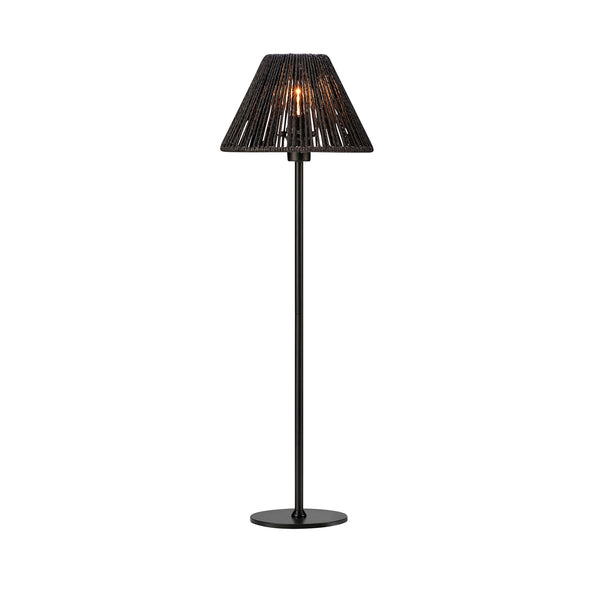
| Corda | 61.5 cm | Metal and paper | E14 | 40 W | Black and beige |
| Cordulle | 33.5 cm | Paper and rope | E27 | 40 W | Grey and black |
| Sofie | 31 cm | Metal and paper | E27 | 10 W | Black |
| Sillanano | 22 cm | Paper | Integrated LED | 1.5 W | Brown |
How do you wire several lamps to a single power supply?
Several lamps can run from the same supply if they are connected in parallel on a terminal block or connector strips, each receiving the live and neutral. The number of points depends on the total wattage drawn: have the connection checked by an electrician, especially on a fixed circuit.
Wiring several lamps in parallel: the principle
Each lamp is powered independently, so switching one off does not cut the others. The neutrals are joined on one side, the switched lives on the other, and the earth if the fixture has one. Switch off the power at the breaker before working, even for a test. This arrangement works for a lighting circuit as well as for a socket line.
Wiring three lamps to one switch: what to check
The three lamps switch on and off together, controlled by the same wire. Add up the wattages drawn, bulbs included, and compare with the circuit rating before powering up. Connectors suited to the wire gauge prevent a doubtful connection. One supply per lamp remains the simplest solution when the walls are open.
What kind of light does a paper table lamp give?
Paper filters the light and makes it diffuse, without direct glare: these lamps suit accent lighting rather than task lighting. Models with an E27 or E14 socket let you choose the bulb; the integrated LED version is given as warm white, between 2700 and 3500 K.
Rice paper or woven paper table lamp: what effect?
Rice paper, thin and taut, gives an even, gentle light; woven paper rope draws stronger shadows and keeps a visible texture, both off and on. A beige or brown colour warms the effect, white neutralises it. For discreet accent lighting in a bedroom, look at the LED table lamps for the bedroom.
Warm white 2700-3500 K: what does that correspond to?
These are ambient colour temperatures, close to classic incandescent light: 2700 K leans orange, 3500 K towards a more neutral white. Below that, you enter a candle-like rendering; above 4000 K, the light becomes cold and suits a worktop better. In a living room, stay below 3000 K.
Where should you place a paper table lamp in the home?
These lamps are intended for the living room and bedroom. A large silhouette sits at the end of a sofa, on a tall unit; a small format finds its place on a bedside table or a shelf. Models listed as IP20 should therefore be kept indoors.
On a bedside table
A model of 22 to 40 cm, such as the Sillanano lamp with its USB-C port, fits on a narrow surface without getting in the way of the alarm clock or a book. The light source should stay below eye level when you are lying down. The large-format designer table lamps for the living room are too tall there.
At the end of a sofa or on a tall unit
Allow a silhouette of 61 to 69 cm to reach seat height. The base should be wide and stable, with the surface clear for about fifteen centimetres around the base. Avoid walkways: a paper lamp tips over and the paper creases.
Floor lamps or tall table lamps: how do you decide?
A tall table lamp, from 61.5 to 69 cm, lights almost like a small floor lamp without taking up floor space: it sits on a piece of furniture. A floor lamp, by contrast, stands on the floor and lights lower down. The choice depends on the space available and the seat height.
Floor lamps and tall table lamps: what sets them apart
A floor lamp needs no furniture and moves in one gesture; a table lamp requires a surface but takes no floor space. In a small living room, that saved surface counts. The tall silhouette of the Papia illustrates this compromise: large format, no floor footprint.
When should you prefer a 65 cm silhouette to a small format?
Above 65 cm, the light source rises above an armrest and lights an open book. Below 40 cm, it highlights an object, a console, a headboard. The practical guide: furniture height plus lamp height around 90 to 110 cm for reading use.
How do you match a paper lamp with your decor?
The models combine paper with metal, steel or rope, in black, beige, white, brown or grey. A light shade brightens a dark interior, a black colour blends into a graphic decor. Japanese style favours simple shapes, Nordic style soft lines.
Japanese, Nordic or Italian design style: what are the differences?
The Japanese line works with tube and taut paper, with crisp lines; the Nordic vein seeks low shapes and matte materials; Italian design embraces contrast, such as the Corda lamp with its paper shade and black base. The Nordic selection and the modern table lamps for the living room offer two opposite directions.
Paper and metal, paper and rope: material pairings
Paper and steel give a clean line and a crisp white; paper and metal play on matte contrast; paper rope brings a woven texture that warms a white interior. For a change, look at the ceramic versions, the wooden lamps or the black finishes.
| Socket | Models concerned | Max wattage listed | What it implies |
|---|---|---|---|
| E27 | Tai L 30 cm, Tai Blanche, Cordulle, Sofie | from 10 to 60 W depending on the model | Bulb to choose and replace |
| E14 | Corda | 40 W | Small socket, more compact bulb |
| Integrated LED | Sillanano | 1.5 W | LED module, warm white from 2700 to 3500 K |
How do you care for and install a paper table lamp?
A paper shade is dusted dry, with a soft cloth or a light brush, without liquid products that would stain the paper. The IP20 rating means protection against contact and solid objects, not against water: these lamps stay indoors, away from a bathroom.
How do you clean a paper shade without marking it?
Switch off and let it cool before touching. A feather duster, or a vacuum with the brush attachment on minimum power, is enough for everyday care; a soft eraser reduces a fingerprint on taut paper. No damp sponge, no alcohol: the paper warps and the stain spreads.
Why does the IP20 rating limit use to indoors?
IP20 protects against fingers and coarse dust, nothing more: neither splashes nor bathroom humidity. Change the bulb while respecting the maximum wattage indicated on the socket, with the power off. A bulb that is too strong eventually yellows the paper.
How do you arrange the light around a paper table lamp?
A paper table lamp serves as accent lighting: place it off the axis of ceiling spotlights to avoid two sources on the same point. Two or three light points are enough in a living room, including one near the sofa or on a console.
How do you arrange ceiling spotlights with a table lamp?
Spotlights provide the general lighting, the lamp adds the accent. Move it towards a corner, a console or the back of the sofa, and keep a single strong point per zone. For a work corner, adjustable models, desk lights or designer LED table lamps are better suited than a paper shade.
Ball, oval or tube lamp: which shape for which effect?
The round shape diffuses in all directions and suits a living room; the oval, taller shape, dresses a console; the tube, like the Mardanella model, draws a clean vertical line on a piece of furniture. Choose the shape before the colour: it is what structures the corner.
At Designix, payment is secure, delivery is tracked and returns are possible; customer service answers questions about height, socket or colour before you order. Unsure between two formats? Browse all our light fixtures by room, material and colour, or compare the models designed for the bedroom with those for the living room.
Frequently asked questions
How do you wire three lamps to one switch?
The three lamps are connected in parallel: the live wires arrive on the same wire controlled by the switch, the neutrals are joined. They switch on and off together. Use connectors suited to the wire gauge and check the total wattage before powering up.
Can several lamps be wired in parallel?
Yes, it is the usual arrangement for several light points on the same circuit: each lamp is powered independently and switching one off does not cut the others. The limit comes from the total wattage drawn and the circuit rating, not from the number of lamps.
What are the most beautiful paper living room lamps?
The choice comes down to silhouette and colour rather than a ranking. A large beige lamp in paper rope structures a corner of the living room, a more compact black and white model slips onto a console. White paper table lamps light without making their mark on the decor.
What is a designer ball table lamp?
It is a table lamp whose shade has a round or oval shape, set on a short base. In this selection, round and oval shapes sit alongside tube shapes: the effect ranges from a soft sphere to a more graphic cylinder, always with a shade that filters the light.
How do you choose a Japanese paper table lamp?
Look first at the height: on the paper and steel models, it ranges from 40 to 65 cm. Check the socket, E27 on most of them, and the maximum wattage listed. Japanese paper gives a diffuse light, suited to accent lighting rather than task work.




