
Paper LED garlands
This selection is also available in our French store: Guirlandes LED en papier
No products in this selection.
- Tracked delivery to your country Tracked delivery
- Secure payment at checkout Multiple payment methods
- 14 days to change your mind 14-day returns
- Secure payment Secure payment
Not sure of your style? Find it in 30 seconds
A few questions, and we will show you the pieces made for you.
Frequently asked questions
How do I choose the right product?
What are the delivery times?
Can I return an item?
Can I pay in instalments?
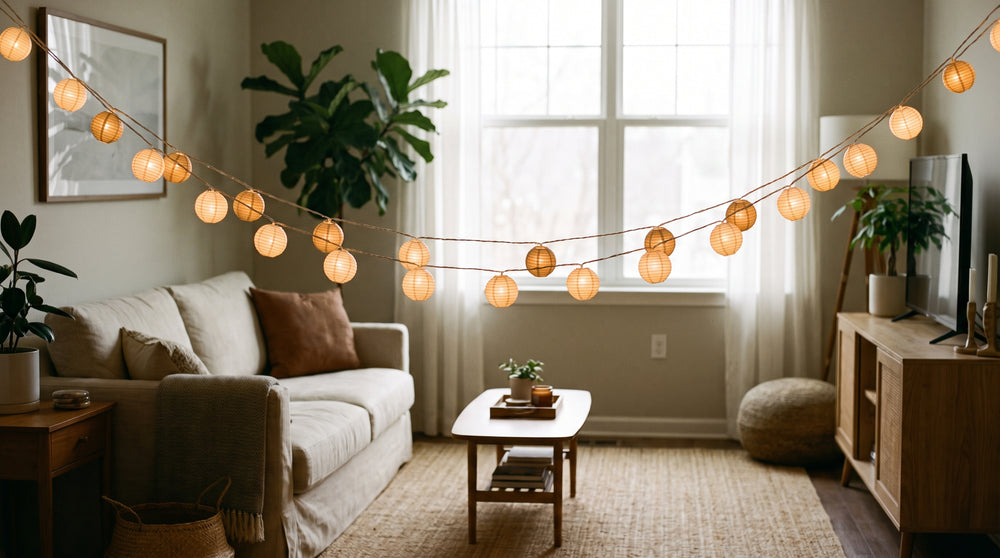
An interior that reflects who you are
Carefully selected pieces, shipped from our warehouses. Our team advises you before you buy, so you choose with confidence.
- Tracked delivery
- Pay in instalments, where available
- 14 days to change your mind
- Advice & showroom in Lyon, France
Plan one string light per area to highlight, not per room: a line above a headboard, one slipped between two shelf boards, one stretched above a party table. A paper LED string light gives off a warm, low light, made to define a corner rather than to light a whole room.
What is a paper LED string light and what kind of light does it give?
Paper string lights: what the material changes
The principle is simple: small LEDs spaced along a flexible wire, each dressed in a paper shade. The paper does all the visual work. It intercepts the direct point of light, spreads it, and turns a point source into a halo. That is what sets these decorative string lights apart from a bare LED wire, whose points shine and dazzle as soon as you look at them. A well-chosen shade makes the line invisible to the eye: you see a soft trail, not a succession of bulbs.
A warm, low light, decorative before functional
Generally, these string lights sit around 2700 to 3000 kelvins, the so-called warm white range: an amber tone, close to a candle, that relaxes in the evening. The power stays low, a few tenths of a watt per point, so there is no risk of the paper heating up. Do not count on them for reading or working: they are lighting fixtures for atmosphere, to switch on as a second layer, once the main lighting is dimmed.
Where to install a paper string light in the home?
Paper string light for a child's room: the bedroom and the reading corner
In a child's bedroom, it serves as a night light and a landmark: a line along the wall, at adult height, above the headboard or framed around a window. The effect is clear, the room warms up without becoming a beacon. Prefer battery power or a USB model to avoid a cable crossing the room, and keep the wire out of reach of the youngest.
Above a table or along a shelf
On a shelf, slip the string light behind the books: the light comes out at an angle and highlights the spines. Above a party table or a coffee table, a line stretched slightly as a floating garland (a little slack between two points) is enough to change the mood of the meal. On a covered terrace, it is with a rechargeable string light that you avoid a cable across the living room.
Rice paper, Japanese paper or origami: which material to choose?
Three families, three effects. Rice paper gives the softest light and hides the bright points best; washi, more textured, keeps a warm, matte tone; folded origami plays with shadows and becomes a pattern in its own right. Thick tinted paper, on the other hand, concentrates the light downwards and helps separate two areas.
| Paper | Light effect | Where it works best | Point to watch |
|---|---|---|---|
| Rice paper | Very diffuse, almost milky, hides the LED points | Bedroom, headboard, living room wall | Creases quickly when taken down |
| Japanese washi paper | Warm and matte, visible texture | Shelf, party table, reading corner | Marks on contact with water |
| Folded origami | Graphic, marked shadows, a little less bright | Graphic decor, child's room | Folds that open if the paper is thin |
| Thick tinted paper | Concentrated light, reduced halo | Separating areas, desk corner | Can dim the small LED points |
Rice paper string light: the most diffuse effect
It is the default choice when you are after a glow rather than a pattern. The long fibres of rice paper diffract the light and smooth the beam: at fifty centimetres, the diode is no longer distinguishable. It does, however, require gentle handling, as it marks at the fold and from damp fingers.
Origami paper string light: more graphic, less bright
The fold creates facets that bounce the light back intermittently. The result is more drawn, more contrasted, and slightly less bright since the overlapping layers filter more. It is the material to choose for a graphic wall or a bedroom where you want to highlight the structure rather than the colour. For format and length variants, see the LED string light range.
How does an LED string light work?
Batteries, USB or mains: how to power the string light
Three modes, three constraints. Batteries free up the placement, but require an accessible box and regular replacement. USB suits a shelf or headboard near a socket, with a thin, discreet cable. Mains power, at 220 V, allows the longest lengths: that is the territory of models that plug into 220 V mains. There are also low-voltage 24 V string lights, safer to touch and suited to long lines.
LED string light or cuttable LED strip: what is the difference?
An LED strip is a flat circuit, often adhesive, that you cut at marked points and that lights continuously. A string light is a flexible wire with spaced points: you do not cut it, and you choose its length at purchase. The strip is for highlighting a straight line (under a piece of furniture, behind a screen); the paper-dressed string light is for creating rhythm. The diodes of the two families are not interchangeable.
Paper LED string light for outdoors: what should you check?
IP44 or IP65: what the rating protects
The protection rating describes a housing's resistance to dust and water. IP44 protects against splashes and fine rain; IP65 protects against water jets and can be cleaned with a jet. On a paper string light, it is the power supply and the plug that must be protected, not the wire. See the IP44-protected string lights and the IP65 models for water jets.
Covered terrace and garden: the right habits
Paper fears damp and hangs: under a canopy, it stays dry as long as it does not rain sideways. In the garden, turn to solar lighting for the garden, without paper, or to all the string lights designed for outdoors. A dry, ventilated shelter, never a closed plastic bag over damp paper.
How can I make a paper string light myself?
DIY paper string light: the starting materials
You need a flexible LED wire with spaced points, paper thin enough to let light through (tissue paper, rice paper, washi), scissors, a pencil to draw a template and white glue or a dot of tape. A battery or USB wire makes trying it out easier, since you can move it during assembly.
How to create a unique paper LED string light
Draw a cone or accordion template, cut a series of identical shapes and fold each piece. Then thread the shades one by one onto the light points and fix them with a dot of glue at the base, never on the diode. The variety of shapes and heights makes the originality, not the number of pieces. Allow one shade per light point to keep a regular line.
How to hang and care for a paper string light without damaging it?
Fixing the string light without drilling or stretching the wire
The wire carries the weight, never the paper: place adhesive hooks or small clips on the wire between two shades. Leave some slack between two points, otherwise the tension builds and the shades lose their shape. For delicate walls, adhesive fixings come off without a trace; for a ceiling, a simple small-diameter nail is often enough.
Cleaning and storing the paper without folding it
Dust dry, with a feather duster or a soft cloth, without water or product. When taking it down, wind the string light around a large piece of cardboard rather than into a ball, and store it flat in a closed box, away from damp. That is what prevents marked creases on rice paper from one season to the next.
What mistakes should you avoid before buying a paper string light?
Measure before choosing the length
Length is measured on the wall, not estimated: add the drop between two fixing points and the space lost behind a piece of furniture. A string light that is too short forces you to space the points and breaks the rhythm; too long, it piles up. Measure the actual path, then compare with the formats offered in all our LED string lights.
Check the power supply and the location
Find the nearest socket before ordering: without it, you will need an extension lead or a battery model. Also check the room (bedroom, covered terrace, outdoors) and the thickness of the paper. Paper that is too thick dims the light points; outdoor use without shelter damages the string light within a few weeks. For a living room wall, a plug-in string light remains the simplest.
| Room or use | Recommended format | Power supply | What to avoid |
|---|---|---|---|
| Child's room | Short, flexible string light along the wall | Batteries or USB | Fixing it at children's hand height |
| Headboard | A simple line, small shades | USB or mains | Contact with the pillow |
| Shelf and bookcase | Fine string light slipped between two boards | Batteries | Paper stuck to the wall |
| Party table or covered terrace | Longer string light, regular shades | Mains or rechargeable | Unsheltered outdoors |
| Living room wall | A single graphic line, origami paper | 220 V mains | Multiplying visible wires |
Frequently asked questions
What is a Japanese paper string light?
It is an LED string light in which each light point is dressed in a Japanese paper shade, often washi. This textured paper keeps the light warm and matte, without filtering it completely. The effect is more artisanal than with a plastic shade, and the paper remains sensitive to damp.
What is the difference between a string light and an LED string light?
A string light refers to the family of light decorations, whatever the type of source. An LED string light specifies the technology: small low-consumption diodes that heat little and last a long time. A paper string light is therefore almost always an LED string light dressed in paper.
Can a paper string light be installed in a child's room?
Yes, provided it is fixed out of reach of the youngest and you prefer battery or USB power, with no cable stretched across the room. Paper remains a light material: hang it on the wall or high up, never above the bed, and check that the wire does not hang down.
Does a rice paper string light stand the test of time?
Rice paper is strong when dry but fears water, grease and repeated handling. It creases when taken down and marks on contact with damp fingers. To last, the string light is dusted dry and stored flat, without being folded into a ball with the wire.
Can a paper LED string light be hung outdoors?
Paper does not withstand rain or prolonged damp: keep it indoors or under a dry shelter. On a covered terrace, check above all the protection rating of the power supply and the plug, because that is what remains exposed to splashes.
One last point before choosing: note the wall, the length and the socket, then compare with all our lighting fixtures and the Designix LED string lights. Secure payment, tracked delivery, returns possible and customer service to help you decide between two formats.




