
Waterproof outdoor LED strips
This selection is also available in our French store: Réglettes LED d exterieur étanches
No products in this selection.
- Tracked delivery to your country Tracked delivery
- Secure payment at checkout Multiple payment methods
- 14 days to change your mind 14-day returns
- Secure payment Secure payment
Not sure of your style? Find it in 30 seconds
A few questions, and we will show you the pieces made for you.
Frequently asked questions
How do I choose the right product?
What are the delivery times?
Can I return an item?
Can I pay in instalments?
An interior that reflects who you are
Carefully selected pieces, shipped from our warehouses. Our team advises you before you buy, so you choose with confidence.
- Tracked delivery
- Pay in instalments, where available
- 14 days to change your mind
- Advice & showroom in Lyon, France
Choose the IP rating based on exposure before anything else: IP65 for a facade, terrace or garage cleaned with a jet, IP44 under a sheltered awning. Then come colour temperature, warm white for a stone facade, neutral white for a work room, then the power supply, mains or motion sensor.
What is an outdoor waterproof LED strip light?
This collection brings together 10 outdoor waterproof LED strip lights. Each reference is presented with its technical specifications on its product page. Check this data before choosing the location, under an awning, along a facade or in a damp room.
On a wall, it draws a continuous line instead of a series of bright points: no dark zone between two sources, no shadow cast on the ground. The opal diffuser softens the light, which matters when walking close to the wall. Find these profiles in waterproof LED strip lights, and more broadly in all our light fittings.
Outdoor waterproof LED strip lights: how to recognise a truly waterproof model?
Three parts make the difference: the gasket running around the entire edge of the diffuser, the cable glands at the cable entries, and closing screws that do not rust. A diffuser simply placed on the profile, without gasket or clips, lets moisture in by capillary action after a few months. Also look at the thickness of the housing: a rigid aluminium profile screws on without deforming.
What a line of light changes on a facade
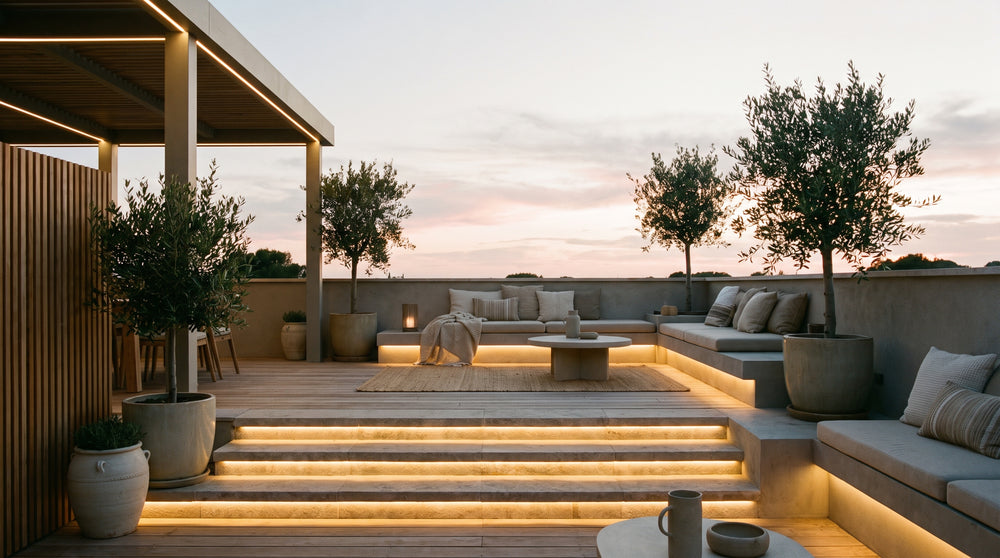
Raking light highlights the relief of a stone or wood wall without lighting up the sky. Usually placed thirty or forty centimetres under the awning, it lights the path and lets the eye adapt: you see where you are walking, you do not get the source in your eyes. It is the simplest way to give relief to an entrance without multiplying wall lights.
Which IP rating to choose for an outdoor waterproof LED strip light?
The IP rating is read in two digits: the first concerns solids, the second water. Outdoors, an IP65 covers dust and water jets, which suits a facade or a garage. An IP44 is enough under a sheltered awning, while IP67 concerns areas with puddles.
The IP rating says nothing about light quality or tint: these are two separate criteria, to be decided one after the other. A perfectly waterproof strip light can very well give cold white light, which is not always wanted on a terrace. See the references rated IP65 for exposed installations.
| IP rating | What it protects against | Where to install it |
|---|---|---|
| IP44 | Solid bodies over 1 mm and water splashes | Under a sheltered awning, on the edge of a damp room |
| IP54 | Limited amounts of dust and water splashes | Open shelter, lightly exposed technical room |
| IP65 | Total dust and water jets | Facade, terrace, garage, jet cleaning |
| IP67 | Temporary immersion | Area subject to puddles or run-off |
Where to place an outdoor waterproof LED strip light?
Under an awning, along a facade, above a garage door or in a technical room: the waterproof strip light is useful wherever you need to see clearly without multiplying light points. It is mounted on the surface, at access height for maintenance, and away from walkways to avoid glare.
Outdoor waterproof LED strip lights: where to place them without mistakes?
Generally allow one metre eighty to two metres twenty under an awning, higher in a garage or workshop so you do not hit the profile with a ladder or a load. Avoid placing it directly in line with a glazed door: the source reflects in the evening. To light a garage, place it on the ceiling, parallel to the direction the vehicle enters.
Under an awning, on a facade or in a technical room: three different situations
Under an awning, the rain does not reach the strip light: an IP44 holds. On an exposed facade, the wind drives water onto the profile and IP65 becomes the baseline, with the cable entering from below so water does not follow the sheath. In a technical room, dust is the deciding factor, and a closed profile can be wiped clean in one go. For a workstation, see workshop lighting.
Waterproof LED strip light or cuttable LED tape: which to choose?
The rigid strip light screws on as it is and connects directly, which makes it simple on a wall or a garage ceiling. Cuttable LED tape adapts to curves and precise lengths, but requires a support, a profile and a suitable power supply. Outdoors, the closed strip light remains easier to make waterproof.
Cuttable LED tape: how does it work?
A tape has cut marks every few modules: you cut at that precise point, then reconnect the end to the power supply. Cutting between two marks breaks the circuit and leaves a portion unlit. Outdoors, the cut must be closed with a waterproof end cap, otherwise moisture gets into the tape and makes it flicker. Tape suits curves and corners, not long straight runs.
When the rigid strip light remains simpler
On a straight line of several metres, the aluminium profile screws onto the planned centres and wipes clean without detaching anything. No support to build, no extra power supply to house. It is the choice for facades, garage ceilings and dusty rooms. Browse outdoor LED strip lights and all LED strip lights to compare formats.
How to install and wire a 220V LED strip light outdoors?
A 220V strip light connects to the mains in a junction box, with the cable entering through a cable gland. Switch off the power, identify live and neutral, fix the profile to the planned centres, then close the diffuser. 12V models go through a transformer placed away from water.
220V supply or 12V transformer: what to check before drilling
The voltage is indicated on the product: it is what decides the installation, not the other way round. In 220V, you need a nearby mains supply and an accessible junction box. In 12V, the transformer must be housed in a dry area, a garage or a closed box, never under the awning. The models powered at 220V avoid this extra box.
Cable gland, fixing and mounting direction
Drill at the profile's centres, not at random: a single misplaced hole goes through the housing. Pass the cable through the cable gland, tighten without forcing, then close the diffuser until it clicks. Point the strip light downwards or towards the wall, never towards the eye. On stone or concrete, use suitable wall plugs. For an area without a power supply, look at the rechargeable models.
Which colour temperature to choose for an outdoor LED strip light?
It all depends on the use: a warm white, around 2700 to 3000 K, warms a stone facade or a terrace, while a neutral white around 4000 K gives clear light for a garage or a workshop. Cold white remains reserved for walkways that you want to see plainly.
| Tint | Rendering | Recommended outdoor use |
|---|---|---|
| Warm white, 2700 to 3000 K | Golden light, close to a halogen | Stone or wood facade, terrace, desire for ambience |
| Neutral white, around 4000 K | White, clear light | Garage, workshop, technical room, service entrance |
| Cold white, 6000 to 6500 K | Bluish, highly contrasted light | Walkway to be lit plainly, little ambience |
In terms of glare, an opal diffuser and a downward orientation change more than a change of tint. For a damp room in the house, also see our bathroom strip lights.
Is an LED strip light with motion sensor useful outdoors?
Yes, for an entrance, a courtyard or a rarely used passage: the light only comes on with movement and then goes out, which avoids lighting an empty area all night. You need to check the range, the detection angle and be able to adjust the delay.
Two settings decide comfort: the switch-off time, which you want neither too short nor endless, and the sensitivity, to be lowered if a shrub triggers the light at the slightest gust of wind. Point the sensor towards the walkway, not towards the street.Compare the motion sensor versions and the 220V motion sensor models, which connect without a transformer.
How to maintain and make a waterproof LED strip light last?
A soft cloth and a non-abrasive product are enough on the diffuser; avoid high-pressure jets on the seals and check once a year that the cable glands are tight. An aluminium profile dissipates heat better than plastic, which helps the LEDs keep their brightness.
A gasket that turns white or a diffuser that takes on water are quickly spotted: a trace of condensation inside signals moisture ingress, to be dealt with before the circuit oxidises. Tighten the cable gland, replace the gasket if needed. On the control side, our lighting universe groups the profiles and accessories, and the waterproof strip light section remains the starting point for a facade.
Take the time to check the voltage and IP rating before drilling, the rest follows.
Frequently asked questions about outdoor waterproof LED strip lights
Cuttable LED tape: how does it work?
A tape has cut marks every few modules: you cut at that precise point with scissors, then reconnect the end to the power supply. Cutting elsewhere breaks the circuit and leaves a portion unlit. Outdoors, the cut must be closed with a waterproof end cap, otherwise moisture gets into the tape.
What is the difference between an IP65 LED strip light and an IP44 strip light?
IP44 protects against solid bodies over one millimetre and water splashes: it is a good level for a sheltered awning. IP65 completely stops dust and withstands water jets, which suits an exposed facade or a garage cleaned with a jet. Outdoors without shelter, aim for IP65.
Can a waterproof LED strip light be installed in a bathroom?
Yes, provided the bathroom zones are respected. A waterproof strip light is placed outside direct shower splashes, in IP65 to be safe. It is mainly used as supplementary light above the mirror or the vanity top, and connects to the existing switch or a sensor.
How to fix an LED strip light to a facade?
First mark the mounting height and the axis of the support, then check the nature of the wall: wood or PVC screw on directly, stone and concrete require suitable wall plugs. Drill at the profile's centres, pass the cable through the cable gland, screw without over-tightening, then close the diffuser.
LED strip light with motion sensor: is it useful outside?
Yes, when the area does not deserve continuous lighting: entrance, courtyard, side passage. The sensor turns the strip light on with movement and off after an adjustable delay. Check the range and detection angle, and avoid pointing the sensor towards a road or a tree that moves in the wind.




