
Outdoor LED strips for patio
This selection is also available in our French store: Rubans LED d exterieur pour terrasse
No products in this selection.
- Tracked delivery to your country Tracked delivery
- Secure payment at checkout Multiple payment methods
- 14 days to change your mind 14-day returns
- Secure payment Secure payment
Not sure of your style? Find it in 30 seconds
A few questions, and we will show you the pieces made for you.
Frequently asked questions
How do I choose the right product?
What are the delivery times?
Can I return an item?
Can I pay in instalments?
An interior that reflects who you are
Carefully selected pieces, shipped from our warehouses. Our team advises you before you buy, so you choose with confidence.
- Tracked delivery
- Pay in instalments, where available
- 14 days to change your mind
- Advice & showroom in Lyon, France
First assess how exposed the area is: under a covered pergola, a strip protected against splashes is enough; on a low wall or an open staircase, you need a strip sealed against water jets and waterproof connectors. Next come the supply voltage and the shade of white, which decide how it will look once night falls.
Which outdoor LED strip should you choose for a terrace?
Three criteria decide it: how exposed the area is, because a strip under a covered pergola and a strip in an open, windy spot do not need the same ingress protection rating; the supply voltage, with a 12V or 24V transformer or a direct 220V connection; and the light effect you want. The rest (strip width, connector type, mounting accessories) falls into place once those three points are settled.
Outdoor LED strips for decking: 12V, 24V or 220V?
Low voltage requires a transformer, housed somewhere dry and ventilated, but it makes installation near a pond simpler and stays safe to touch. 220V removes the box and connects to the mains with a waterproof connector. Compare the 24V low-voltage LED strips and the 220V LED strips without a transformer depending on the space available near the terrace.
Which IP rating for a covered or exposed terrace?
Under a canopy, a strip protected against splashes is up to the job. On a low wall, a railing or a staircase that takes rain head-on, you need a strip sealed against water jets, and above all connectors treated the same way: it is often the connector that fails before the strip. The waterproof outdoor LED strips range gathers these models.
Which light colour for a terrace in the evening?
A warm white between 2700K and 3000K keeps the terrace welcoming and flatters both wood and stone; beyond that, the light hardens faces. RGB lets you change the mood to suit the occasion, and RGBW adds a clean white on top of the colours.
Warm white 2700K or 3000K for dinner outside?
2700K is closer to a living-room lamp and suits coffee tables, wooden decks and seating corners. 3000K, a little crisper, lights a summer-kitchen worktop or a path better. See the 2700K LED strips for soft light and the 3000K warm white LED strips.
When should you choose an RGB LED strip rather than RGBW?
The colour-changing RGB LED strip is enough to liven up a party or highlight a low wall without daily use. The RGBW strip with adjustable white keeps a clean white for everyday meals and switches to colour for special occasions: it is the most versatile choice when you do not want two installations.
| Temperature | Mood | Where to use it |
|---|---|---|
| 2700K | Very warm white, close to a lamp | Table, garden seating, wooden deck |
| 3000K | Warm but crisper | Pergola, low wall, summer kitchen |
| RGB | Colour-changing | Party, seasonal decorating |
| RGBW | Colours and clean white | Mixed everyday use |
Outdoor LED strips for a wooden deck: how do you fix them?
On decking boards, the strip goes on the edge of a board, under a joist or in a groove, never on the surface you walk on. You need a clean, dry surface, a base that moves little and an aluminium channel as soon as the strip stays exposed.
Can you stick an LED strip directly onto a decking board?
Adhesive alone holds poorly: composite boards and wood alike swell and contract with moisture, and terrace dust reduces grip. A channel or clips take the strain and leave the option of removing the strip. Browse the cut-to-length light strips to match the length to the actual run.
How do you run the strip from one board to the next without breaking it?
Cut at the marked points, close the cut with a waterproof end cap, then continue around the corner with a connector designed for outdoor use. Board-to-board jumps are handled with short linked sections, not by folding the strip: a fold marks the circuit and the section eventually goes out.
Outdoor LED strips for decking in a channel: how is it different from an adhesive strip?
A channel means the strip housed in an aluminium profile with a diffuser: the light comes out softened, with no visible dots and no glare, and the profile protects the strip from rain and sun. A bare adhesive strip is quicker to fit but remains more fragile outdoors.
Channel light or bare strip: which glares less?
The channel's diffuser breaks up the light points and turns the strip into a continuous line. That is clear when the strip runs at eye level, along a railing or a pergola. A bare strip at eye height shows every LED and becomes unpleasant as soon as you sit next to it.
Which profile for a terrace exposed to rain?
A closed profile, with a diffuser clipped along its full length and end caps, prevents water from collecting. The aluminium profile also adds rigidity over a long span. The models in the weather-resistant channel strips selection are designed for this kind of installation.
Where should you install an LED strip on a terrace, a low wall or a pergola?
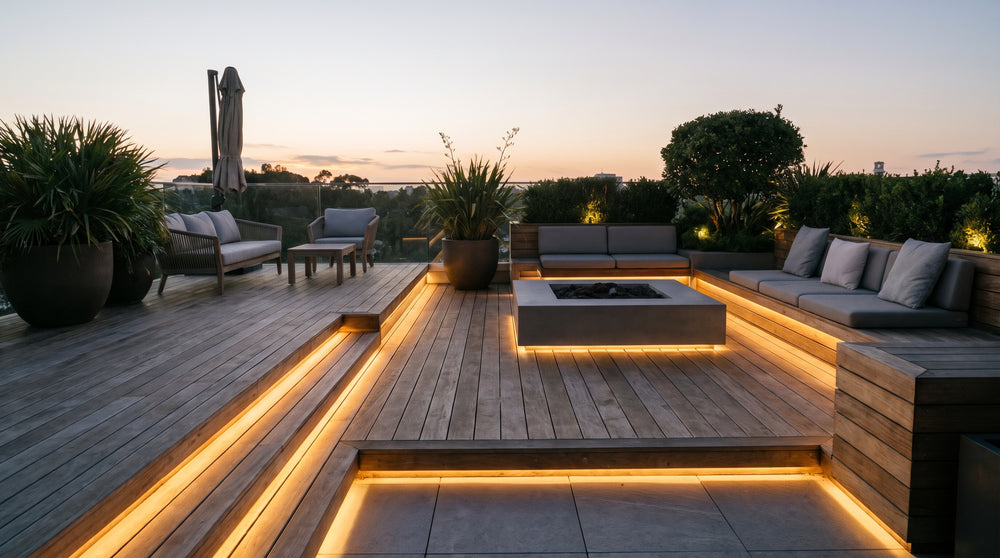
The positions that work: under the handrail of a railing, along the top of a low wall, in the beams of a pergola, along a staircase or behind a planter. You light a surface or a walkway, never the eyes of the people sitting there.
Under a railing or on top of a low wall?
Under the handrail, the light falls on the ground and outlines the edge of the terrace without glare. On top of a low wall, it underlines the line and gently lights the walkway behind. In both cases, aim the beam downwards or towards the surface, never towards the area where people sit.
Pergola and conservatory: where should the strip go to light the table?
In the beams or on the crossbars, at a good distance from the tablecloth, indirect light illuminates the table without reflecting in the glasses. Around a pool area, keep the strip out of reach of splashes and look at the lighting for the pool and its surround. For the staircase, aim for grazing light on the step.
| Area | Exposure | Protection | Power supply |
|---|---|---|---|
| Under a covered pergola | Indirect rain | Protected against splashes | 12V or 24V |
| Low wall and railing | Rain and wind | Sealed against water jets | 220V or 24V |
| Wooden decking boards | Ground moisture | Waterproof, on board edge | 24V |
| Outdoor staircase | Direct rain | Waterproof, waterproof connectors | 24V |
| Pool surround | Splashes | Waterproof, closed profile | 24V |
How do you power and secure an LED strip outdoors?
A 12V or 24V strip needs a transformer placed under cover, and the length of a single strip is limited to what that transformer accepts, otherwise the end of the strip loses brightness. A 220V strip connects directly to the mains, with a waterproof connector.
Where do you hide the transformer when there is no utility room?
It goes in a ventilated waterproof box, under the terrace if access remains possible, in an adjoining garage or behind a hatch in a low wall. Heat has to escape: a sealed box with no ventilation shortens the life of the unit. 220V avoids this box and brings the connection as close as possible to the strip.
Why does the end of a long LED strip lose intensity?
The longer the strip, the more the voltage drops at the end of the run: the start stays bright, the end looks dull. The solution is several separately powered sections rather than one long length. 24V copes with distance better than 12V. Check the stated maximum length with the direct mains power supply or the low-voltage unit.
How do you match the terrace LED strip with the decor of a kitchen open to the outside?
When the kitchen looks out onto the terrace, keep the same colour temperature on both sides of the patio door: 2700K inside, 2700K or 3000K outside. The strip then highlights the continuity between the modern kitchen decor and the garden seating, with no break in tone.
Should the kitchen and the terrace have the same light colour?
Yes, and it is the most noticeable thing once the patio door is open: two different whites create a sharp boundary on the floor. Choose the room's shade as your reference and align the outside with it. The 3000K warm white LED strips remain a good compromise between the two areas.
Which strip for a summer kitchen or an outdoor worktop?
On a worktop, you need to see what you are cutting: a slightly crisper white, in a channel with a diffuser, fitted under the upper shelf. The kitchen decor continues outside through the same low lines and the same shade. Browse all our light fittings to match the rest of the terrace.
How do you look after an outdoor LED strip so it lasts several seasons?
Dust the profile and diffuser with clean water, check the seals and connectors before winter, and switch off the power before any handling. A strip that flickers or has a section that stays off points to a damp connector or a poorly closed cut.
How do you clean a channel strip without drowning the connectors?
A damp cloth on the diffuser, never a direct jet on the connections. End caps and joints are checked at the same time, especially after a rainy season. Remove leaves and dust that collect in the groove of the profile: they hold moisture against the strip, as the waterproof outdoor LED strips selection reminds you.
What should you do if part of the strip no longer lights up?
Switch off the power, then inspect the connector and the cut nearest the unlit area first: that is almost always where the contact has taken on water. A dead section can be replaced without redoing the whole run. If several sections fail together, look at the transformer or the start of the run.
Choosing a light fitting for the terrace: the rest of the decor
The strip provides the line, the other fittings do the rest: a floor lamp near the garden seating, a wall light on the house wall, two bollards along the path. The light fitting catalogue for home and garden lets you match these sources, and a guide to choosing a light fitting room by room helps keep the same family of light inside and out.
Check the connectors before winter: a simple check avoids bad contacts on a terrace.
For the number of metres, the FAQ covers measuring the run and choosing the voltage.
Frequently asked questions
Does an outdoor LED strip withstand rain?
It all depends on the strip's ingress protection rating and how it is installed. Under a covered pergola, a strip protected against splashes is enough; on an exposed low wall or staircase, you need a strip sealed against water jets and waterproof connectors, otherwise moisture reaches the contacts.
Which light colour for a living room or a terrace in the evening?
A warm white around 2700K to 3000K remains the most comfortable in the evening, indoors and out: it does not harden faces and keeps wood warm. RGB and RGBW versions are for when you want to vary the mood from one evening to the next.
How do you install an outdoor LED strip for decking without it coming unstuck?
Clean and dry the board, avoid the walking surface, and prefer a channel or clips over adhesive alone: wood swells and contracts, which lifts a glued strip. Housed in a channel, the strip can be removed and replaced.
How many metres of LED strip should you allow for a terrace?
Measure the run to be lit, add an allowance for corners and returns, then check what the transformer accepts on a single length. Several separately powered sections are better than one strip that is too long and fades at the end.
Do you need a transformer for an outdoor LED strip?
Only 220V strips connect directly to the mains; 12V and 24V strips need a transformer, to be placed somewhere dry and ventilated. The transformer's power rating must cover the total length of strip connected to it.




