
Metal floor lamps
This selection is also available in our French store: Lampes à poser sur pied en métal
No products in this selection.
- Tracked delivery to your country Tracked delivery
- Secure payment at checkout Multiple payment methods
- 14 days to change your mind 14-day returns
- Secure payment Secure payment
Not sure of your style? Find it in 30 seconds
A few questions, and we will show you the pieces made for you.
Frequently asked questions
How do I choose the right product?
What are the delivery times?
Can I return an item?
Can I pay in instalments?
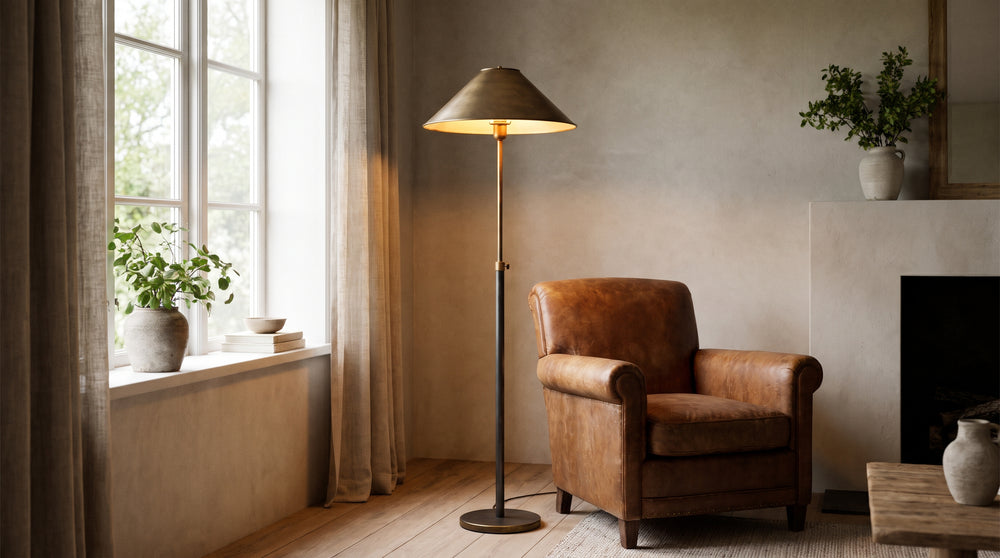
An interior that reflects who you are
Carefully selected pieces, shipped from our warehouses. Our team advises you before you buy, so you choose with confidence.
- Tracked delivery
- Pay in instalments, where available
- 14 days to change your mind
- Advice & showroom in Lyon, France
Plan on one metal floor lamp per reading zone: near the sofa, beside an armchair, or against a free wall in an office. The steel or iron stem holds the shade at seat height, the light comes from the shoulder and moves with one hand when the room changes use.
What is a metal floor lamp?
A metal floor lamp is an accent light whose stem and often base are in steel or iron, standing on the floor on a stable foot. It gives ambient or reading light at seat height and moves easily from one corner of the room to another.
Metal floor lamp, a light that moves
It differs from a pendant or ceiling light by its mobility: no drilling, no ceiling connection, just a cable and a plug. You slide it behind the sofa for reading, bring it closer to the armchair when guests arrive, push it against the wall when the room opens up. The metal foot, slim but weighted, keeps the whole upright without taking up floor space like a piece of furniture.
Metal floor lamps: what the socket type changes
The socket decides the bulb, and therefore the result. An E27 socket takes the most common bulbs and lets you choose between wide light and a narrow beam, an E14 socket settles for smaller formats. An LED bulb designed for 230 V mains screws in directly, with no transformer. The switch on the cable or on the stem only changes the gesture, not the light. Browse all the Designix lights and the design floor lamps for living rooms to get a sense of the formats.
Which floor lamp for a living room and where to place it?
In a living room, the floor lamp goes in the corner of the sofa, next to a reading armchair or against a free wall, never in the middle of a walkway. The shade drops to shoulder height of a seated person to light without glare, and the base stays heavy enough not to tip over.
Living room floor lamp: light comes from the shoulder, not the ceiling
A shade placed higher than the eye casts its light downwards and leaves the inside of the shade visible: the eye receives the bulb head-on. Lowered to the shoulder height of a seated person, it lights the book or the cup without glare. This is the point to check before any purchase, more than the shape of the foot.
Living room floor lamp: the positions that work
The corner of the sofa, between the seat and the wall, serves reading without crossing the room. Behind an armchair, the lamp creates a halo that lifts the furniture off the wall. Against a bookcase, it lights the spines of the books. The modern living room lamps and the black living room floor lamps suit these three positions.
Floor lamp or tall floor lamp: what is the difference?
Both stand on the floor. The floor lamp, lower, lights a nearby zone and moves with one hand; the tall floor lamp rises above the furniture and serves more as general lighting. The metal foot and base provide stability in both cases.
Steel floor lamps, the accent format
The short stem keeps the shade below the eye level of a standing person and at the shoulder height of a seated one. The result: a local pool of light, a readable book, an armchair lifted off the wall, without lighting the whole room. This is the format of the home lights designed for accent lighting.
Tall floor lamp: when height does the work
A tall stem places the source above low furniture and spreads over a wider zone, like a general halo. It sometimes replaces a pendant in a room where you do not want to drill the ceiling. Choose it when the light must cover a space, not light a single person.
How to choose height and format depending on the room?
Think in terms of light height: at shoulder height for a seated person in a living room, above the worktop for an office, below eye level for ambient light. The diameter of the base and the clearance left around the foot matter as much as the height of the stem.
Height is measured at the light point, not at the end of the foot
Two lamps of the same total height do not give the same light if the shade is placed differently on the stem. Look at where the light comes out: upwards for ambience, downwards for reading. For a desk, the source must fall on the worktop without casting the shadow of the hand on the page. The metal desk lamps answer this case.
Footprint: the base matters as much as the stem
A wide base stands straight on a wooden floor and supports a slim stem; a narrow base slips between a piece of furniture and a wall but tips at the slightest knock. Allow for the space of the foot, the walkway and the cable path. For a bedroom, a short stem near the bed is better than a large model. See the black models designed for the bedside.
| Room or use | Target light height | Foot and base | Expected result |
|---|---|---|---|
| Living room, reading corner | At shoulder level, seated person | Wide, heavy base, slim stem | Light directed at the book, warm halo |
| Living room, corner behind the sofa | Lower than the sofa seat | Discreet foot, flat base | Glow without glare |
| Office | Above the worktop, no shadow on the hand | Stable foot, adjustable arm or joint | Clean light, no reflection on the screen |
| Bedroom, high bedside | Just above the mattress | Short stem, narrow base | Soft light for reading in bed |
| Hallway, dark corner | Diffuse, no fixed point | Slim foot, small footprint | Luminous presence and decorative object |
Which metal and which colour for which interior?
The colour of the metal decides the presence of the lamp: matte black absorbs light and draws a silhouette, brushed steel reflects it without tinting it, gold warms it, white fades away. Choose according to the contrast already present in the room, not according to fashion.
Black metal floor lamp: what black changes in the room
A matte black stem reads as a line: it structures a corner, stands out against a light wall and disappears against a dark background. It absorbs light instead of reflecting it, so the shade works alone. On a dark wooden floor, check that the foot stays visible to avoid stubbing your foot in the dark.
Gold and black finishes, playing with contrast
Gold reflects a warm light and changes appearance depending on the angle, which is enough to warm up a white or grey interior. Gold on black creates a sharp contrast, legible whether on or off. Painted white diffuses more and fades into a light wall: the choice of a calm interior. Comparing the gold and black finishes helps you decide, as do the white design models or a more understated Nordic style.
| Finish | Light rendering | Style | Care |
|---|---|---|---|
| Brushed steel | Reflects light without colouring it | Contemporary, workshop | Soft cloth, no abrasive |
| Matte black metal | Absorbs light, sharp silhouette | Industrial, graphic | Damp cloth, dry immediately |
| Gold or brass | Warms the light, reflections depending on the angle | Refined, Italian | Avoid standing water and acidic products |
| Painted white | Diffuses more, fades into the wall | Nordic, minimal | Soft cloth, avoid knocks |
How to connect several lamps to a single electrical outlet?
Group the lamps on a power strip or a socket block, checking that the total wattage of the bulbs stays below what the line allows, and avoid stacked extension leads behind a piece of furniture. If other devices are already on the circuit, an additional socket remains the safest solution.
LED connection on 220 V: socket, cap, maximum wattage
An LED bulb with an E27 or E14 cap designed for 230 V screws in directly, with no transformer. Three checks before buying: the voltage on the packaging, the cap type, and the maximum wattage indicated on the socket or near the stem. A low-wattage LED often replaces a more power-hungry filament bulb, but never exceed the value engraved on the socket. The design LED lamps and the adjustable lamps are the simplest to fit this way.
Several lamps on one socket: power strip or additional socket
A power strip with a switch is enough for two or three low-wattage accent lamps. Count the total of the bulbs, not the number of sockets. If the circuit already powers a heater or a kitchen appliance, have a dedicated socket added: a lamp that trips the breaker in the evening is never a good sign.
How to match a floor lamp with the other lights in the room?
Layer three levels: general ceiling lighting, spotlights directed at the use zones, then the metal floor lamp as an accent near the armchair. The lamp is judged when switched on: it is its halo and the material of the shade that decide the mood, not its shape when off.
How to arrange ceiling spotlights
Align the spotlights on the use zones rather than scattering them at random, keeping them away from the wall to avoid too marked a cone. Avoid pointing them at a sofa or a screen. In general, a warm light around 2700 to 3000 K suits the evening, a more neutral one around 4000 K suits an office. The ceramic feet and the design wood versions pair well with this type of soft lighting.
Italian design floor lamp: the piece that stays discreet
What distinguishes an Italian line is the simplicity of the volumes and the accuracy of the proportions: slim stem, geometric shade, single colour, often black, white or gold. It does not seek to dominate the room. In an office, this discretion is found in the contemporary desk lamps.
How to install and maintain a metal floor lamp?
Assemble the lamp on a flat surface, run the cable along the wall or under the sofa, and check that the base does not stick out into the walkway. For care, a soft cloth is enough on the metal; avoid standing water and abrasive products on gold finishes.
Setting up the foot: stability and cable routing
Screw the stem down to the stop, without forcing the fine threads. Place the base flat, test stability by gently pushing the top of the stem. Run the cable behind the furniture rather than across the room, and leave a little slack at the plug to avoid tension. In a bedroom, the lamps that find their place in a bedroom are often placed near the headboard, cable along the wall.
Cleaning a metal stem without damaging the finish
A slightly damp microfibre cloth removes fingerprints on steel and matte black; dry immediately to avoid limescale marks. On gold, avoid acidic products and water that stagnates in the recesses. A bulb is replaced with the power off, when cold. For any doubt about a finish or a spare part, Designix customer service answers before disassembly.
Secure payment, tracked delivery, returns and Designix customer service: you order, you install, you change your mind if the light does not fall as planned. For a workstation, also compare LED desk lighting before making your choice, then browse the available lights.
Frequently asked questions
What are the most beautiful living room lamps?
There is no ranking: a beautiful living room lamp is one whose foot, shade and colour match the rest of the room and whose light falls where it is needed. A slim metal stem and a matte shade ride out trends more easily than a very marked shape.
What is an Italian design floor lamp?
It is a lamp whose line favours simple volumes and accurate proportions: slim metal stem, geometric shade, single colour, often black, white or gold. It is recognised by its restraint and its attention to detail, base, ring, switch. It fits into a contemporary living room without dominating it.
What should be checked for an LED connection on 220 V?
An LED bulb with an E27 or E14 socket designed for 230 V mains screws directly into the lamp socket, with no transformer. Check the voltage indicated on the packaging, the maximum wattage tolerated by the socket and the cap type before buying.
Which floor lamp to choose for a living room?
First choose the use: reading near the sofa, ambience in a corner, or light for an office. The foot must be heavy enough not to tip over, the shade must drop to shoulder height when seated, and the metal must stay discreet in the room. The colour changes the mood a great deal.
What is the difference between a floor lamp and a tall floor lamp?
Both stand on the floor. The floor lamp is an accent light, of medium height, whose shade lights a nearby zone; the tall floor lamp rises higher and often serves as general lighting. In both cases, the metal foot and base provide stability.




