
LED hallway lighting
This selection is also available in our French store: Luminaires LED pour couloir
No products in this selection.
- Tracked delivery to your country Tracked delivery
- Secure payment at checkout Multiple payment methods
- 14 days to change your mind 14-day returns
- Secure payment Secure payment
Not sure of your style? Find it in 30 seconds
A few questions, and we will show you the pieces made for you.
Frequently asked questions
How do I choose the right product?
What are the delivery times?
Can I return an item?
Can I pay in instalments?
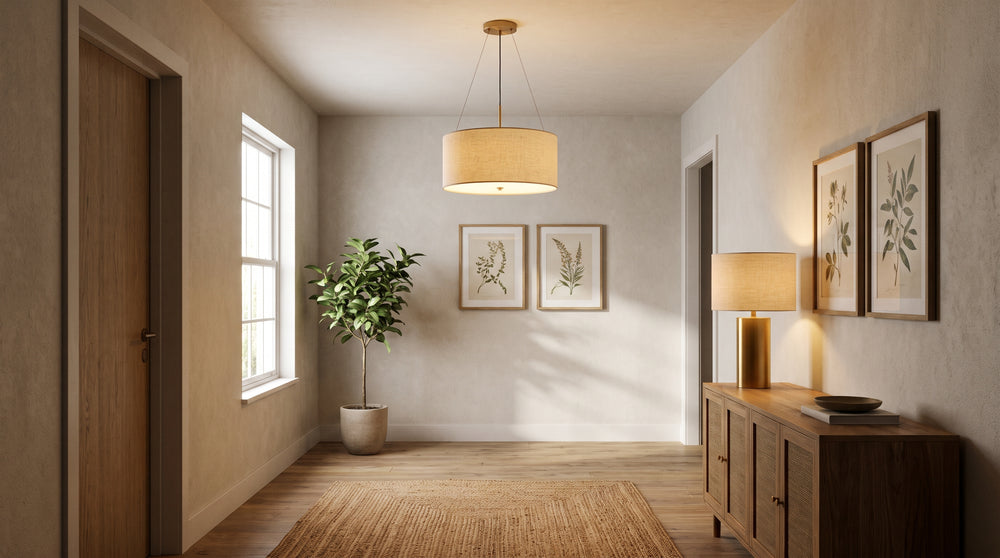
An interior that reflects who you are
Carefully selected pieces, shipped from our warehouses. Our team advises you before you buy, so you choose with confidence.
- Tracked delivery
- Pay in instalments, where available
- 14 days to change your mind
- Advice & showroom in Lyon, France
Start with a central ceiling light, complemented by two wall lights set in a staggered arrangement: that is the basis of a well-lit LED hallway. A flush ceiling light is enough in a short passage, while aligned spotlights or wall washing take over in a long hallway, and a pendant hangs low in a hall with a high ceiling.
- Lighting ideas for a hallway
- Which type of light to choose
- Lighting a dark hallway
- Ceiling light, wall light or chandelier
- Height and dimensions
- Matching the hallway to living rooms
- Checks before buying
- Where to find these lights
What are the LED lighting ideas for a hallway?
A hallway is lit with a central light point complemented by wall sources: a ceiling light or recessed spotlights overhead, staggered wall lights on the sides, a pendant or chandelier if the ceiling is high. Several weak points rather than one single strong source prevent shadow zones in a long, narrow passage.
LED ceiling light for a hallway
Place it at the centre of the passage: it lights the full width and leaves the floor clear. Models with several light points suit hallways of good length, each source covering a portion of the route. When ceiling height is limited, recessed ceiling spotlights give the same result on the surface, with no protrusion into the walkway.
LED light for a hallway: one central point or several?
A single point strongly marks the centre and leaves the ends in half-light. Two or three softer sources distribute the light better: a ceiling light in the middle, a wall light near each door, extra lighting at the end of the hallway. A motion sensor or dimmer avoids lighting the whole passage for a few seconds. For fittings with no bulb to change, the LED lighting range gathers models with integrated LED.
Which type of light for a hallway?
The ceiling light remains the most common choice: placed at the centre, it lights the full width of the passage without cluttering it. If the hallway is long, aligned spotlights or wall lights are preferred, as they spread the light and avoid a single point that is too harsh in the middle.
LED lamp for a hallway: wall light or spotlight?
The wall light is fitted on the side walls and washes the surface: it accompanies your step without sending light into your eyes. The recessed spotlight, on the other hand, directs its beam downwards from the ceiling and suits narrow passages, where you want output without anything protruding. A wide hallway accepts both, a one-metre-wide hallway prefers recessed.
LED chandelier for a hallway: good idea or not?
In a wide hallway with a high ceiling, yes: a chandelier or pendant held at the centre becomes the main point and brings the light down to the floor. In a narrow passage, it gets in the way and loses light to the sides. Pendants and chandeliers for high ceilings are therefore reserved for halls and open entrances.
| Hallway configuration | Recommended light | Where to place it | Desired effect |
|---|---|---|---|
| Short hallway with no window | Flush ceiling light or recessed spotlight | At the centre of the ceiling | Even light with no dark zone |
| Long, narrow hallway | Staggered wall lights, complemented by a ceiling light | At shoulder height, on both sides | Accompany your step without glare |
| Entrance hall with a high ceiling | Pendant or chandelier | On the axis, at the centre of the hall | Fill the volume and bring light down |
| Entrance with a low ceiling | Flush or recessed ceiling light | At the centre, on the surface or recessed | No clutter, clear passage |
| Hallway leading to a wet room | Light with a suitable ingress protection rating | On the ceiling, away from splashes | An installation that does not fear damp |
| Hallway with a window | Ceiling light or additional wall light | On the side opposite the window | Light the area daylight does not reach |
How to light a dark hallway with no window?
In a hallway with no window, multiply the sources rather than increasing the power of a single fitting: a ceiling light at the centre, wall lights on the side walls, and possibly a point near each door. Light-coloured walls and a regular white light reduce the feeling of being enclosed.
Lights for a dark hallway: what to add?
First add wall sources: two wall lights are enough to break up a hallway that was lit only by a central point. Then pay attention to wall colour, as a white or light beige reflects far more light than a dark tone. A motion sensor completes the setup: the light comes on when you enter the passage and turns itself off, which avoids leaving the hallway lit permanently.
How to avoid shadow zones in a long hallway?
Align the light points on the axis of the passage and space them regularly, without leaving more gap at one end than the other. Then look ahead of you, at walking height: if you see the bulb directly, the source is badly oriented. A model diffusing upwards and downwards lights without glare, and the light remains useful for our entire lighting range placed in a row.
Ceiling light, wall light or chandelier: which to choose for a hallway?
The ceiling light suits hallways, halls and toilets, the wall light suits long passages and staircases, the recessed spotlight suits low ceilings, and the chandelier suits halls with high ceilings. The right choice depends above all on the width of the passage, the available height and the natural light already present.
Powerful LED ceiling light: for which hallway?
A generous ceiling light is justified in a long, dark hallway with no window, where a single source must cover several metres. In a small, bright, short hallway, it instead creates too marked a point. The same reasoning applies to lighting for toilets and small spaces, where a compact, clear model is more than enough.
Powerful LED wall light: where to place it?
At shoulder height, staggered on either side of the passage, never face to face: two aligned sources bounce light off each other and create an alternation of shadow and brightness. A wall light that diffuses upwards and downwards draws two sheets of light on the wall, which visually enlarges a narrow hallway. For a generously sized hall, a more elaborate piece for a hall is a better replacement for two wall lights.
How to choose the height and dimensions of the light?
First measure the ceiling height and the width of the passage. A ceiling light or a recessed model stays flat so as not to hinder movement; a pendant hangs low in a tall hall, keeping enough clearance at floor level to walk underneath without bumping into it. A large chandelier requires an open volume.
LED ceiling light for an entrance hall: what size?
A ceiling light is chosen according to the width of the hall, not its total surface area: allow roughly one third of the room width for the diameter of the light, in general. In a narrow entrance, a flat model of moderate size lights better than a large diffuser that comes down to forehead level.
Large chandelier for a high ceiling: how to hang it?
Shorten the cable so that the bottom of the light stays at a good distance from the floor, high enough to walk underneath without touching it: that rule takes priority over aesthetics. Hang it on the axis of the hallway or at the centre of the hall, never in the walkway. A black pendant above the passage marks the axis without overloading the room, and a floor lamp for the corner of the hall completes the setup when the entrance is spacious.
How to match hallway lighting with the rest of the home?
As the hallway serves as a transition, it benefits from continuing the same family of light as the rooms it leads to: a discreet light that echoes the living room chandelier, the light colour chosen for the lounge or the palette of a modern kitchen decor. Unity comes from shape and finish more than from power.
Should the same light colour be used everywhere?
A similar temperature from one room to the next avoids the feeling of jumping between moods as you go through a door. In practice, a neutral white around 3000 to 4000 kelvins suits a hallway and blends well with a lounge in warmer light. If you have used the same light colour in the living room with a modern living room light, stay in the same family in the hallway.
Which finishes work in a hallway?
Sober finishes stand the test of time: black metal, matt white, natural wood. A narrow passage copes badly with very shiny materials, which reflect the light sources. A black wood light works as well in an entrance as in an adjoining dining room, and you can continue the same family as a modern dining room light to link the two spaces.
What should you check before buying a hallway light?
Before buying, check the dimensions against the width of the hallway, the type of socket or integrated LED, the ingress protection rating if the passage leads to a wet room, the material and finish, and compatibility with an existing dimmer or motion sensor.
| Criterion | What to look at | Why it matters |
|---|---|---|
| Dimensions | Width, height and depth | A light that is too wide clutters a narrow passage |
| Socket and bulb | Type of socket or integrated LED | Determines whether the bulb can be replaced |
| Ingress protection rating | IP marking of the light | Useful near a wet room or a damp area |
| Material and finish | Wood, metal, glass, colour | Must match the style of the hallway |
| Number of light points | Single or multiple | A model with several points covers a long hallway |
| Control | Dimmer or sensor compatibility | Avoids changing the fitting after installation |
Socket or integrated LED: how to decide?
A classic socket lets you replace the bulb and choose its colour temperature. An integrated LED cannot be replaced: the light is kept as long as it works, which makes the choice final. In a hallway you do not want to reopen every two years, integrated is simple; in an entrance you want to be able to warm up or cool down, the socket remains more flexible. Models with a unique design exist in both formats.
Ingress protection rating: when to check it?
As soon as the hallway leads to a bathroom, a toilet or a utility room, the IP marking of the light matters. For a damp area, compare as needed with models protected against damp. Conversely, a dry, heated hallway imposes no particular constraint. One last thing: the furniture stripping recipes circulating online are for furniture, not lighting; a wooden light just needs a soft cloth.
Where to find LED hallway lights?
The selection can be browsed online, with secure payment, tracked delivery and Designix customer service; returns are provided if the model does not suit once installed. Many buyers look for a lighting shop in Lyon or a clearance sale: on Designix, the entire catalogue can be viewed from home.
How to choose without seeing the light in person?
Note the dimensions on the product page and mark them out on the floor with a tape measure: that is the step that avoids a nasty surprise. Then compare the protrusion height with the ceiling height, and check the type of socket. The same benchmarks apply to garage or outbuilding lighting, where clear light is the main requirement.
What happens if the model does not suit?
Returns are provided, and Designix customer service answers compatibility questions before ordering. If you hesitate between two families, start from the adjoining room: LED living room lighting often sets the tone, and modern kitchen decor or the complete lighting catalogue finish settling the finish. For a style question, keep in mind that these benchmarks work as well for designer living room lighting as for the hallway.
Frequently asked questions about LED hallway lights
Can an LED chandelier suit a hallway?
Yes, provided the hallway is wide enough and the ceiling high enough: placed at the centre, the chandelier becomes the main light point and diffuses downwards and to the sides. In a narrow passage, a flush ceiling light or wall lights are better, as they do not hinder movement.
What power for an LED hallway ceiling light?
It is chosen according to the surface area and wall colour: a narrow, bright hallway is fine with a low-power model, while a long, dark hallway with no window needs more output, often by multiplying the light points rather than oversizing a single fitting. A dimmer or sensor helps to adjust it.
Which LED wall light to choose for a dark hallway?
A wall light that diffuses upwards and downwards lights without glare and draws pools of light on the wall. Place it at shoulder height, staggered on either side of the passage, and favour a light finish or frosted glass to soften the result.
Can an LED bulb be used in a hallway light?
It depends on the light: those with a socket take an LED bulb of compatible cap, while models with integrated LED cannot be replaced. Check the type of socket on the product page and the maximum power accepted by the fitting before buying.
How to maintain a hallway light?
A soft, dry cloth is enough on wood, metal or glass, with no abrasive product: the stripping recipes circulating online concern furniture, not lighting. Also dust the diffuser, which loses its effect when it gets dirty.




