
LED floor lamps for living room
This selection is also available in our French store: Lampes à poser LED sur pied pour salon
No products in this selection.
- Tracked delivery to your country Tracked delivery
- Secure payment at checkout Multiple payment methods
- 14 days to change your mind 14-day returns
- Secure payment Secure payment
Not sure of your style? Find it in 30 seconds
A few questions, and we will show you the pieces made for you.
Frequently asked questions
What table size for how many people?
Which tabletop material should I choose?
Extendable or fixed?
How do I care for the tabletop?
The right furniture, in the right place
Check the dimensions with our fit checker and receive pieces made to last. Unsure? Our team will answer your questions.
- Tracked delivery
- Pay in instalments, where available
- 14 days to change your mind
- Advice & showroom in Lyon, France
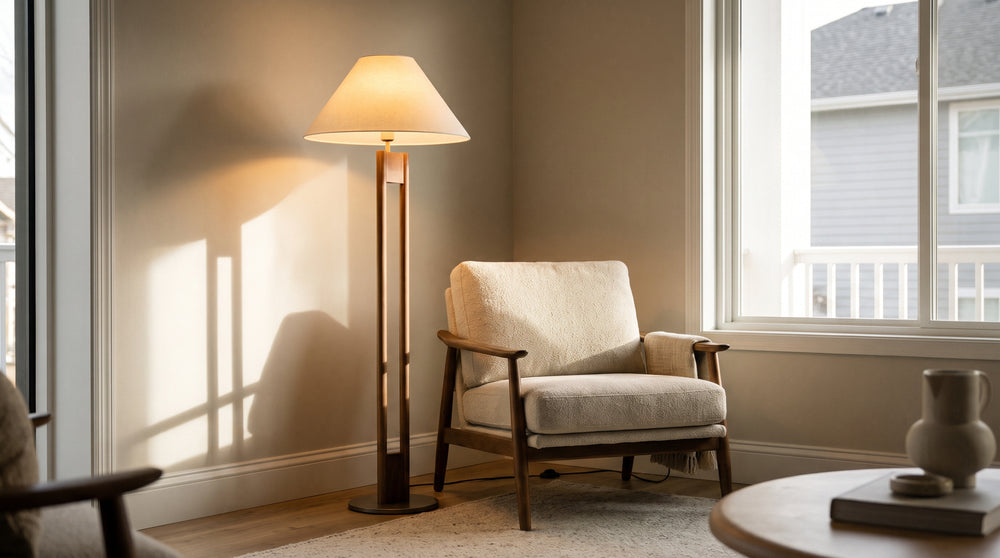
Plan on one low, movable light source per seating area: an LED floor table lamp near the sofa, another in the free corner of the living room. It lights knees, book and low wall, complements the ceiling light without replacing it, and moves when the room changes use.
What light does an LED floor table lamp bring to a living room?
An LED floor table lamp adds low-level accent light, illuminating seats and low walls rather than the centre of the room. It complements the ceiling light without replacing it: the result depends on how the shade diffuses light and on the colour temperature, warm or neutral.
Ambient or reading light: what the shade position changes
A low shade, at seated shoulder height, sends light down to the book and leaves the rest of the room in a soft half-light. A high shade, or a head turned towards the wall, instead gives a broad halo that lifts the paint and visually enlarges the corner. The same base can therefore serve as ambient light in the evening and as occasional reading light, provided the head or shade is adjustable. For regular reading, compare the adjustable reading lamps: the head moves, the shadow follows the page.
Warm white or neutral white: what it looks like in the evening in a living room
As a general guide, a warm white (around 2700 to 3000 K) gives an amber light suited to rest and the sofa corner; a neutral white (around 4000 K) renders colours more sharply and suits a workspace or a very dark through-living room better. The temperature is stated on the product sheet, for both an integrated LED and a screw-in bulb. It is best to stay within a single white family between the lamp and the room's other sources.
Where to place a floor lamp in a living room?
A floor lamp goes next to the sofa or an armchair, in a free corner or behind the seat, within reach of the switch. Leave a clear passage around the base and aim the light at the wall or the book rather than at the eyes.
Next to the sofa or in a corner: the positions that work
Along the sofa, on the side opposite the door, the lamp serves the reading spot without blocking the view of the television. In an empty corner, it fills the area without furniture and lights two walls at once. Behind the seat, it creates a grazing light that sets off the sofa's silhouette. A slim design slips more easily into a narrow corner, like the design table lamps for living room.
What height and footprint to plan so as not to obstruct the passage
The right height is the one that places the shade above a seated person's shoulder, never in their line of sight. Keep a clear walking corridor between the base and the sofa, and prefer a flat base that slides under the furniture over a wide tripod. Base height, base diameter and shade diameter are given on the product sheet: these three measurements decide the position, not the photo.
| Use in the living room | Type of light sought | Position | Point to check |
|---|---|---|---|
| Reading corner near the sofa | Light directed at the book | Next to the seat, head above the shoulder | Adjustable head and accessible switch |
| Corner ambience | Light diffused towards the wall | Free corner, behind the sofa | Shade that does not glare from the sofa |
| Living room open to the kitchen | Continuous light between the two zones | At the boundary of the two spaces | Same white family as the kitchen |
| Small living room | Low, discreet light | Near a coffee table or armchair | Floor footprint and clear passage |
| Large room | Complement to the ceiling light or spotlights | Near the conversation area | Base height and adjustability |
How to choose an LED floor table lamp for a living room?
First choose by use: reading, ambience or accent lighting. Then come the source, integrated LED or bulb in a socket, the presence of a dimmer or foot switch, the stability of the base, the height of the base and the adjustability of the head.
Integrated LED or bulb in a socket: what it changes in use
An integrated LED source cannot be replaced: the lamp is thrown away or repaired the day the module weakens. A bulb in a socket, often E27 or E14, can be changed in seconds and lets you choose the colour temperature and diffusion yourself. On a light you will keep for ten years, the standard socket remains the most flexible choice. Check the socket type before buying. The LED models with crafted designs show what an integrated source allows in a slim silhouette.
Base material and finish: appearance and care
Black metal blends into a contemporary interior and dusts off with a cloth; warm wood warms an already bright living room; ceramic brings a matte colour and a weight that stabilises the base. For a room in soft tones, look at the warm wood bases or the ceramic bases. The shade matters as much as the base: a linen shade diffuses a soft light and hides the bulb.
Modern living room chandelier or floor lamp: which to choose?
A living room chandelier lights the room from above and structures the volume; a floor lamp lights from below and moves. If the living room has no central ceiling point, or if you want to read in the evening, the floor lamp can carry the ambience on its own.
Large living room chandelier and floor lamp: how to make them coexist
The chandelier or ceiling light provides general light and draws the volume; the floor lamp lights the seating area when the rest is switched off. In the evening, dim the ceiling and raise the lamp: the room draws in around the sofa. A very large living room chandelier hanging low over a coffee table, however, means moving the floor lamp to a corner, so as not to stack two sources on the same axis.
Modern living room chandelier: the cases where the floor lamp is enough
In a living room with no central electrical point, in a rental, or in a room with a low ceiling, a well-placed floor lamp replaces the pendant without works. It is also enough when the room is mainly used in the evening: two low sources are then better than a single high source. To compose a coherent set, browse the Designix lighting catalogue and note what exists in modern style for the living room.
| Solution | What it lights | Where to place it | When to prefer it |
|---|---|---|---|
| LED floor table lamp | Low light, conversation area | On the floor, near a seat | Need for a movable light |
| Chandelier or ceiling light | General light from above | Central ceiling point | Large room with a central electrical point |
| Wall light | Accent light on a wall | Wall, above a piece of furniture | Wanting to clear the floor |
| Recessed spotlights | Distributed general light | Ceiling, at several points | Even lighting without a pendant |
| Table lamp | Close light, reading | On a piece of furniture or coffee table | Complement on an already occupied surface |
How to match the floor lamp with the living room's other lights?
Aim for a single ambience: the floor lamp provides low light, the ceiling spotlights general light, the wall light accent light. Avoid two sources of the same intensity facing each other and keep the same white family so the room does not split into two zones.
Living room ceiling spotlight layout and floor lamp: avoiding double shadows
The living room ceiling spotlight layout benefits from being thought through with the lamp: a spotlight falling right above the sofa casts the shoulder's shadow on the page, even with the floor lamp on. Shift the spotlight towards the wall or the walkway, and reserve the low light for the seat. Two sources of the same intensity facing each other at eye height flatten the room: better to rank them.
Living room wall light and opening to the kitchen: keeping a coherent light
A living room wall light illuminates a stretch of wall or a piece of furniture, never a seat: it takes the accent role and leaves the floor lamp on the floor. When the living room opens onto the kitchen, extend the same white temperature from one space to the other, in keeping with the kitchen decoration and the modern kitchen decor. A room that changes tone when you walk through the door reads as two rooms.
How to wire several lamps on a single electrical outlet?
Several LED lamps can share a socket via a power strip or a socket rail, provided you add up their wattages and stay below the limit of the circuit and the block. Avoid daisy-chained extension leads, prefer a block with a switch and keep cables out of walkways.
Power strip, socket rail or extension lead: what is built to last
A power strip placed on the floor behind the sofa stays accessible and saves fumbling to unplug. A socket rail fixed along the skirting board does the same without taking up walking space. An extension lead is a stopgap, but a thin lead running across the living room heats up if loaded and gets caught underfoot: reserve it for short use, flat against the wall.
Combined wattage and safety: the point to check before plugging everything in
Add up the wattages shown on each lamp and compare with the total allowed by the socket block and by the circuit. LED lamps stay modest, but a ceiling light, a space heater or a bike charger on the same power strip change the calculation. If in doubt, have the circuit checked: safety is not settled by guesswork.
Cheap LED floor table lamps for living room: where does the difference lie?
The budget gap lies in the source, integrated LED or replaceable bulb, in the material and finish of the base, in the presence of a dimmer and in the quality of the base. An affordable model can light a reading corner very well; the difference shows mainly in the finish and in how long it lasts.
Entry level or exceptional piece: what really changes
An entry-level model does its job: it stands, it lights, it moves. Mid-range brings a heavier base, a better-tensioned shade and sometimes a dimmer. The exceptional piece plays on the design, the welding, the base material and the quality of the filtered light. None of these levels changes the function: lighting a seat or a corner.
Replaceable source and stable base: the two points that last
A bulb in a standard socket can be replaced, which extends the lamp well beyond its first source. A wide, flat base resists kicks and the vacuum cleaner. These two points matter more than colour at resale or when moving. For a contemporary living room, the black finishes for the living room and the gold and black combinations remain the easiest to reuse.
How to install and care for an LED floor lamp?
Assembly means base on the floor, base screwed on, cable unrolled to the socket; check stability before plugging in. Care is limited to dusting the shade and base with a soft cloth, with the power off, avoiding abrasive products on metal and wood.
Assembly and stability: the checks on unboxing
Place the base flat, screw the stem on until it makes contact without forcing, then check the balance by gently pushing the top of the stem: the lamp should not wobble. Unroll the cable fully before plugging in and keep it on the side away from the walkway. On a very smooth floor, a pad under the base prevents slipping. If the lamp is adjustable, set the head before switching it on.
Cleaning the shade and base without damaging the finish
Unplug, then dust the shade with a soft brush or the furniture nozzle of the vacuum cleaner. A linen shade is not wetted, it is brushed. On a metal base, a microfibre cloth is enough; on wood, a barely damp cloth then dried; on ceramic, a soft sponge without abrasive. Avoid alcohol-based products and powders, which dull finishes. To widen the range of materials, compare the design white versions and the clean-lined wood.
Reassurance and ordering
Designix customer service answers questions about dimensions and socket types before purchase. The guide remains valid for a living room lamp as for a design office lighting, an LED table lamp for bedroom or a piece chosen from all the lighting for the home. If you hesitate between two heights, first check the floor space available, then the product sheet. For a halogen bulb in an E27 or E14 socket, check compatibility, heat output and consumption, and plan to replace it with an LED.
Frequently asked questions
Which paint colour makes a living room bright?
Light, low-saturation shades reflect more light and brighten corners; dark colours absorb it and make sources stand out. With a floor lamp, a light wall behind the shade diffuses the halo and visually enlarges the room.
Can LED floor table lamps for living room be used in a garden?
Only if the model states a protection rating suited to outdoors and humidity. A lamp intended for indoors must not stay outside: base, cable and switch are not protected there. Check the IP rating on the product sheet before taking it out onto the terrace.
Does a living room wall light complement a floor lamp?
Yes, provided it is given a different role: the wall light illuminates a wall or a piece of furniture as an accent, the floor lamp lights the seating area. Two sources of the same intensity facing each other flatten the room; reserve the wall light for a free stretch of wall.
What does a design LED floor table lamp for living room change?
The design of the base and shade changes the result as much as the light: a slim silhouette goes unnoticed, a large shape becomes a decorative element. Design says nothing about lighting quality, so check the source, the adjustability and the stability of the base.
What ceiling spotlight layout for a living room with a floor lamp?
The spotlights provide general light, the floor lamp low light near the sofa. Avoid placing a spotlight right above the seat, which casts a shadow on the book, and keep the same white family between ceiling and lamp.




