
LED table lamps
This selection is also available in our French store: Lampes à poser LED sur pied
No products in this selection.
- Tracked delivery to your country Tracked delivery
- Secure payment at checkout Multiple payment methods
- 14 days to change your mind 14-day returns
- Secure payment Secure payment
Not sure of your style? Find it in 30 seconds
A few questions, and we will show you the pieces made for you.
Frequently asked questions
How do I choose the right product?
What are the delivery times?
Can I return an item?
Can I pay in instalments?
An interior that reflects who you are
Carefully selected pieces, shipped from our warehouses. Our team advises you before you buy, so you choose with confidence.
- Tracked delivery
- Pay in instalments, where available
- 14 days to change your mind
- Advice & showroom in Lyon, France
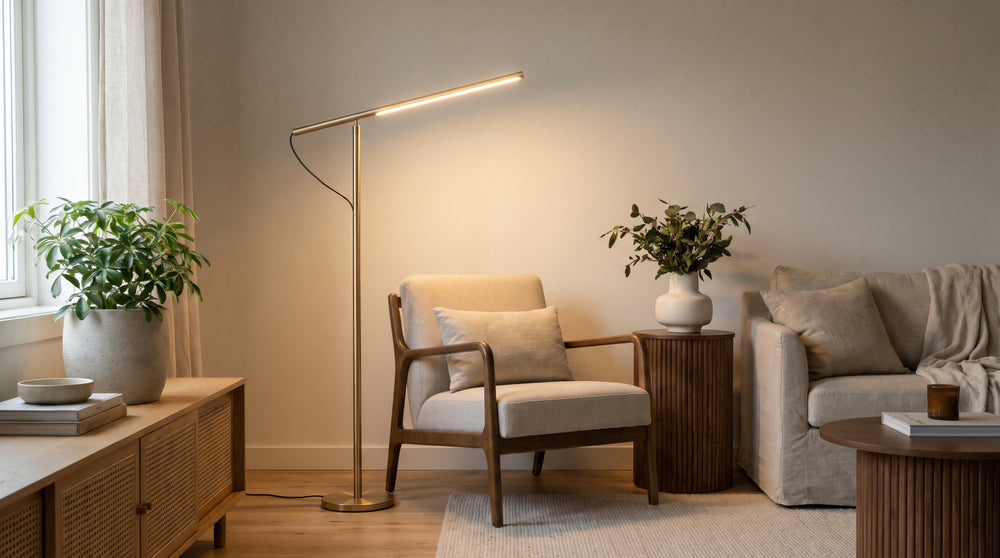
Plan for one low light source per living area: a LED floor lamp lights at seat height, next to the sofa, the bed or the desk, and moves when the way you use the room changes. The choice comes down to stem height, light source type and colour temperature, before style.
This guide gathers the reference points that avoid common mistakes: height, socket, adjustability, base stability and shade care.
What is the difference between a floor lamp and a standard lamp?
A standard lamp is a tall lamp whose source reaches shoulder height or above; a floor lamp is lower, with a short stem and a shade that lights at seat height. The first lights a whole room, the second creates a reading or conversation corner.
What stem height do you need to light an armchair?
The stem height decides what the lamp lights. For an armchair, the shade should sit around seat height, with your eye line staying below the edge of the diffuser: the light falls on the book, not in your eyes. A stem that is too tall turns the lamp into a standard lamp and lights the wall above people's heads. Measure the height of the backrest and the distance from seat to floor, then compare with the stated overall height. The models gathered in the Designix lighting range give this height, so you can decide before ordering.
Can a floor lamp be used as the main light?
Yes, if the room has no other source. A shade that throws light upwards lights a small living room in the evening without glare. In a large room it stays a complement and the ceiling keeps the general light. The useful benchmark is simple: if you have to squint to read at the other end of the room, a source is missing. Designer LED floor lamps cover both uses, as an extra or as the only source, depending on how much volume the shade diffuses.
How do you choose a floor lamp for the living room?
In a living room, you want an accent light that does not glare: a shade that diffuses up and down, a base stable enough to withstand people walking past, a warm tone for the evening. Place it beside the sofa, never in front of the screen or in a walkway.
The most beautiful living room lamps: which styles stand out?
Three families hold the stage. The slim stem with a fabric shade stays discreet and suits every piece of furniture. The sculptural silhouette, often in metal or ceramic, works as a piece in its own right. The adjustable-arm model, more technical, suits mixed rooms where you read as much as you entertain. Compare the designer floor lamps for the living room with the modern models for the living room: the difference lies in the proportion between stem and shade, not in the price tag.
One or two floor lamps in a living room?
One is enough if the sofa runs along a wall and the ceiling light covers the rest. Two make sense in a through room or a living room open to the dining area: one near the sofa, one near the bookcase or the TV unit, each within reach of a seat. Avoid lining them up symmetrically, the decorative effect is better when the heights differ slightly. A dark model goes unnoticed in a corner, while a black finish for the living room structures the line of a pale wall.
A fabric shade closes the light and softens it: linen shades give that subdued light you look for in the evening, with no reflection on a television screen.
Socket, integrated LED, colour temperature: what light for the evening?
A floor lamp takes either a bulb with a socket, E27 or E14, or an integrated LED module. The socket lets you choose brightness and tone, the integrated module fixes the result. In the evening, a warm, diffused light rests the eye better than a directed beam.
E27 or E14 socket: what does the diameter change?
E27 is the large screw socket, the one that takes the most common and most powerful bulbs; E14 is slimmer and limited to low wattages. A large socket leaves more latitude for changing the bulb in five years. Read the packaging: lumens give the amount of light, kelvins the tone, around 2700 K for warm white, 3000 K for soft white, above 4000 K for cool white, reserved for work. These figures are industry benchmarks, not a measurement of our models.
Integrated LED or replaceable bulb?
An integrated module gives a purer line, with no visible bulb, and often a better distributed light in the shade. On the other hand, the source cannot be replaced: when it fades, the whole fixture stops. A screw-in bulb costs little to replace and lets you adjust the tone with the season or the use. If you are unsure, note that the adjustable lamp and the interchangeable bulb often go together in adjustable lamps.
| Criterion | Why it matters | What to look at |
|---|---|---|
| Stem height | The light must reach seat height | Overall height and shade position |
| Source | The socket can be replaced, the LED module cannot | E27 or E14 socket, or integrated LED |
| Light tone | A tone that is too cool tires the eye in the evening | Kelvin rating on the packaging |
| Ingress protection | Use near water is different | IP rating of the fixture |
| Stability | A low lamp is easily knocked | Width and weight of the base |
Which floor lamp for working or reading at the desk?
At the desk, the light must fall on the worktop without casting the shadow of your hand: an adjustable head or a tilting arm sets the beam. A stable base and a flat foot that slides under the furniture matter as much as power. Avoid direct reflection on the screen.
Can a floor lamp serve as a desk lamp?
Yes, when the top is narrow or cluttered: the stem stands on the floor, beside the drawer unit, and the shade rises above the worktop. The condition is that the head reaches above the keyboard without the arm hitting the top. LED desk lamps meet this use, and metal models for the desk withstand chair knocks better than a ceramic stem.
How do you direct the light without reflection on the screen?
Place the source to the side, at shoulder height or just above, and tilt the head towards the worktop: the light grazes the keyboard without reaching the panel. A matte screen limits reflections, a glossy screen throws them all back. If the room is dark around, add soft backlighting behind the screen rather than turning up the brightness on the desk. Designer pieces for the desk with an articulated arm allow these adjustments without moving the base.
How do you connect several lamps to a single power point?
Group the lamps on a power strip or a socket block connected to a single power point, provided you do not exceed the current allowed by the circuit and the socket. LEDs draw little, but the combined power of the fixtures and other devices must stay within that limit.
Power strip or spur: which to choose depending on the room?
A power strip works when the power point is visible behind the sofa and two or three lamps connect to it. A spur, with a box mounted high up, takes over when the furniture hides the socket and the sources need spreading over two walls. In both cases, keep the cables along the skirting boards, never under a rug or behind a curtain, and check the total power supported. The full range of lighting families can be found in our lighting collections.
Can several lamps be controlled with a single switch?
Yes, by grouping them on a switched socket or a power strip with a switch: one control turns them all on. The drawback is differentiated use, since you can no longer light the reading corner without the TV corner. A socket controlled by remote or by a wireless module solves the problem without touching the circuit. Check that each lamp accepts this type of supply, particularly models with a built-in dimmer.
How do you match a floor lamp with the ceiling light, the chandelier and the wall lights?
The ceiling gives the general light, the floor lamp the accent light. Keep one dominant tone in the room and avoid stacking two sources aimed at the same point. A chandelier or a LED ceiling light serves meals and circulation, the floor lamp the conversation corner.
LED chandelier or ceiling light: what role should the ceiling keep?
A LED ceiling light covers circulation and meals, with an even light downwards. A LED chandelier, lower and more decorative, suits above a table where you want close light and a silhouette. In both cases, keep the warm tone for the evening and leave the ceiling at a moderate brightness: a floor lamp placed next to a crystal fixture loses its effect if the ceiling washes everything in white.
Is a powerful LED wall light useful as well?
Only if the wall stays dark or the walkway is poorly lit. A wall light diffuses up and down and visually lightens a partition, without taking up floor space. If the room is already served by the ceiling and the floor lamp, an extra wall light overloads the lighting scheme and creates areas that are too bright.
Changing a recessed LED spotlight in the ceiling: when should you think about it?
When the ceiling ages, the tone no longer matches the rest or the spotlights light a wall instead of a useful surface. Replacing a recessed light is a short job, but it means cutting the circuit and choosing a model with the right cut-out diameter. Do it at the same time as adding the floor lamp: tone consistency is easier to achieve in one go.
Where should a floor lamp go in the bedroom, hallway or kitchen?
In the bedroom, it replaces the bedside lamp when the bed has no table; in the hallway, it welcomes without lighting the whole ceiling; in the kitchen, it lights a worktop or a dining corner. Keep it within reach and out of the walkway.
| Room | Role of the lamp | Type of light | Point to watch |
|---|---|---|---|
| Living room | Accent light near the sofa | Diffused up and down | Stable base, out of the walkway |
| Bedroom | Replaces the bedside table | Warm and subdued | Easy to reach from the bed |
| Desk | Lights the worktop | Directed and adjustable | No reflection on the screen |
| Kitchen | Lights a worktop or dining corner | Aimed at the surface | Material that is easy to wipe |
| Hallway | Welcome without the ceiling light | Soft and indirect | Compact footprint |
Which floor lamp for a bedside or a reading corner?
For a bedside without a table, a short stem and a low shade placed just above the mattress, with a switch you can reach lying down. Bedside ceramic brings a heavy base that does not tip when you grope for the switch in the dark. In a reading corner, the shade should drop below your eye line; LED floor lamps for the bedroom favour warm tones and closed diffusers.
A model for the kitchen: what precautions?
Near a sink or a worktop, damp and splashes decide: a fixture whose ingress protection suits damp use wipes clean in one stroke, a fabric model does not. Keep the stem away from cooking areas and from the walkway between units, where it will be knocked. For a dining corner, a low lamp is enough; kitchen lighting then completes the worktop spotlights.
Which style and material to choose: Italian design, wood, metal, ceramic?
Italian design plays with sculptural shapes and noble materials; wood softens a pale room; metal structures a contemporary interior; ceramic and crystal bring a more dressed presence. The shade material above all changes the way the light comes out.
Italian design floor lamp: what sets it apart
A worked silhouette, often drawn by a studio, with a curved stem or a graphic shade: the lamp takes on a decorative role when it is switched off. Check the weight of the base and the stability before giving in to the shape, because a narrow base tips over at the first brush past. Ceramic floor lamps offer this sculptural presence with a generally heavy base, and designer wood pieces play the opposite card, warmer and visually lighter.
How do you check stability and care before buying?
Three checks are enough. The base: wide and flat for a tiled floor, more massive if the lamp will be around children or a pet. The shade: fabric dusted with a brush, glass and crystal cleaned with a soft cloth, metal wiped without abrasive products. The cable, finally: long enough to reach the socket without a stretched extension lead. A gold and black model needs a lint-free cloth to keep its sheen.
At Designix, payment is secure, delivery is tracked and returns are possible. Our customer service answers questions about dimensions before you order, which avoids unpleasant surprises when you unpack.
Now take your measurements: seat height, available base width, distance to the socket. Then compare the families in the designer floor lamps for the living room or, for the bedroom, in the designer selection for the bedroom, and choose the lamp that suits your corner, not the most flattering photo.
Frequently asked questions
What are LED floor lamps?
They are movable fixtures, plugged into a socket, whose LED source is carried by a stem or a base: they move around and stand on the floor like an accent lamp. They differ from the table lamp by their height and from the standard lamp by their lower format, with a shade close to seat height.
Are the most beautiful living room lamps necessarily designer?
No. A floor lamp with a slim stem and a linen shade structures a sober living room as well as a sculptural piece. What makes the difference is the proportion between stem and shade, the material, and the consistency with the rest of the furniture. A well-proportioned simple shape holds up better than a spectacular piece in the wrong place.
What is an Italian design floor lamp?
It is a lamp with a worked shape, often by a studio, that takes on a decorative role in the room: curved stem, graphic shade, noble materials such as glass, metal or ceramic. It is chosen for its silhouette as much as for the light it gives, and it needs a stable base.
Can you light a bare wooden table with a floor lamp?
Yes, provided you do not put the source in your eye line and you choose a shade that closes the beam downwards. A floor lamp placed beside the table lights the surface without leaving a hard reflection. For a waxed top, prefer a warm, diffused light that brings out the grain.
Should you add a powerful LED wall light as well as a floor lamp?
It depends on what is missing: if the wall stays dark or the walkway is poorly lit, a LED wall light complements the floor lamp. If the room is already well lit by the ceiling and the lamp, an extra wall light overloads the lighting scheme and creates areas that are too contrasting.




