
Kitchen lampshades
This selection is also available in our French store: Abat jours pour cuisine
No products in this selection.
- Tracked delivery to your country Tracked delivery
- Secure payment at checkout Multiple payment methods
- 14 days to change your mind 14-day returns
- Secure payment Secure payment
Not sure of your style? Find it in 30 seconds
A few questions, and we will show you the pieces made for you.
Frequently asked questions
How do I choose the right product?
What are the delivery times?
Can I return an item?
Can I pay in instalments?
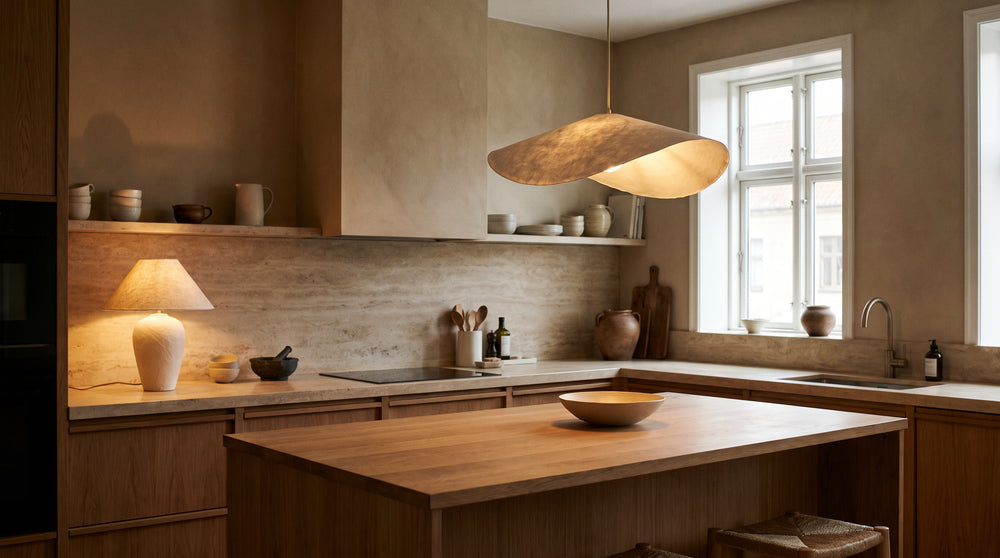
An interior that reflects who you are
Carefully selected pieces, shipped from our warehouses. Our team advises you before you buy, so you choose with confidence.
- Tracked delivery
- Pay in instalments, where available
- 14 days to change your mind
- Advice & showroom in Lyon, France
Start with the spot to light: a low pendant above the worktop for task lighting, a ceiling light in the centre for general light, and the lampshade follows. Material and shape come next, depending on the light you want over the prep area and the table.
Which type of light fitting is best suited to a kitchen?
Combine two light sources: a ceiling light or spotlights for the general light of the room, a pendant above the worktop for task lighting. The pendant lights what you are chopping, the ceiling light lights the floor and the units. A chandelier takes over when the ceiling is high and the dining corner wide.
Trendy kitchen ceiling light or kitchen pendant: which to choose?
The ceiling light sits in the centre and spreads light through the room: it is the choice for open kitchens, passageways and small spaces. The pendant hangs closer to the useful zone, with an adjustable rod or cable, and concentrates light where you work. In a kitchen open to the living room, the two coexist without getting in each other's way. To broaden your view, browse all our light fittings, then lampshades to hang or to place.
| Type | Where it goes | What it brings | When to choose it |
|---|---|---|---|
| Ceiling light | On the ceiling, in the centre of the room | Even general lighting | Open kitchen, passageway, small room |
| Pendant | Rod or cable above a zone | Directed task lighting | Worktop, island, table |
| Chandelier | High ceiling, above the dining corner | Several sources and a visual presence | High volume and wide dining corner |
| Wall light | On the wall, often near the worktop | Close-to-the-wall accent lighting | Cooking and prep along the wall |
Modern kitchen chandelier: when does it work
With a generous ceiling height and a wide dining corner, a multi-point chandelier brings the light down to the right height and fills the empty volume above the table. It also works in an open kitchen when it echoes the material of the worktop. It does not replace task lighting: above the sink or the hob, a dedicated source is still needed. Our modern lampshades give a more understated version of the same silhouette.
How to choose the size and format of a kitchen lampshade?
Keep the lampshade narrower than the surface it lights and make sure the light falls onto the worktop. Above an island, a low, wide shape covers the whole zone; above a table, a compact format lets you see your guests. A closed lampshade under the socket concentrates the output, an open model spreads it more widely.
Kitchen lampshade: where to place it above the worktop?
Centre the lampshade on the prep zone, not on the edge of the worktop: that is where your hands work and where shadow is least in the way. Between two pendants above an island, keep an even gap to avoid dark zones. A model with a raised edge lets a little light through at the sides and lights the tall units. The lampshade range gathers shapes to place and to hang according to this criterion.
Kitchen pendant lampshade: which socket and fitting to look at?
Check the socket of the fitting in place, E27 for large diameters and E14 for small sockets, then the type of fitting: screw ring, notched holder or collar. A lampshade is therefore also chosen for the pendant that will carry it. If you are hesitating between several pieces in the house, the living room lampshades show the same fittings in wider formats.
Rattan, glass, linen or fabric lampshade: which material for a kitchen?
In a kitchen, the material decides how the light renders and how it is cared for. Rattan and fabric filter and warm, glass lets the output through and wipes clean in one go, linen brings a matte weave, metal frames a crisper style. In a room where you cook, favour what dusts off effortlessly.
Rattan kitchen lampshade: what it changes in the room
Rattan draws a visible weave and filters the light, creating a soft atmosphere above a dining corner. It warms a bright kitchen, matches wood and terracotta, and dusts off dry. It is placed above a specific zone rather than in the centre of a large volume, where it would lose its presence.
Glass kitchen lampshade: light and care
Glass lets light through without colouring it and becomes almost invisible once the lamp is on: handy above a worktop where you want to see clearly. It cleans with a soft, slightly damp cloth, which matters in a room where splashes are frequent. Linen lampshades and fabric models play the opposite game: they soften and mattify. White finishes remain the easiest to match.
| Material | Light rendering | Care | Style that suits |
|---|---|---|---|
| Rattan | Soft light, visible weave | Dry dusting | Natural, country, seaside |
| Linen | Soft, matte light, no reflection | Dry dusting, without rubbing | Bright, pared-back kitchens |
| Fabric | Enveloping light, little glare | Dry dusting preferably | Soft interior, homely feel |
| Glass | Direct light, discreet shade once lit | Slightly damp cloth | Contemporary, very bright kitchen |
| Metal | Directed light, slight halo on the sides | Soft cloth | Industrial, workshop, dark kitchen |
What light to illuminate a worktop without glare?
The light must fall onto the worktop without getting into your eyes. A low, closed lampshade under the socket directs the output downwards; an open model spreads it and lights more widely. Stay with a warm or neutral tone, and a material that does not bounce direct glare when you cook in the evening.
Kitchen pendant: how to direct light onto the worktop?
The useful move: place the source at face height or a little lower, so your gaze does not meet the bulb. A lampshade closed underneath makes a crisp cone of light on the chopping zone, an open lampshade lets a halo filter around. If the room is open to the living room, keep the same family of tones from one space to the other.
Living room light colour: the same logic as in an open kitchen?
Yes. A warm tone makes rest areas more enveloping in the evening, a neutral tone keeps colours true for reading or working. In an open kitchen, too marked a break between the two zones shows. Nursery lampshades and bedroom models apply the same rule. To compare styles, go through the Designix lighting catalogue.
How to match lampshades with a modern kitchen decor?
Pick up the materials already present: light wood with linen, matte black with metal, white with plain fronts. Limit patterns, keep one dominant tone and repeat the same family of shapes above the worktop and above the table. It is this repetition that gives the impression of a room thought out in a single gesture.
Modern kitchen decoration: which finishes to favour?
Matte finishes absorb light and avoid reflections on lacquered fronts. A solid-colour lampshade carries less weight than a pattern when the kitchen is already graphic. This contemporary selection favours simple silhouettes, easy to repeat in two copies above an island.
White or black lampshades: what effect in a kitchen?
White brightens the volume, blends into a light ceiling and bounces light back: it suits bright kitchens and small spaces. Black draws a crisp silhouette, structures a white or wood kitchen and stands out mostly when switched off. The two marry in the same room if you repeat the shape.
Large chandelier for a high ceiling and light fitting for a WC: how to adapt the choice?
The criterion is the same in both cases: the distance between the source and what it must light. A high ceiling calls for a fitting that comes down, otherwise the light stays far from the table. A small room demands the opposite: a close, soft source that does not glare when switched on.
Large chandelier for a high ceiling: which pendant to choose?
Choose a silhouette that reads from afar, multi-point or large in diameter, whose shape occupies the volume without saturating it. The rod or cable is adjusted to bring the bottom of the fitting to a comfortable height above the table. Too short, the chandelier disappears into the ceiling; too long, it gets in the way of movement.
Light fitting for a WC: ceiling light or small pendant?
In a WC, the room is small: a compact ceiling light or a small pendant is enough, with soft light when switched on and a closed shape that is easy to dust. Avoid materials that are fragile to occasional humidity and large diameters that would clutter the space visually. For the same logic applied to other rooms, seeing the whole range helps compare formats. Our lampshade selection covers both cases.
How to install and care for a kitchen lampshade?
Switch off the power at the breaker, unscrew the ring or holder that keeps the old lampshade, fit the new one and screw it back. For care, a soft cloth is enough: dry dusting for fabric, linen and rattan, a slightly damp cloth for glass.
How to fit a lampshade onto a kitchen pendant?
Three common assemblies: the screw ring on the socket, the collar held by a screw, the notched holder. Identify yours before ordering, and check the diameter of the lampshade opening, which must match the holder. Fabric versions fit the same sockets as glass or metal.
How to clean a fabric or rattan lampshade?
Dry, with a microfibre cloth or a soft brush attachment, without rubbing: moisture marks the fibres and distorts the weave. Glass and metal tolerate a slightly damp cloth, wiped straight away. Avoid products intended for wood. For a living room, the moves are the same, as our lampshades for lighting a living room show.
What mistakes to avoid before choosing a kitchen lampshade?
Four mistakes come up again and again: a lampshade wider than the zone to light, a material that is hard to clean in a room where you cook, too directed a light that glares, an assembly incompatible with the socket in place. Check the location, the socket, the care and the way the light falls in the evening before confirming.
Cheap kitchen lampshade: where does the manufacturing difference lie?
The difference lies in the material, the finish of the edges and the strength of the assembly. An entry-level piece in fabric or rattan does the same job as a more elaborate model, provided the socket is well adjusted and the weave even. The right calculation remains durability: a solid, washable material saves you buying again.
Summary: check these points before ordering
Location and surface to light, socket and type of fitting, material and ease of care, match with the kitchen colours. Once these four points are set, the choice narrows to a few shapes. On the shop side, secure payment, tracked delivery, returns and Designix customer service accompany the order right through to installation. Compare shapes in Designix light fittings and refine among our lampshades.
Frequently asked questions
What are the lighting trends for kitchens in 2026?
What is emerging: low, simple shapes above the worktop, natural materials such as rattan or linen, and discreet sources that light without glare. The real question remains the match between the lampshade material, the kitchen colour and the daily use of the room.
Living room chandelier: how to choose it?
In a living room, the chandelier is chosen according to ceiling height and the position of the sofa: it must light without creating hard shadow zones. A shape hung above the coffee table or the reading corner works well, provided you keep a warm, diffuse light and do not hang it too low in the walkway.
Living room light colour: warm or neutral?
A warm light makes the living room more enveloping in the evening, a neutral light keeps colours true for reading or working. In a living room as in an open kitchen, keep the same family of tones from one room to the other to avoid a visual break as you move between them.
Rattan kitchen lampshade: for which style?
Rattan brings a soft light and a weave pattern that shows on the ceiling, warming a bright kitchen or a dining corner. It pairs well with wood, terracotta and kitchens open to the living room. Keep it above a specific zone rather than in the centre of a large volume.
Is a grandmother's recipe for stripping furniture useful for a lampshade?
No: this type of recipe targets the wood of a piece of furniture, not a lampshade. Linen, fabric, rattan and glass do not tolerate strippers intended for wood. Stick to dry dusting, or a soft, slightly damp cloth on glass and metal, without rubbing the fibres.




