
Japandi floor lamp
This selection is also available in our French store: Lampadaire japandi
No products in this selection.
- Tracked delivery to your country Tracked delivery
- Secure payment at checkout Multiple payment methods
- 14 days to change your mind 14-day returns
- Secure payment Secure payment
Not sure of your style? Find it in 30 seconds
A few questions, and we will show you the pieces made for you.
Frequently asked questions
How do I choose the right product?
What are the delivery times?
Can I return an item?
Can I pay in instalments?
An interior that reflects who you are
Carefully selected pieces, shipped from our warehouses. Our team advises you before you buy, so you choose with confidence.
- Tracked delivery
- Pay in instalments, where available
- 14 days to change your mind
- Advice & showroom in Lyon, France
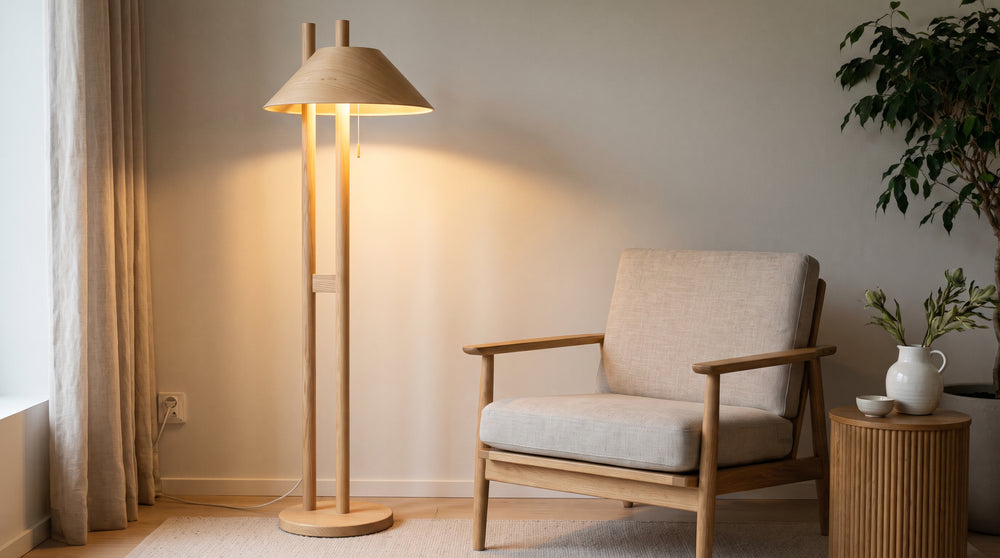
The japandi floor lamp is chosen on two practical points: the free floor space available and the type of light you want in the evening. The frame stays understated, in light wood or matte black metal, and the fabric shade determines how soft the glow is. The finish and diameter are then adjusted to suit the room.
- What kind of light a japandi floor lamp gives
- Wood, beige or black
- Where to place it in the living room
- Choosing one for a bedroom
- Home office and small spaces
- Gold and crystal
- Halogen or LED
- Installing and caring for it
- Deciding between two models
What is a japandi floor lamp and what light does it give a room?
A japandi floor lamp combines a simple frame, in light wood or matte black metal, with a fabric shade that sends light downwards and to the sides. It serves as supplementary lighting in the evening, next to a sofa or an armchair, rather than as the main light source.
On the product page, three details are enough to picture it: the height of the stem, the diameter of the shade and the bulb socket. The diameter determines the lit area, the socket determines which bulb you can fit. Floor lamps can be browsed by format, from the most compact to the tallest.
Japandi floor lamp in wood, beige or black: what each finish changes
Light wood warms a room and blends into a white wall. Beige and white make the piece recede and keep the room calm. Matte black draws a clean line and brings out the light from the shade. The collection currently contains no products, so no stem, socket or dimension is described here: these families can be found in wood floor lamps and matte black models.
Japandi lamp and japandi chandelier: two ways to light the same room
A japandi chandelier lights from the ceiling and suits general lighting. A japandi lamp on a stand works as supplementary light, at seating height. In the same living room, the two complement each other: the ceiling for the whole room, the stand for reading.
Japandi floor lamp in wood or black: which finish to choose for each room?
Light wood and beige go with linen and rattan. Matte black gives structure to an already light living room and brings out the light. As no model in the collection is available yet, these finish guidelines serve as a buying guide rather than a product page.
Budget is a relative matter: budget-friendly models stay understated, while an exceptional piece is justified by the material of the stem and the quality of the fabric.
Japandi floor lamp in wood and beige: the easiest base to match
A light wood or beige stem works with a linen sofa, a rug in natural fibres and an off-white wall without any fuss. It is the choice that is most forgiving in an already furnished room. Just check that the wood tone does not clash with the floor, and stay within the same family of lightness.
Japandi floor lamp in black: when contrast helps the room
Matte black is useful when everything is already light: it gives the eye a focal point and avoids a washed-out look. You then need to watch the number of dark masses around it, otherwise the room feels heavy. A single visible black line is enough, in contemporary lines for example.
| Finish | Effect in the room | Goes with | Avoid |
|---|---|---|---|
| Light wood | Warms, natural look | Linen, rattan, off-white | Mixing too many wood species |
| Beige and white | Makes the piece recede | Light walls, natural textiles | Shade that is too opaque |
| Matte black | Structure, contrast | White walls, light wood | Piling up black furniture |
| Gold | Reflects light | Dark wood, glass, plaster | Several shiny sources |
| Glass or crystal | Transparency, light reflections | Fine metal, wood, neutral walls | Room very busy with patterns |
Where to place a japandi floor lamp in the living room?
In a living room, it goes in the corner of the sofa or next to an armchair, close enough for the light to fall on the book without dazzling the person seated. A low shade suits a reading corner, a taller model lights the whole room.
Floor lamp and reading corner: the right distance from the seat
Place the stem just behind the shoulder of the seat, not in front of the face: the light should fall on the pages, never into the eyes. Then leave a clear path to walk through, and locate the socket before settling on the spot. An already furnished living room accepts the lamp in a spare corner, never in the middle of a walkway.
Original living room floor lamp: stepping away from the expected model without breaking the mood
An original light is recognisable by a shape or detail that departs from the expected model, without losing japandi restraint. It stays stable, its shade hangs low enough for reading and it does not block movement. The most design-led pieces or a living room floor lamp are best considered in plan first, before deciding.
Which japandi floor lamp for a bedroom?
In a bedroom, it replaces the bedside lamp when the nightstand is short of space: fabric shade, warm light directed downwards. Choose a narrow stem and low intensity so as not to wake up the room in the evening.
Evening light at the foot of the bed: what to look for in the bulb
Aim for a warm colour temperature, around 2,700 K, and a low-wattage bulb for supplementary light. A dimmable model can be adjusted for the evening. Dimmable floor lamps and bedroom models are chosen on this point.
Natural japandi floor lamp with shade: the effect in a light bedroom
In a bedroom with light walls, a slim natural wood stem and a linen shade create a pool of warm light without adding visual clutter. The fabric should stay thin enough to let light through, dense enough not to show the bulb. See also the more elaborate bedroom models.
Japandi floor lamp for the home office and small spaces: which narrow format?
For a home office or a small space, look for a slim stem and a compact shade that does not get in the way. In a damp room such as a toilet, check the protection rating shown on the product page before choosing.
Toilet, hallway or entrance floor lamp: the narrow format and safety
A toilet or hallway floor lamp must fit within the available width and not encroach on the walkway. A compact base limits knocks, a straight stem avoids leaning. In a damp area, the product page gives the protection rating: that is the detail that decides, not the look of the model.
Home office floor lamp: directing light onto the desk
In a home office, the shade should come down to seated eye level and direct light onto the desk, not towards the screen. A slim stem slips in next to the drawer unit. Desk floor lamps can be compared on this height criterion.
| Room | Recommended format | Finish | Type of light | Point to check |
|---|---|---|---|---|
| Living room | Tall stem, wide shade | Light wood, beige, matte black | Diffused downwards and to the sides | Space behind the sofa, cable length |
| Bedroom | Slim stem, compact shade | Light wood, white, beige | Warm and low | Dimmer or soft bulb |
| Home office | Straight and narrow | Matte black, wood | Directed onto the desk | Shade height relative to the chair |
| Small space and toilet | Narrow format, compact base | White, black, metal | Supplementary light | Protection rating on the product page |
How to match a gold or crystal floor lamp with a japandi interior?
Gold and crystal fit into japandi in small touches: a slim gold stem, a frosted glass shade, a few reflections are enough. Avoid piling up several shiny pieces in the same room and keep wood and linen as the base.
Gold in small touches, never all over
A slim gold stem catches daylight and warms a dark corner without weighing it down. It works against neutral walls, next to a dark wood piece. Two shiny objects in the same field of view is already too many: choose a single source of reflection. Gold finishes should be considered on that basis.
Glass and crystal: the transparency that lightens a solid piece
A glass shade or a transparent stem lets light through and visually lightens a solid piece placed next to it. Keep the bulb low-wattage to avoid harsh reflections. Glass floor lamps complement an interior that is already heavy on wood.
Halogen or LED floor lamp: which light source to choose?
A halogen floor lamp heats up and uses more energy than an LED bulb. If the socket is E27 or E14, the halogen bulb is generally replaced with an LED of the same cap, keeping the original shade and the warm evening light.
Replacing a halogen bulb: what to check first
Three checks: the cap marked on the socket, the maximum wattage the light allows and how much room the bulb has inside the shade. A replacement LED gives off less heat, which suits fabric shades. LED models avoid this step when the light source is integrated.
E27, E14 or integrated LED: reading the product page without mistakes
The E27 cap is the most common on floor lamps, the E14 fits small shades. An integrated LED cannot be replaced: the whole light lasts as long as the source. Finally, the colour temperature is read on the bulb packaging, not on the frame.
How to install and care for a japandi floor lamp?
First check that the base is stable on a flat floor, then fit the stem and shade following the model's instructions. Run the cable behind the furniture so no one trips over it, and dust the fabric shade with a dry cloth.
Fitting the stem and attaching the shade without damaging the fabric
Place the base on the floor before screwing on the stem, tighten by hand and keep the model's instructions within reach. For the shade, hold the fabric by the frame, never by the fabric itself. A slightly uneven floor can be corrected with a discreet wedge under the base, never by tilting the stem.
Routine care: wood, metal and fabric shade
Wood and metal are dusted with a soft, dry cloth, without abrasive products. The fabric shade is brushed dry or vacuumed on low power with a soft nozzle. Unplug before any handling, and never wet the fabric.
Secure payment, tracked delivery, returns and Designix customer service accompany every order. To compare formats, browse all our floor lamps and white floor lamps.
How to decide between two models and where to find the right piece?
You decide on three points: the floor space actually free, how the light will be used and the finish already dominant in the room. Two models of the same style are often separated by the diameter of the shade, which determines how much light is diffused.
Three questions to ask before ordering
Does the stem fit without getting in the way? Does the light fall on the book, the desk or the floor? Does the finish echo a wood already present? If the three answers are clear, the model is chosen quickly. If not, the Designix lighting catalogue lets you compare by format.
A japandi floor lamp that lasts: consistency with the rest of the room
An understated model stands the test of time because it does not depend on a trend. It stays consistent if its wood tone echoes the floor or a piece of furniture, and if its metal remains discreet. Modern lines and elaborate living room pieces offer other options. The choice is finalised in the full floor lamp range.
Frequently asked questions
What is a japandi floor lamp?
It is a floor lamp that follows the codes of the japandi style: a simple frame in light wood or matte black metal, a fabric shade, understated lines. It diffuses a soft light downwards and serves as supplementary lighting in a living room, bedroom or home office.
Driftwood or stained wood floor lamp: which to choose?
Driftwood refers to a raw, irregular tone that brings a natural look without overloading the room. A more uniform wood suits an interior that is already graphic. In both cases, match the tone with the floor and the other furniture in the room.
Can a halogen floor lamp suit a japandi interior?
Yes, if the socket accepts a replacement LED bulb: you keep the warm light and the original shade. Halogen heats up and uses more energy, so check the cap shown on the product page before ordering, rather than relying on the look of the light.
Japandi chandelier or japandi floor lamp: which to choose?
The japandi chandelier lights the room from the ceiling and suits general lighting. The japandi floor lamp provides supplementary light near a seat or the bed. In a living room, the two complement each other rather than replace each other.
How to install a floor lamp in a bedroom?
Check that the base is stable on a flat floor, fit the stem then the shade following the instructions, and run the cable behind the nightstand. Choose a warm, low-intensity bulb so the whole room is not lit up. A dimmable model makes evening adjustment easier.




