
Hallway lampshades
This selection is also available in our French store: Abat jours pour couloir
No products in this selection.
- Tracked delivery to your country Tracked delivery
- Secure payment at checkout Multiple payment methods
- 14 days to change your mind 14-day returns
- Secure payment Secure payment
Not sure of your style? Find it in 30 seconds
A few questions, and we will show you the pieces made for you.
Frequently asked questions
How do I choose the right product?
What are the delivery times?
Can I return an item?
Can I pay in instalments?
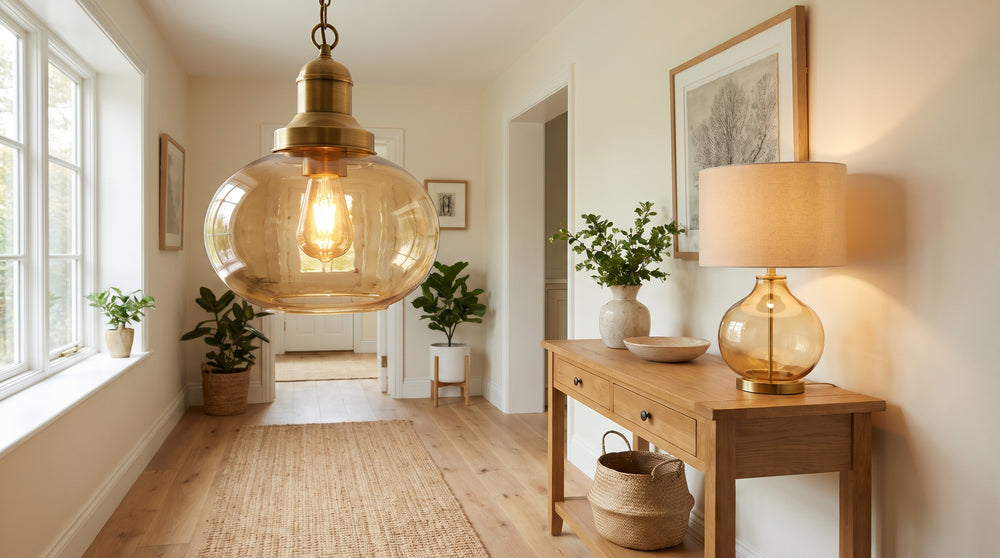
An interior that reflects who you are
Carefully selected pieces, shipped from our warehouses. Our team advises you before you buy, so you choose with confidence.
- Tracked delivery
- Pay in instalments, where available
- 14 days to change your mind
- Advice & showroom in Lyon, France
Choose a compact hallway light shade, aligned with the wall or the furniture that carries it, in a light material that diffuses light without extinguishing it. In a hallway, the footprint decides the format, the material decides the softness of the flow, and the colour decides whether the passage looks brighter or more muted.
In this guide:
- Which hallway light shade should you choose according to the width of the passage?
- What light does a shade give in a hallway without a window?
- Linen, fabric or modern shade: which material for a hallway?
- Coloured shade for a lamp or coloured shade for a floor lamp: what does the tint change?
- How do you install and maintain a shade in a hallway?
- Which light fitting for a WC, a toilet or a windowless hallway?
- How do you match the hallway shade with the living room and kitchen decor?
Which hallway light shade should you choose according to the width of the passage?
Measure the clear width of the passage before choosing: the shade must stay aligned with the wall or the furniture that carries it, without overhanging into the walking area. A narrow hallway calls for a model taller than it is wide. The diameter shown on the product sheet settles the rest, along with the mounting height.
Entrance hall shade: wider than in the hallway?
Yes, an entrance hall accepts a wider shade: people stop there, they do not walk straight through. Allow for the width of the console it hangs above and keep some margin for doors opening. A generous format acts as a focal point there, whereas a hallway calls for discretion. Designix's shade range can be browsed by format and by material.
Narrow or conical shade: which one lets light through?
A narrow cone concentrates light downwards and leaves the wall in shadow; a wide cone diffuses it to the sides. In a hallway, a conical model opening downwards lights the floor without dazzling at eye level. A narrow cylinder suits a small table lamp better than a passage pendant.
| Space | What you are looking for | Format and mounting | Material and colour |
|---|---|---|---|
| Narrow hallway | Light without dazzling or hindering walking | Compact shade, aligned with the wall | Linen or light fabric, ecru or white |
| Entrance hall | Create a focal point on arrival | Wider format, pendant or table lamp | Fabric, contrasting colour |
| Hallway with a high ceiling | Bring light down to eye level | Cable pendant, deep shade | Matte material, dark or white colour |
| Hallway without a window | Compensate for the lack of natural light | Two light points rather than one | Light, diffusing shade |
| WC and toilet | See clearly in a small volume | Wall light or small pendant | Easy-clean fabric, light colour |
What light does a shade give in a hallway without a window?
A hallway without a window needs light that bounces off the walls. A light shade, in linen or ecru fabric, lets through and reflects more light than an opaque, dark model. White and ecru brighten the passage; black keeps the flow upwards and downwards, for a more muted atmosphere.
Light colour for living room and hallway: should they be the same?
Not necessarily the same tint, but the same family. The living room gets a warm, enveloping light, while the hallway needs more brightness to stay readable as you walk through it. Reusing a similar colour avoids a break between the two rooms. The white finishes play this linking role effortlessly.
Light or dark shade: what effect on the light?
A light shade diffuses and reflects; a dark shade directs and concentrates. The first brightens a windowless passage, the second gives a settled atmosphere in an already bright hallway. The black colours are justified when the walls are painted light and the passage receives light from elsewhere.
Linen, fabric or modern shade: which material for a hallway?
Linen gives a soft, matte light, stretched fabric diffuses more evenly and can be dusted with a feather duster, and a modern model delivers a more directed light. The choice comes down to what you want to see: a dressed wall or a discreet passage. The material matters as much as the shape.
What linen changes in a passage
Linen filters without extinguishing: the irregular weave breaks up the light and avoids harsh reflections on a narrow wall. It needs regular dusting and does not like humidity, which makes it suited to dry hallways. Our selection of linen shades brings together natural tones.
Modern shade in a hallway: how far should you go?
A simple shape, a plain colour, a matte material: modern works in a hallway when it does not saturate the space. Modern models deliver a more directed light, best kept for passages that already receive light. For a more classic plain fabric, see the fabric shades.
| Type of shade | Light given | Maintenance | Best if |
|---|---|---|---|
| Natural linen | Soft, matte, without reflection | Regular dusting, avoid humidity | Period hallway, soft decoration |
| Stretched fabric | Diffuse and even | Feather duster or soft brush | Frequently used passage |
| White colour | Reflects light, brightens | Marks more quickly when touched | Narrow, dark hallway |
| Black colour | Keeps light inside | Dust less visible | Already bright hallway, muted atmosphere |
| Coloured shade | Tints the ambient light | Depending on the chosen material | Floor lamp or small table lamp |
Coloured shade for a lamp or coloured shade for a floor lamp: what does the tint change?
A coloured shade acts like a filter: it changes the light more than the furniture. A white or ecru interior reflects a neutral light, a vivid interior reflects the tint. On a hallway floor lamp, it is better to choose a colour that stays readable in the half-light and a material that does not block the flow.
Coloured shade for a lamp: what effect on a small cone?
On a small cone, the inner surface matters more than the outer tint. A white interior reflects light downwards and lights the console, a tinted interior colours it. For a hallway table lamp, a light interior keeps the passage readable; the white shades fulfil this function simply.
Coloured shade for a floor lamp: the trap of a dark hallway
A vivid colour on a floor lamp is noticed before the furniture and can darken an already dark passage by filtering the flow. A deep tone suits a bright hallway, a light tone a windowless hallway. A thick material filters more than linen.
How do you install and maintain a shade in a hallway?
Hang the pendant high enough not to bump into it, and keep the shade accessible for changing the bulb. On a sloped ceiling, the cable or a suitable ceiling rose restores the alignment. Cleaning is done dry, with a feather duster, without removing the fabric or rubbing the seam.
Pendant light for a sloped ceiling: how do you keep the shade straight?
The shade hangs straight, never parallel to the slope: set the height from the lowest point of the passage and correct the tilt with the cable or a suitable ceiling rose. Check this before drilling into the ceiling. All our light fittings specify the fixings provided for each model.
Large chandelier for a high ceiling: what about in the hallway?
A large chandelier brings light down to eye level and leaves the upper part of the room darker. In a hallway, this loss at ceiling level is compensated by a second light point. A deep, narrow shade is better than a wide chandelier in a passage. Shades for pendants, table lamps and floor lamps can be compared on this depth criterion.
Which light fitting for a WC, a toilet or a windowless hallway?
A WC without a window needs a clear but not aggressive light, with a shade that protects the bulb and is easy to clean. The passage through it is short: a compact, light model is enough, placed near the mirror or on the ceiling, to avoid making it a dark room.
Light fitting for a WC: which model when there is no window?
A wall light or a small pendant with a closed shade avoids harsh shadows in a small volume. A light shade reflects light onto the walls, which compensates for the lack of a window. For table models, lighting the living room and its adjoining spaces with the same family of materials stays consistent.
WC decoration: the shade as the only object?
In a small volume, the shade can carry all the decoration: one tint or one material is enough when the walls stay neutral. It then links the toilet to the hallway without copying it. To compare families by room, all the light fitting families can be read side by side.
How do you match the hallway shade with the living room and kitchen decor?
The hallway connects the rooms: reuse the living room's family of materials and the kitchen's tone rather than an isolated model. A shared colour, or the same material in different versions, is enough to give a sense of continuity from one space to another, without buying the same light fitting twice.
Kitchen decoration and modern kitchen decor: extending the same light
In a kitchen, you want a clear light on the worktop; a hallway shade can reuse the same material without copying the model. For modern kitchen decor, a plain colour and a simple shape maintain this continuity. See the modern models for this family of shapes.
Living room chandelier or modern kitchen chandelier: the hallway shade as a link
A living room chandelier brings light downwards; a modern kitchen chandelier often plays on more graphic shapes. Between the two, the hallway shade reuses a shared colour and a similar material. The same logic applies to shades for the bedroom. In a night version, the baby's room night light reuses a soft colour.
Order from Designix: secure payment, tracked delivery, returns and Designix customer service. To find models by room and by material, browse our full lighting catalogue.
Frequently asked questions about the hallway light shade
An entrance hall supports a wider shade than a hallway, because people stop there. It is chosen according to the furniture or console it hangs above, keeping some margin so as not to hinder doors opening. A generous format acts as a focal point there.
What light colour for a living room?
In a living room, you want a light that lets you see faces and materials without dazzling: a rather warm tint, carried by a shade that diffuses instead of directing. A light shade reflects more light, a dark model concentrates it upwards and downwards.
Coloured shade for a floor lamp: which colour to choose?
On a hallway floor lamp, a coloured shade is noticed more than the furniture: a strong colour suits a bright passage, a deeper tone an already bright hallway. The material matters as much, a thick fabric filtering more light than linen.
Toilet light fitting: how do you light it without a window?
In a toilet, the light fitting is there to see clearly without dazzling: a closed, light shade, placed near the mirror or on the ceiling, avoids cast shadows. It must also be easy to clean, as the room is small and often damp.
Large chandelier for a high ceiling: how do you match it with a hallway?
A large chandelier for a high ceiling brings light downwards and leaves the upper part of the room darker. In the hallway leading to it, a more diffusing shade balances the transition. A shared colour or material is kept in both spaces so the passage stays readable.




