
Gold-colored brass wall lamps
This selection is also available in our French store: Appliques murales en laiton coloris doré
No products in this selection.
- Tracked delivery to your country Tracked delivery
- Secure payment at checkout Multiple payment methods
- 14 days to change your mind 14-day returns
- Secure payment Secure payment
Not sure of your style? Find it in 30 seconds
A few questions, and we will show you the pieces made for you.
Frequently asked questions
How do I choose the right product?
What are the delivery times?
Can I return an item?
Can I pay in instalments?
An interior that reflects who you are
Carefully selected pieces, shipped from our warehouses. Our team advises you before you buy, so you choose with confidence.
- Tracked delivery
- Pay in instalments, where available
- 14 days to change your mind
- Advice & showroom in Lyon, France
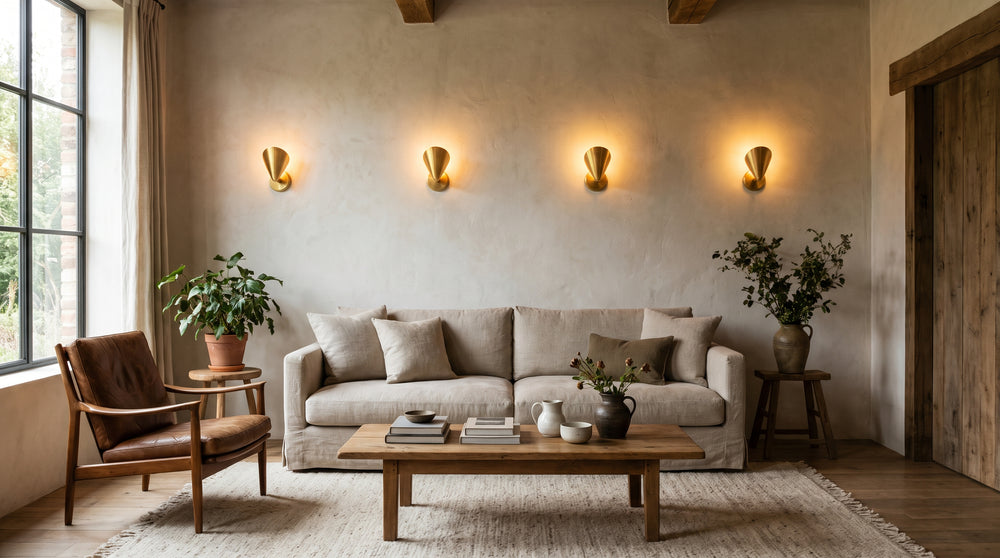
Place two gold brass wall lights on either side of the element you want to highlight, a sofa, a bed or a painting, at a practical height: around 1.50 m from the floor for accent lighting, a little lower when the wall light is meant to accompany bedtime reading. Gold brass gives a warm light that bounces off the wall and a metallic finish that matches handles, frames and other metals already present. Everything then comes down to three choices: the finish, brushed or polished, the direction of the light and the size of the model. Our entire lighting range follows this logic.
Which gold brass wall light for which room
| Room | Desired effect | Criteria to check before buying | Recommended gold finish |
|---|---|---|---|
| Living room | Frame the sofa or a wall of paintings | Direction of light, stem length, match with other metals | Brushed or polished brass |
| Adult bedroom | Replace bedside lamps | Install in pairs, dimmable intensity, non-glare light | Satin brushed brass |
| Stairs and landing | Light the steps without glare | Compact size, staggered layout, downward light | Brushed brass, low reflection |
| Hallway | Guide a narrow passage | Solid fixing, low protrusion, easy maintenance | Brushed or aged brass |
| Bathroom | Mirror or accent lighting | IP rating suited to the zone, fixing outside wet areas | Lacquered brass |
| Terrace and outdoors | Light a facade or entrance | High IP rating, metal treated for outdoor use | Outdoor-treated brass |
| Toilets | Small accent light | Compact format, warm low-output light | Discreet gold brass |
Which gold brass wall lights to choose for a living room?
In a living room, a gold brass wall light serves as accent lighting: it frames a sofa, a bookcase wall or a painting. Choose a model whose light spreads upwards or downwards, and a brass whose shade matches the handles and frames already present.
Where to place them in a living room
The right reference point is seat height: a wall light placed a little above the back of the sofa lights the seat without sending light into your eyes. Two symmetrical models on either side of the sofa, or on each side of a low unit, structure the wall better than a single ceiling source. For a bookcase, the wall light is fixed to the side upright and directs its beam towards the shelves. Upward light visually enlarges the wall; downward light draws a sharp circle on the paint and highlights an object. LED wall lights for living rooms are well suited to this accent role, and bold gold designs take over when the wall needs to become a decorative feature in its own right.
What makes the price of a wall light vary
Solid, substantial brass costs more to produce than folded sheet metal: to the touch, the weight and thickness of the wall reveal the difference. The finish also matters, a mirror polish requires more preparation than a brushed one, and a moulded glass shade takes longer to work than a simple diffuser. An adjustable bracket, a joint, a screwed assembly add material and labour. This collection brings together 14 gold brass wall lights.
To compare shapes and brackets, start with our brass and glass selection, which clearly shows these differences in construction.
Brushed brass or polished brass lighting: which gold finish to choose?
Brushed brass has a matt, satin surface: it reflects less light and shows few fingerprints. Polished brass, brighter, reflects light and brightens a dark room. Both are gold brasses: it is the surface treatment that changes the look, not the base colour.
Brushed or polished: the effect on the wall
A dark wall, deep green, midnight blue or busy wallpaper, benefits from a polished brass that catches the light and creates shifting glints. On a light or beige wall, brushed brass brings a more discreet presence and matches light woods, oak or ash. Polished brass demands more care with fingerprints, especially around a nearby switch or handle. If you are looking for a play of materials, smoked glass combined with brushed brass works on dark walls.
The patina of time
Brass is a living metal: without protection, it darkens and develops a patina, giving a deeper, more irregular gold, appreciated in an antique setting. A lacquer blocks this evolution and keeps a uniform shade, but it does not tolerate abrasive products and solvents well. A deliberate patina is chosen at the time of purchase; it cannot be achieved on a lacquered model.
| Finish | Appearance | Effect on light | Maintenance |
|---|---|---|---|
| Brushed brass | Matt satin, fine grain | Diffuses gently, little reflection | Soft cloth, dry dusting |
| Polished brass | Bright, mirror effect | Reflects light, brightens the room | Soft cloth, fingerprints more visible |
| Aged or patinated brass | Darker, irregular gold | Warm light, antique look | Little maintenance, deliberate patina |
| Lacquered brass | Protected uniform gold | Stable appearance over time | Avoid abrasive products and solvents |
How to light a staircase with wall lights?
For a staircase, place the wall lights in a staggered pattern or at hand height, so as to light the steps without glare. Choose a compact model, which does not protrude into the passage, and a warm light directed downwards or towards the wall to avoid shadow areas in the stairwell.
At what height to place them
The practical reference is the handrail: a wall light fixed at this level lights the steps and is naturally protected from shoulder rubbing. On a stringer, a regular layout, one wall light every two or three linear metres, gives a readable rhythm; staggered, from one wall to the other, it avoids a garland effect. Light directed downwards or grazing the wall lights the tread without projecting the beam into the eyes of someone coming down. At the top of the stairs, a wall light on the landing avoids the black zone when turning.
Hallway and landing: what light
A narrow hallway does not cope well with large volumes: better a low-protrusion wall light, fixed at a good height and directed along the wall. A warm light, around 2700 to 3000 kelvins, remains comfortable in the evening and keeps the passage welcoming. Modern wall lights for hallways cover this need, and there are even small wall lights for toilets when the passage is very short.
Art Deco 1930 and Art Nouveau wall lights: how to recognise them?
1930s Art Deco is recognised by its geometric lines, its stepped or fan shapes and its glass shades. Art Nouveau, older, favours plant curves, scrolls and flower stems. In gold brass, these two styles are distinguished mainly by the design of the bracket and the shade.
Art Deco: geometric lines and glass
A flat, symmetrical bracket, sharp edges, a fan or sunburst motif: Art Deco is read in the geometry. Moulded or frosted glass plays an important role, often tinted or engraved with parallel striations. This vocabulary matches furniture with straight lines and large-pattern parquet. Conversely, a very curved model clashes in an Art Deco interior, and a too-bare model looks poor there. For a sharp contrast, black metal wall lights play an opposite tune.
Art Nouveau: curves and plant motifs
Here the metal twists: stems, leaves, scrolls, an assumed asymmetry and a shade that echoes the motif. Gold brass suits these shapes well, because it accepts patina and keeps a warm reading. It is associated with dark woods, tinted glass, sometimes wrought iron. On the other hand, minimalist lines, a thin bracket and a sober shade, marry with white ceramic and light walls. An industrial style, visible metal and clear glass, prefers the exposed bulb in industrial style.
How to choose a high-end designer wall light?
A high-end designer wall light is judged first by the quality of the metal and its assembly: thickness of the brass, consistency of the gold finish, solid fixings, well-held shade. Then come the practical details: stem length, adjustability, compatibility with a dimmer and ease of changing the bulb.
What you can feel by touch
This collection has 14 gold brass wall lights. Take the piece in your hand: solid brass has weight, a well-made assembly has no play or messy solder points. The gold finish should remain consistent in the corners and under the bracket, places where sloppy treatment is immediately visible. Check that the shade does not move when you brush the piece, and that the collar holding the bulb unscrews without force. A model compatible with a dimmer will let you lower the intensity in the evening; dimmer-compatible models settle this question.
What the installer checks before fitting
Before drilling, locate the electrical supply and the nature of the wall, plasterboard, brick or concrete. The weight of the piece and the fixing centres determine the plugs and the number of anchor points. A heavy wall light on plasterboard requires suitable fixing, not a simple expansion plug. Also check the wire gauge, the presence of an earth wire if the light requires it, and the accessibility of the box once the piece is in place. It is the same reflex on all our wall lights.
Which gold brass wall light for an adult bedroom?
In an adult bedroom, you want a soft, directed light: two wall lights on either side of the bed replace bedside lamps and free up the bedside table. Choose a discreet gold shade, a model that is readable from the bed and, if possible, dimmable intensity for reading then resting.
A pair rather than a bedside lamp
Two symmetrical wall lights, one on each side of the bed, aligned at the same height, give a balanced reading and leave the floor free around the bed. The point of attention is the position of the beam: a light grazing the wall does not bother the sleeper who turns their head, whereas a source too frontal creates glare. A slightly long stem moves the light away from the wall and widens the halo; a short stem gives a more concentrated glow. LED wall lighting for bedrooms covers this programme with often adjustable outputs.
A soft light, a discreet gold
Around 2700 kelvins, the light remains warm and promotes relaxation; above 3000 kelvins, it becomes whiter and less conducive to rest. A satin brushed brass fits better in a bedroom than a very bright polish, which attracts the eye even when switched off. For the rest of the decor, dark woods respond well to gold, like black wood, very matt, which keeps the whole calm.
Gold chandelier, brass chandelier or wall light: how to coordinate the whole?
A gold chandelier in the centre and gold brass wall lights on the walls can coexist provided you keep the same family of gold shades. Repeat the finish, avoid mixing a very bright gold and a matt gold, and align the heights so that the whole looks considered rather than accumulated.
The rule of shades
One single family of golds per room: either all brushed, or all polished, or all patinated. Two different golds in the same room cancel each other out and the eye no longer knows where to rest. If you insist on mixing, keep the bright one high up, on the pendant, and the matt one low down, on the wall lights, to respect a natural reading of light. A deliberate contrast with a cold metal or black works better than an approximate half-tone.
What changes in a living room
The chandelier carries the general light, the wall light carries the mood: you lower one when you raise the other. Repeating the same bracket shape, round or square, is often enough to weld the whole together. Aligning the fixing heights on the same horizontal level also gives an impression of order. To broaden the range of matches with other materials, look at the gold and black versions.
How to install and maintain a gold brass wall light?
A wall light is fitted on an existing flush box or surface-mounted, outside wet areas in a bathroom, and the circuit breaker is switched off before any work. Gold brass is dusted dry with a soft cloth; abrasive products scratch the metal and damage the lacquered finish.
Step-by-step fitting
Switch off the power at the circuit breaker, then locate the wires and the box. On a flush box, the bracket screws directly; surface-mounted, use a base plate and trunking, or drill the wall cleanly. Connect respecting live, neutral and earth when provided, then refit the wall light before restoring power. In a bathroom, stay outside the water projection volumes around the bath and washbasin, and for outdoors check the IP rating of the model before purchase. Brass wall lights for bathrooms are designed for these damp rooms, and the outdoor brass version handles facades. On a terrace, outdoor wall lights for terraces follow the same weather requirement.
Cleaning gold brass without damaging the finish
A duster or dry microfibre cloth is enough for everyday care. On lacquered brass, water and mild soap remain acceptable, but scouring powders and solvents attack the protection. On unlaquered brass, polishing pastes make it shine then accelerate the patina: reserve them for finishes you want to see evolve. Before any bulb change, let the piece cool, and check the cap, E14 or E27, to use the same reference.
Why order your gold brass wall lights from Designix?
Designix supports the choice of a gold brass wall light with secure payment, tracked delivery, a returns policy and a reachable customer service. The collection grid shows the current price of each model, which avoids gaps between the displayed price and the invoice. Once the piece and finish are decided, all that remains is to check the bulb cap and the wall projection before ordering.
Frequently asked questions
Which wall lights to choose for a living room?
In a living room, choose a gold brass wall light as accent lighting, on either side of a sofa, a bookcase or a painting. A slim, adjustable model, with a warm light directed towards the wall or upwards, lights without glare and emphasises volumes.
What is a brushed brass light?
Brushed brass is brass whose surface has been rubbed to obtain a satin, matt appearance, without marked reflections. In a light, this gold finish diffuses a soft light, hides fingerprints and matches both light woods and dark walls.
How to light an adult bedroom with wall lights?
Two gold brass wall lights placed on each side of the bed give a directed light, practical for reading, and free up the bedside table. Align the two models at reading height and choose a warm-light bulb rather than too powerful an output.
How to coordinate a gold chandelier with brass wall lights?
Keep the same family of golds: a bright gold chandelier calls for polished brass wall lights, a more matt chandelier calls for brushed brass. Also repeat the bracket shape, round or square, and align the heights to avoid a heterogeneous overall effect.
How to recognise a 1930 Art Deco wall light?
1930 Art Deco wall lights are recognised by their geometric shapes: straight lines, fan, stepped or sunburst motifs, often combined with a frosted or moulded glass shade. In gold brass, the bracket is generally flat and symmetrical, with few curves.




