
Glass hanging table lamps
This selection is also available in our French store: Lampes à poser suspendus en verre
No products in this selection.
- Tracked delivery to your country Tracked delivery
- Secure payment at checkout Multiple payment methods
- 14 days to change your mind 14-day returns
- Secure payment Secure payment
Not sure of your style? Find it in 30 seconds
A few questions, and we will show you the pieces made for you.
Frequently asked questions
What table size for how many people?
Which tabletop material should I choose?
Extendable or fixed?
How do I care for the tabletop?
The right furniture, in the right place
Check the dimensions with our fit checker and receive pieces made to last. Unsure? Our team will answer your questions.
- Tracked delivery
- Pay in instalments, where available
- 14 days to change your mind
- Advice & showroom in Lyon, France
Choose the glass tint before the size: clear glass above a table, frosted glass for a bedroom, smoked glass for an evening mood. Light passes through the material instead of being hidden, it drops to working height and draws a halo around the globe, which lights a work surface without acting as general lighting.
What light does a glass pendant table lamp give?
Glass lets the beam through, softens it when frosted or tints it when smoked. The result: lower, more enveloping light than with an opaque shade, a visible halo around the globe, and a lit tabletop without lighting the whole room.
Glass pendant table lamps: a source carried by the material
The fixture does not hide its bulb, it places it inside a volume of glass. That is what sets a glass pendant apart from a fabric shade: the source stays readable, the reflection is part of the design, and the object holds its presence as much switched off as on. In an interior where you want soft light without losing contact with the source, this principle works well. To compare the other families of accent lighting, the full lighting catalogue gives the overview, including crystal pieces that play with reflection differently.
Clear, frosted, smoked or ribbed glass: what it changes
Clear glass sends the beam straight through and lets you see the bulb: crisp light, sometimes harsh within the field of vision. Frosted or satin glass diffuses an even halo, with no bright spot. Smoked glass lowers the overall level and pulls toward grey. Ribbed glass cuts the light into bands and becomes a pattern more than a source.
| Glass type | Diffused light | Recommended room | Style |
|---|---|---|---|
| Clear | Direct beam, visible bulb | Hallway, study, tabletop | Contemporary, glass and metal |
| Frosted or satin | Soft halo, no glare | Bedroom, living room | Minimal, Scandinavian |
| Smoked | Dimmed light, grey tint | Living room, bar corner, evening mood | Design, 1970s spirit |
| Ribbed | Light cut into bands | Hallway, corridor | Decorative, art deco |
| Amber or green tinted | Coloured light, warm or cool | Reading corner, bedroom | Vintage, statement piece |
Which room to install a glass pendant in?
Above a dining table, a kitchen island or the end of a sofa, the pendant brings light down to working height and structures the area. In a bedroom or study, it serves as accent light above a piece of furniture or a reading corner, provided it stays out of the direct line of sight when seated.
Above the dining table or kitchen island
This is the most natural place: the globe sits at the centre of the gaze, light falls on plates and hands, faces stay in indirect light. A low pendant above a tabletop creates a room within the room, without a partition. For a dining room or living area, design table lamps for the living room complement the pendant with a light source placed on a piece of furniture, away from the table. The practical rule: the bottom of the globe should stay higher than the eye line of a seated person, otherwise you get the source straight in your face.
In the hallway, bedroom or study
In a hallway, a glass pendant acts as a focal point visible from the door, often in a small diameter and hung high so it does not get in the way. In a bedroom, it sits at the end of a dresser or in place of a bedside lamp, in frosted glass to avoid glare when lying down. For a study, clear glass above the desk gives crisp light; table lamps for the bedroom show other compact formats, and the Scandinavian table lamps family sets the tone for clean lines.
How to choose the format and size of your glass pendant lamp?
Diameter is chosen in relation to the supporting furniture, not in the abstract: a large globe overwhelms a small table, a small globe gets lost on a large top. A piece whose volume stays proportionate to the lit surface, or several small formats repeated, gives a more balanced result than a single oversized fixture.
The volume rule: fill the area without crushing it
Look at the width of the tabletop or furniture, then the empty space above. A globe that takes up about a third of the tabletop width stays balanced over a dining table; beyond that, it overwhelms the furniture and blocks the view between guests. Over a wide island, two or three smaller globes work better than a single central piece. Also think about cable length: on a high ceiling, a short cable leaves the fixture too far from the table.
One or several pendants: the art of repetition
Repeating a small globe is often simpler than finding the one large piece that fits: alignment creates the rhythm, and each source stays discreet. Over a large table, three pieces aligned at regular intervals give a more even wash of light than a single central point. modern table lamps for the living room offer comparable volumes to extend the series on a piece of furniture.
| Configuration | Desired effect | Room | To check |
|---|---|---|---|
| One pendant alone | Focal point above the furniture | Dining room, hallway | Diameter proportionate to the tabletop |
| Two or three in a line | Even wash of light | Island, large table | Regular alignment and spacing |
| Several at different heights | Volume and a play of globes | Hallway, staircase | Adjustable cable length |
| Pendant and glass wall light | Side echo, accompaniment | Living room, bedroom | Same glass family, smaller format |
How to wire several lamps to a single power supply?
Several pendants can run from the same point: group the supplies in a junction box or connector, then run out to each fixture. You need to add up the wattage of the bulbs and check it stays within what the circuit and the switch can handle before closing up.
What to check before connecting
Switch off the power at the breaker, identify live and neutral, and count the bulbs the point will supply. A lighting circuit already feeds other points: the total must stay within its capacity, otherwise you create a hot spot. If you are unsure about the consumer unit or the wire gauge, have it checked by a professional: it is the one part of the installation that cannot be fixed afterwards. Models with an integrated source, such as design LED table lamps, connect on the same principle but do not allow the bulb to be changed.
Spreading the light points without multiplying switches
Several pendants controlled together form a single logical point: one control, one gesture. If you want to separate mood lighting from task lighting, keep two separate controls rather than adding switches everywhere. A dimmer on the circuit remains the simplest solution for lowering everything in the evening.
How to arrange ceiling spots with a glass pendant?
A glass pendant occupies the centre of the gaze: spots placed too close create two competing lights in the same place. Place spots around the edges, toward walls and work surfaces, and leave the centre to the pendant, with accompanying light rather than a second projector.
Avoiding two sources in the same place
A spot in line with the globe, at a short distance, lights two bright points in the field of vision and distorts the reading of the space. Shift the spots toward the areas that need them: work surface, hallway wall, bookshelf. The pendant remains the central piece, the spots form the backdrop. For workstations, adjustable table lamps bring a mobile complement where the fixed spot is not enough.
Aligning spots and pendants on the same axis
Over a large table, align the spots on the same axis as the pendants, with the same spacing: the eye reads a continuous line instead of a jumble. In a long hallway, run the spots along the wall and leave the pendant at the centre of the volume. A simple alignment is better than a tight calculation.
How to match a glass pendant with a glass wall light?
A glass wall light echoes the pendant without competing with it, provided it stays in the same family: same glass tint, same clean line, but a smaller format. Placed on the side wall or at the end of a piece of furniture, it extends the light without creating a second focal point.
Glass ball wall light: the discreet echo
The wall globe takes the shape of the pendant in a smaller size and avoids a bare wall around a table or bed. It is the easiest piece to pair, because it creates no new line. For a complete set, ceramic bases bring a matte base that calms the reflection of the glass on a neighbouring piece of furniture, and white design finishes keep the composition clear.
Smoked glass, ribbed glass, glass tube: varying without breaking
Smoked glass dims and lowers the overall level: keep it as accompaniment, never as the only source. Ribbed glass draws bands, very readable in a corridor or hallway where you want a pattern. The glass tube, vertical or horizontal, gives grazing light that does not reach the floor and aligns with a headboard or the top of a door.
How to care for the glass of a pendant and choose its bulb?
Glass is cleaned with warm soapy water on a soft cloth, without abrasive products or scouring sponges that scratch frosted surfaces. For the bulb, respect the fixture's socket, choose a warm colour temperature for a living space and avoid models that run hot.
Cleaning clear, frosted or smoked glass
On clear glass, soap is enough, then a microfibre cloth to avoid marks. On frosted glass, never use scouring powder: the surface scratches and the diffusion becomes uneven. On smoked glass, wipe dry after washing, the tint shows drips. Switch off the power and let the bulb cool before removing the globe.
Choosing the bulb according to the fixture's socket
The socket is marked on the holder, often E27 on a large globe and E14 on a small format. For a living space, warm light (around 2700 to 3000 K) stays comfortable; above 4000 K, white light cools the mood. Prefer an LED bulb that runs cool, useful when the globe is closed. LED table lamps for the bedroom show the effect of an integrated source.
How to recognise a beautiful glass lamp, between Italian design and living room pieces?
Blown glass keeps slight irregularities in thickness, visible when the lamp is switched off; that is what distinguishes a crafted piece from moulded glass. The line stays simple, often a globe or a cylinder, and the metal of the frame accompanies the glass without dominating it.
Blown glass, the signature of Italian design
An Italian design table lamp reads through three signs: the shape holds in a single curve, the glass shows tiny variations in tint or thickness, the frame stays discreet. No ornament makes up for dull glass. Look at the junction between the glass and its support, that is where the quality of the work shows.
Building a coherent living room set
In a living room, pair the glass with a single dominant material rather than three: black metal for a crisp design, wood for a softer set, linen for a supple texture. design wood table lamps and linen shades give credible pairing ideas. For a study, design table lamps for the study complete the series without repeating it, and gold and black finishes warm the glass. All our fixtures can be browsed by family from all our fixtures.
Order with confidence
The choice of format and glass tint is decided on dimensions, not on a photo: check the globe diameter and the cable length before confirming. Once the model is chosen, the order is placed with secure payment, with tracked delivery and a possible return if the format does not suit. Designix customer service answers questions on sockets and dimensions.
- Secure payment
- Tracked delivery
- Returns possible
- Designix customer service
Frequently asked questions
Design ball table lamp: what effect in a living room?
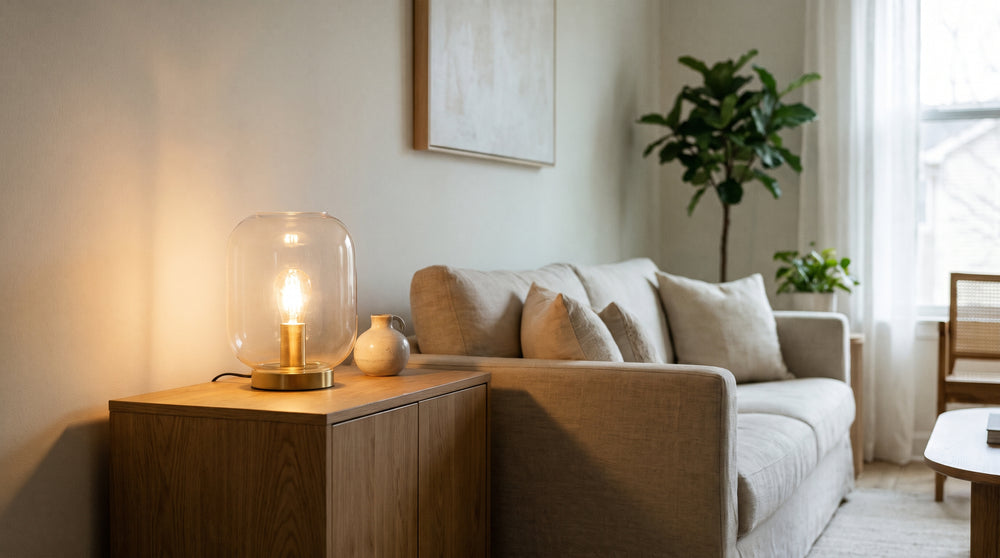
A glass globe placed on a low base diffuses a round light, with no marked direction, suited to the end of a sofa or a console. In clear or frosted glass, it lets you see the bulb and becomes an object in its own right, even switched off.
Glass shade for a bedside lamp: how to choose it?
On a bedside lamp, frosted or opal glass avoids glare when lying down, whereas clear glass shows the bulb and suits mood lighting better. The format should stay compact so it does not get in the way on the bedside table.
Ribbed glass wall light or smoked glass wall light: which to choose?
Ribbed glass cuts the light into bands and suits hallways and corridors, where you want a pattern more than crisp lighting. Smoked glass dims the beam and lowers the overall level: it is used to accompany a pendant, not as the main light.
Glass tube wall light: where to place it?
A vertical or horizontal glass tube finds its place in a corridor, a staircase or on either side of a bed, where you want grazing light that does not reach the floor. Align it with the top of a door or a headboard to stay coherent.
How to refresh a glass table?
Under a glass pendant, a transparent top reflects light upward and doubles the fixture: a matte table runner, wooden seating or colourful tableware break the reflection. Avoid stacking transparent objects. Covering the top with wood absorbs light: the room feels warmer but less bright, and the pendant loses its reflection beneath it. Keeping the glass visible, even partly, preserves that effect.




