
Dimmable E14 light bulbs
This selection is also available in our French store: Ampoules à variateur E14
No products in this selection.
- Tracked delivery to your country Tracked delivery
- Secure payment at checkout Multiple payment methods
- 14 days to change your mind 14-day returns
- Secure payment Secure payment
Not sure of your style? Find it in 30 seconds
A few questions, and we will show you the pieces made for you.
Frequently asked questions
How do I choose the right product?
What are the delivery times?
Can I return an item?
Can I pay in instalments?
An interior that reflects who you are
Carefully selected pieces, shipped from our warehouses. Our team advises you before you buy, so you choose with confidence.
- Tracked delivery
- Pay in instalments, where available
- 14 days to change your mind
- Advice & showroom in Lyon, France
First check that your fixture's dimmer accepts a dimmable bulb, then choose a model with a small E14 base. An E14 dimmer bulb is a dimmable bulb 14 mm in diameter: it screws into a bedside lamp, a wall light or a small pendant and adjusts its light without changing the fixture.
What is an E14 dimmer bulb?
An E14 dimmer bulb is a dimmable bulb fitted with a small screw base 14 mm in diameter. It is controlled from a wall dimmer or from a fixture equipped with a dimmer: the brightness goes down and up without changing the bulb, provided the dimmer is compatible.
E14 dimmer bulb: what it changes at home
On a bedside lamp, adjusting the brightness replaces two or three fixtures. The same bulb gives bright light for reading and a low glow to end the evening. The E14 base remains the small screw format, the one used on wall lights and small fixtures; for a large base, turn to the large E27 dimmer base. The action happens at the wall or on the fixture's control, never on the bulb itself.
E14 dimmable bulbs: LED or filament?
Two families coexist. LEDs give off little heat, light up instantly and dim evenly; filament models show the filament and give a more golden light. The choice therefore depends as much on the look of the fixture as on consumption. Find the dimmable bulbs for daily use and the visible filament bulbs when the fixture is open.
Which fixture accepts an E14 dimmer bulb?
The E14 base is found on bedside lamps, wall lights, small pendants and some compact ceiling lights. In these fixtures, the bulb is often visible or close to the eye: its shape, material and light tone matter as much as the way the brightness is adjusted.
E14 dimmer: bedroom, living room or hallway?
In a bedroom, a dimmable bulb accompanies reading and then bedtime: the brightness goes down without switching off abruptly. In the living room, it is used on a wall light or a small accent pendant, alongside main lighting. In a hallway, low brightness leaves a discreet night light. To go further, see the bedroom lighting and the living room bulbs.
E14 dimmable bulb on a wall light or bedside lamp
On a wall light, the bulb is often at eye level: a flame shape or frosted glass avoids glare. On a bedside lamp with a shade, size matters more than the stated wattage: measure the free height under the shade before choosing. These are the two fixtures where the small base is most common.
| Base | Fitting type | Typical fixtures | Dimmer version |
|---|---|---|---|
| E14 | small screw base | bedside lamps, wall lights, small pendants, compact ceiling lights | yes, this is what this collection is about |
| E27 | large screw base | pendants, floor lamps, ceiling lights | yes, in a dedicated collection |
| GU10 | quarter-turn lock | spotlights and adjustable ceiling lights | depending on the model |
| G9 | pin base | small fixtures, wall lights, ceiling lights | depending on the model |
| 12V or 220V | depending on the fixture | low voltage or mains installation | depending on the model |
How to choose an E14 dimmable bulb?
To choose an E14 dimmable bulb, first check that your dimmer accepts dimmable bulbs, then the base and the size under the shade, then the shape and tone according to the room. A non-dimmable bulb placed on a dimmer flickers or buzzes.
E14 dimmable bulb: checking dimmer compatibility
The words "dimmable" on the packaging are the first thing to read. The dimmer, whether wall-mounted or built into the fixture, must also accept this type of bulb. Some older dimmers only work properly with conventional loads. If in doubt, test: flickering or buzzing signals incompatibility, not a faulty bulb.
Flame, spherical or P45: which to choose?
The flame shape, slim and pointed, suits candlesticks and wall lights with a tall shade. The spherical shape diffuses widely in a globe or a small pendant. The P45, a small classic bulb, fits into compact fixtures. All exist with a small E14 base, in clear or frosted glass depending on the desired effect.
LED or filament: which E14 dimmer bulb to choose?
An E14 LED dimmer bulb suits everyday lighting: it gives off little heat and lights up immediately. A dimmable filament bulb favours the look: the filament remains visible in an open fixture and the light is warm. The choice depends above all on the look you are after.
E14 LED dimmable bulbs: everyday use
A dimmable LED keeps the same light level throughout the dimmer's range, without flickering, and consumes little on a lamp lit every evening. In a bedroom or a hallway, it is the simplest choice. All E14 LED dimmable bulbs are recognisable by the dimmable mention on the base or the packaging.
E14 dimmable filament bulb: looks first
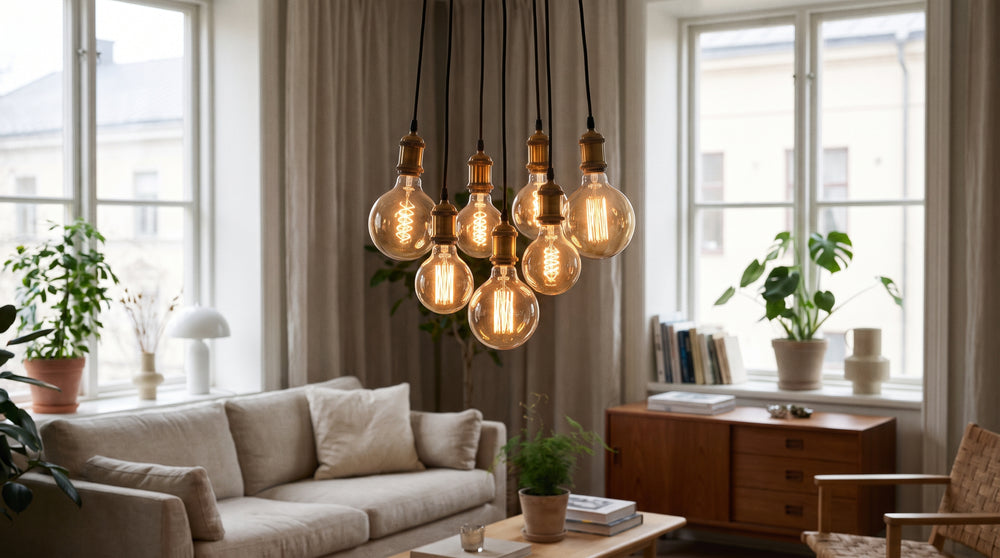
In a pendant without a shade or a glass wall light, the filament becomes a pattern: it is looked at as much as it lights. These models dim normally if they are advertised as dimmable, and their light stays warm at low brightness. Think of glass bulbs for a clean effect, and modern style bulbs for a more graphic silhouette.
| Shape | Look | Suitable fixtures | Recommended tone |
|---|---|---|---|
| Flame | slim pointed silhouette | candlesticks, wall lights, lamps with a tall shade | 2700 K |
| Spherical | round, diffuse light | globes, small pendants, bedside lamps | 2700 K or 3000 K |
| P45 | small classic bulb | compact fixtures, ceiling lights | 2700 K |
| Clear glass with filament | visible filament | open fixtures, pendants without a shade | 2700 K |
| Frosted glass | soft light, hidden filament | shades, wall lights | 2700 K or 3000 K |
Once the shape is chosen, match the tone: a warm 2700 K light suits relaxation rooms, while a 3000 K tone gives a cleaner effect for reading or working. Also check that the bulb is intended for bulbs running on 220V if your fixture plugs into the mains.
Wiring 3 bulbs in parallel: how does it work?
In a parallel circuit, each bulb receives the same voltage: the three light up together and, if one is removed, the others keep working. If they are controlled by the same dimmer, they must all be dimmable and the dimmer must accept the load of the whole set.
Wiring 3 bulbs in parallel on the same dimmer
The parallel circuit is the most common in a fixture with several light points: the wires meet on the same terminals, live and neutral. The practical consequence is simple: switching off one bulb does not switch off the others, and replacing a burnt-out bulb does not break the circuit. On a single dimmer, the control acts on all three at the same time.
What to check before connecting
Cut the power at the circuit breaker before any work, then check that the dimmer supports the total load of the circuit. Also look at the number of light points stated for the dimmer: some only accept a limited number of bulbs, even dimmable ones. If you mix technologies, flickering may appear.
How to adjust and maintain an E14 dimmer bulb?
An E14 dimmer bulb is adjusted according to the moment: high brightness for reading or cooking, low brightness in the evening for ambient light. Let the bulb cool before handling it, dust it dry and screw it in without forcing on the small base.
Settings: bright light for reading, soft light in the evening
Medium brightness is often enough to read without strain, while very low brightness leaves a pleasant night light in a hallway or entrance. On a fixture with several bulbs, first set the general level, then adjust the tone by changing the model rather than pushing the dimmer.
Changing a dimmable bulb: the simple steps
Cut the power, wait until the bulb is cold, then unscrew it gently. A dry cloth is enough to remove dust: moisture on a base brings nothing. When refitting, screw in until contact without tightening further, especially on a wall light socket fixed in a recessed box.
Which mistakes to avoid with an E14 dimmer bulb?
The most common mistakes: fitting a non-dimmable bulb on a dimmer, which causes flickering or buzzing; confusing the small E14 base with the large E27 base; choosing a bulb that is too wide for the shade. Checking compatibility before buying avoids these problems.
Non-dimmable bulb on a dimmer: what happens?
A classic bulb powered by a dimmer receives a voltage it is not designed to absorb: it blinks, buzzes, heats up abnormally and may shorten its lifespan. The phenomenon gets worse when several non-dimmable bulbs share the same dimmer. The solution is to replace the bulb, not the fixture.
E14 or E27 base: don't get it wrong
The E14 is the small screw base, the E27 the large one. An E14 bulb does not screw into an E27 socket and vice versa. If you are unsure about an old fixture, measure the diameter of the socket or consult the guide to compare the two bases. For small fixtures with pins, see the other G4 and G9 bases.
Before ordering, check your dimmer's compatibility and the clearance under the shade: this is what decides the useful model. The bulb section groups the base families, and all Designix fixtures lets you match the whole set. If you are starting from an existing fixture, note its base before looking for the fixture to equip. For a large base, the dimmable E27 LED versions follow the same principles.
Secure payment, tracked delivery, possible returns and Designix customer service: you can order the right reference with peace of mind, then adjust the tone or shape on the second fixture if needed.
Frequently asked questions
E14 dimmer bulb: what size under a shade?
Check that the bulb is advertised as dimmable and that your dimmer, whether wall-mounted or built into the fixture, accepts this type of bulb. The base must be E14. If in doubt, test the bulb on the dimmer: flickering or buzzing signals incompatibility.
E14 dimmable bulbs: what is the difference from a classic bulb?
An E14 dimmable bulb accepts a variable voltage: it shines bright or low depending on the dimmer's position. A classic bulb works on an all-or-nothing basis and does not like being powered by a dimmer. The base, however, remains identical, hence the frequent confusion.
E14 dimmer: what to do if the bulb buzzes or flickers?
A buzz or flicker almost always comes from an incompatibility between the bulb and the dimmer, sometimes from a poorly screwed contact. Cut the power, screw the bulb back in without forcing, then test again. If the problem persists, replace the bulb with a compatible dimmable model.
Can 3 bulbs be wired in parallel on the same dimmer?
Yes, bulbs wired in parallel receive the same voltage and light up together. Each must be dimmable and the dimmer must accept the load of the whole set. If flickering occurs, reduce the number of controlled bulbs or use a dimmer designed for that total.
Can an E14 filament bulb be dimmed?
Yes, provided the model is designed for a dimmer. A classic filament bulb placed on a dimmer gets damaged or blinks; a dimmable version dims normally and keeps its warm light. Check this mention before buying, it is not systematic.
Which tone to choose for an E14 bedside lamp?
For a bedside lamp, a warm light suits moments of relaxation: tones close to 2700 K make the room softer. A slightly whiter tone, around 3000 K, gives a cleaner effect if you read in bed. The choice depends on your use.




