
Ceramic floor lamps
This selection is also available in our French store: Lampadaires en céramique
No products in this selection.
- Tracked delivery to your country Tracked delivery
- Secure payment at checkout Multiple payment methods
- 14 days to change your mind 14-day returns
- Secure payment Secure payment
Not sure of your style? Find it in 30 seconds
A few questions, and we will show you the pieces made for you.
Frequently asked questions
What table size for how many people?
Which tabletop material should I choose?
Extendable or fixed?
How do I care for the tabletop?
The right furniture, in the right place
Check the dimensions with our fit checker and receive pieces made to last. Unsure? Our team will answer your questions.
- Tracked delivery
- Pay in instalments, where available
- 14 days to change your mind
- Advice & showroom in Lyon, France
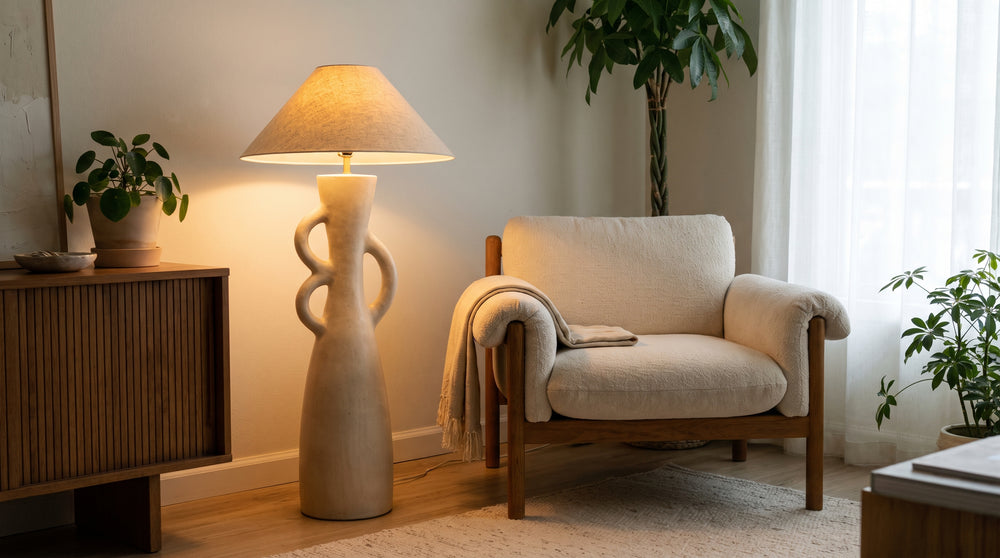
To choose a ceramic table lamp, settle three points: a glazed stoneware base if the lamp lives in a walkway, a light glaze to brighten a dark corner or a matte one to soften, and a shade that sends light downward where you read. Height and base diameter then follow the space available.
What are the two types of ceramic used for a table lamp?
This collection has 3 ceramic table lamps. Before ordering, check the material, socket, height and base diameter on each product page, then choose the shade according to the light in the room.
Ceramic table lamp: stoneware or earthenware?
Glazed stoneware gives a heavy, stable base with a smooth glaze that ranges from deep matte to high gloss. It is the choice for a busy living room, a hallway or a sofa corner where the lamp gets brushed past. Earthenware offers a freer palette, with bright or powdery tones, for a base placed in a quiet corner. Its glaze marks more easily when knocked by a hard object.
Terracotta, a ceramic apart
Terracotta stays matte, porous, with an ochre that runs from sand to brown. It receives no glaze and keeps a grainy feel that catches light rather than reflecting it. In a pale wood living room, it brings a mineral presence. To compare with other natural materials, see the wood bases for the living room.
What is the difference between terracotta and ceramic?
Ceramic is the family, terracotta one ceramic among others, along with earthenware, stoneware and porcelain. In other words, a terracotta table lamp is a ceramic table lamp, but the reverse is not true. This nuance changes care and finish: bare clay absorbs marks, glaze repels them.
Is ceramic always glazed?
No. Glaze is a layer of glass applied to the clay and then fired: it colours, protects and makes the surface smooth. Stoneware and earthenware almost always receive it, terracotta often does not. On a lamp base, glaze makes dusting easier and stops a drop of water leaving a ring.
Why terracotta marks more quickly
Without glaze, the surface stays open: a slightly greasy hand, a glass bottom set down on it or an over-wet cloth leave a pale stain. So keep it away from a kitchen door and wipe it dry. In return, it takes on an even patina, which suits an interior with vintage table lamps for the living room.
Which ceramic is the most durable for a table lamp?
Glazed stoneware comes first for a base set on the floor: dense, fired at high temperature, it withstands everyday knocks. Porcelain is hard too but finer, so more sensitive on the edges. Earthenware and terracotta chip more quickly. A sturdy base is recognisable by an even thickness and a wide foot.
| Ceramic | Appearance | Impact resistance | Care |
|---|---|---|---|
| Glazed stoneware | Dense, smooth glaze, matte or glossy | Good | Damp cloth, no abrasive |
| Earthenware | Coloured glaze, soft surface | Average, chips | Warm water, gentle drying |
| Terracotta | Matte, porous, ochre to brown | Low on edges | Dry wipe, avoid standing water |
| Porcelain | Fine, smooth, slightly translucent | Good but fine | Soft cloth, neutral product |
How can you tell if it is ceramic?
Three clues: the weight, the dull sound when you tap the body, and an unglazed base that shows the clay. A resin base copies the shape well but sounds hollow and stays warm. To find equivalents in other materials, compare with the glass table lamps for the living room.
Which type of ceramic to choose?
Glazed stoneware in a living room, earthenware for a strong colour in a corner that is rarely brushed past, terracotta for a deliberately raw finish, porcelain for a fine, light base. The decisive criterion remains the spot: the closer the lamp is to a walkway, the denser the ceramic should be.
What colour is the ceramic of a table lamp?
The tone comes from the glaze: off-white, ecru, sand, matte black, deep green, blue, terracotta or gold. A glossy glaze reflects light and lightens a dark corner; a matte glaze absorbs it and gives a softer finish. Raw terracotta, meanwhile, keeps its original ochre, with no choice possible.
White or black ceramic table lamp: what effect in a living room?
Off-white blends into the decor and makes the corner look brighter. Matte black gives structure, draws the eye to the shade and acts as an anchor point in an already bright living room. In a dark room, a light glaze stays softer. To push the logic further, look at the modern white colourways.
Warm tones, terracotta and sand
Terracotta, sand and ochre warm a living room with white walls and go with pale wood as well as rattan. A gold base plays the jewel effect near a mirror, in the same spirit as the gold metal versions. Deep green, for its part, works with walnut and brass.
Which ceramic table lamp should go in a living room?
Choose a base tall enough to light above the sofa seat, with a shade that diffuses downward and upward. A wide base stands better near a walkway, a slim base slips behind an armchair. White blends in, black makes a mark, matte softens.
| Room | Base format | Shade | Light sought |
|---|---|---|---|
| Living room, sofa corner | Tall base, wide foot | Cylindrical or drum | Diffused down and up |
| Reading corner | Stable medium base | Opaque directional shade | Direct on the book |
| Bedroom | Slim base, small diameter | Light textile | Soft, no glare |
| Office | Compact base | Low shade | Sideways, onto the desk |
| Hallway | Narrow base | Small diameter | Accent, without clutter |
At what height should a table lamp sit near a sofa?
Generally, the bottom of the shade sits around the height of the backrest, a little above the shoulder of a seated person, so roughly between 110 and 140 cm from the floor. Lower, the light hits the eyes; higher, it lights empty space. Adjust to the size of the sofa, not to an absolute figure.
Reading corner or relaxation corner: the same ceramic?
For reading, an opaque shade that directs the beam downward or an adjustable model makes the difference: see the adjustable table lamps for reading. For atmosphere, a diffusing textile shade is enough, with a matte glaze that does not throw glare. The same base can serve both if the shade is changed.
Vintage or design ceramic table lamp: which style to choose?
Vintage plays the rounded body, the glossy glaze and warm tones. Design prefers clean lines, simple volumes and matte glazes. Both go with pale wood. The choice depends above all on the room: vintage for a cosy interior, design for a pared-back living room.
Vintage ceramic table lamp for a cosy interior
A round body, a narrow neck, a glaze that catches the light: this base goes with velvet, a patterned rug, brass and rattan. It sits well with the bamboo table lamps and the vintage metal models in the same room.
Design ceramic table lamp for a pared-back living room
A cylinder, a cone, a straight stem: the volume is enough, the glaze stays matte and the colour discreet. This type of base lines up with the Nordic table lamps and the Scandinavian table lamps for the living room, with pale oak and low lines.
What are the drawbacks of ceramic?
A ceramic base is heavier and more fragile than a metal base: it fears knocks on the edges and repairs badly. It stays indoors, away from splashes. These limits can be managed: place it out of walkways, on a level floor, with felt pads under the base and a light shade.
Is a ceramic table lamp heavy to move?
Yes, a solid base weighs noticeably more than a metal stem of the same size, and you lift it with both hands holding the base, never the shade. That is also what makes it stable. Choose the spot before assembling it, then leave it alone. For a lamp you move often, a metal model stays handier, like the black metal table lamps.
Can it be placed near a door or a staircase?
Better to avoid it: a narrow walkway multiplies the risk of a knock on the edge, and a fall onto a step is dangerous. If space is short, a narrow base against the wall, out of the door's opening swing, is still workable, provided the cable does not cross the floor.
How do you set up and care for a ceramic table lamp?
Screw a bulb into the socket without forcing, check the base is stable on a level floor, then keep the cable out of the walkway. Glazed ceramic is dusted with a soft, slightly damp cloth, with no abrasive and no immersion. Raw terracotta simply gets a dry wipe.
Which bulb for a ceramic table lamp?
Follow the lamp's socket: an E27 for a large base, an E14 for a small one. A warm-white LED, around 2700 to 3000 K, suits a living room and stays cool to the touch, which matters under a closed shade. Respect the maximum wattage marked on the socket, without exceeding it.
How do you clean ceramic without damaging the glaze?
Microfibre cloth or soft sponge, warm water, no abrasive sponge or scouring product: the glaze scratches and loses its shine. Dry straight away to avoid limescale marks. On terracotta, a barely damp cloth is enough, without letting water stand in the clay. For all your lamps, see all the lighting in the house.
Ceramic table lamp: what to remember before ordering
For accent lighting, also see the ceramic table lamps.
Glazed stoneware covers most uses, earthenware brings colour, terracotta the raw finish. Then match the colour to the light in the room and the shade to what you want to light. To complete a living room, compare with the LED table lamps for the living room or the wood and metal table lamps, and for a workspace with the LED table lamps for the office. An already graphic interior will benefit from a ceramic base in a mineral space, next to an industrial metal style or a design LED table lamp model.
Your order is covered by secure payment, tracked delivery and returns; the Designix customer service answers before and after purchase. To see all the available families, browse the full lighting catalogue and the modern LED table lamps.
Frequently asked questions
Which type of ceramic to choose for a table lamp?
For a table lamp set on the floor, glazed stoneware remains the safest choice: dense, low porosity, it withstands everyday knocks and cleans with warm water. Earthenware suits if you want a very colourful glaze in a quiet corner. Raw terracotta appeals for its matte finish.
How can you tell if it is ceramic?
Ceramic is recognised by its weight, the dull sound when you tap the body, and the surface: smooth, cool glaze, or porous, matte clay. An unglazed base often shows the clay. A resin base imitates the shape well but sounds hollow and stays warm to the touch.
Is it possible to make ceramic yourself?
Yes, modelling or throwing is practised in a workshop, but firing requires a potter's kiln, much hotter than a kitchen oven. A private individual can take classes, fire their pieces in a shared workshop, then fit a socket onto a handmade base.
Is a ceramic table lamp suitable for a small room?
Yes, provided you choose a slim base and a small-diameter shade: ceramic brings material without taking up floor space. A light glaze brightens the room, a narrow base slips between an armchair and a wall. See also the design LED table lamps for the living room.
White or black ceramic table lamp: which to choose?
Off-white or ecru blends into the decor and visually brightens a dark corner. Matte black makes a mark, gives structure and draws the eye to the shade. In a bright living room, black creates an anchor point; in an already dark interior, a light glaze stays softer.




