
Brass lampshades
This selection is also available in our French store: Abat jours en laiton
No products in this selection.
- Tracked delivery to your country Tracked delivery
- Secure payment at checkout Multiple payment methods
- 14 days to change your mind 14-day returns
- Secure payment Secure payment
Not sure of your style? Find it in 30 seconds
A few questions, and we will show you the pieces made for you.
Frequently asked questions
How do I choose the right product?
What are the delivery times?
Can I return an item?
Can I pay in instalments?
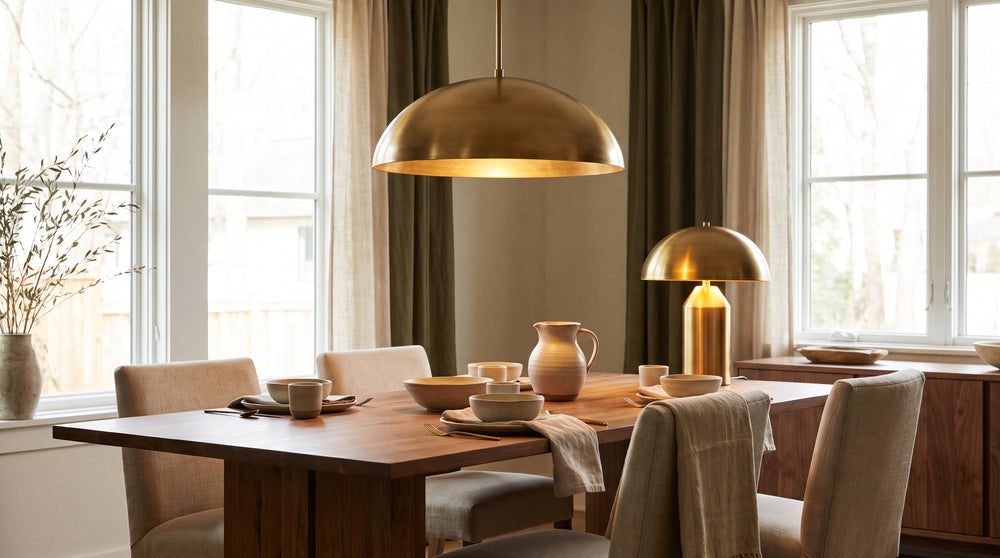
An interior that reflects who you are
Carefully selected pieces, shipped from our warehouses. Our team advises you before you buy, so you choose with confidence.
- Tracked delivery
- Pay in instalments, where available
- 14 days to change your mind
- Advice & showroom in Lyon, France
A brass lampshade is chosen first by its support, bedside lamp, floor lamp or pendant, then by its finish, brushed, gilded, hammered or patinated. It is the finish that decides the look, matte or shiny, and how the light is reflected back into the room.
What kind of light does a brass lampshade give?
A brass lampshade gives directional light and a metallic look that is more or less matte depending on the finish. Brushed brass diffuses a soft glow, gilded brass reflects light, hammered brass creates highlights. The perceived light depends above all on the socket, the bulb and the shape of the lampshade.
Brushed brass lampshade: what look?
Brushed brass has fine parallel lines that break up reflections. The result is a surface that stays matte under the light, without glare, and pairs well with light wood, a beige wall or a solid colour. It is the most discreet finish in the family, the one that lets the room breathe. It also withstands fingerprints better than a polished surface, which matters on a floor lamp you brush past.
Gilded or hammered brass lampshade: what atmosphere?
Gilded brass catches the light and reflects it towards the wall or ceiling, with a warm glow that warms up a white that is too neutral or a black that is too harsh. Hammered brass, for its part, offers an irregular surface: each dent reflects light differently, giving a lively look that is never smooth. Both stand out. Count them as a visual statement, not a detail.
How to choose a brass lampshade for the living room or the bedroom?
In the living room, a brass lampshade can highlight a floor lamp or a pendant and become a visual statement; in the bedroom, choose something more discreet, for a bedside table or a reading lamp. The priority remains the support, the space available and the level of light you want.
Living room lampshade: how much presence?
In a living space, brass stands out from a distance. A model for the living room goes on a corner floor lamp or as a pendant above a coffee table, and becomes the metallic touch that ties together a sofa, a rug and a bookcase. The point to check before settling your choice: the stability of the base and the clearance around the bulb, so the light is not blocked by the frame.
Bedroom lampshade: what light at the bedside?
At the bedside, you want low, directed light, not a spotlight. A small format on the nightstand, or a version to place for bedside lighting, is enough. Check access to the switch once the lamp is in place and the height of the lampshade relative to the mattress: it should stay below eye level when you are sitting. For a light for a baby's room, stick to a small format with a stable fixing, placed out of the child's reach, and ask for advice rather than improvising a setup.
| Room or use | Recommended support | Expected look | Point to check |
|---|---|---|---|
| Living room | Floor lamp or pendant | Visual presence and localised light | Stability and bulb clearance |
| Bedroom | Bedside lamp | Soft, directed light | Access to the switch and bedside height |
| Baby's room | Small lamp or night light | Discreet light | Stable fixing out of reach |
| Hallway | Pendant or ceiling light | Warm welcome | Ceiling height |
| Office | Desk lamp | Directed light | Reflections on the screen |
Unsure between two options? Compare models designed for the living space with models in a modern style: the support and the overall line often decide faster than the finish.
Brass, glass or fabric lampshade: how to choose the material?
Brass structures and reflects light; glass lets the flow through and is easy to clean; linen and fabric soften the look and absorb part of the brightness. For a bedside lamp, glass works if you want maximum light, brass if you are after a more lived-in presence.
Glass lampshade for a bedside lamp: what is the point?
Glass lets light pass through without filtering it: the halo is sharp, the room stays readable, and cleaning takes a quick wipe on a smooth surface. It is the logical choice on a bedside table or desk where you need to see clearly. It does, however, require a bulb that does not stand out too much, because everything shows through.
Linen or fabric lampshade: how to pair it with brass?
Linen filters the light and makes it softer, without cutting it. Paired with brushed brass, it creates a contrast of materials that works in a living room or bedroom. To go further, browse a linen lampshade and a fabric lampshade: the density of the fabric changes the look, the shade changes the atmosphere. A light fabric reflects more light, a dark fabric concentrates it downwards.
How to install a brass lampshade on a lamp, a floor lamp or on the ceiling?
You install a brass lampshade by first checking the support: screw socket, screw fixing or pendant to wire. The lampshade must stay stable and leave the bulb clear. For a floor lamp, tighten the ring without forcing it; on the ceiling, cut the power before any handling.
Brass lampshade support: how to fix it?
First read the light fitting's instructions: they indicate the intended fixing method. On a table lamp or a floor lamp, the lampshade sits on the socket or on a ring, then locks into place. Tighten by hand, without a tool that would mark the brass. Then check that the bulb touches neither the frame nor the fabric, and that the whole thing does not tip when you brush the base.
How to hang a lampshade from the ceiling?
Cut the power at the circuit breaker before anything. Fix the support according to the instructions, wire the socket, then lock the lampshade. The whole thing must stay stable and the bulb must not come close to the edge. If the fixing point seems weak or the wiring is not clear, have it checked by an electrician: it is a point that cannot be put right afterwards.
How to change the fabric of a brass lampshade?
To change the fabric, you take the lampshade apart, note the template of the old fabric, cut the new one keeping a margin, then fix it to the frame before reassembling. An old brass lampshade can be kept if the frame is sound; the fabric, on the other hand, is easier to replace.
How to change a lampshade's fabric?
Remove the lampshade and lay the old fabric flat: it serves as a pattern. Transfer the shape onto the new fabric adding a margin of a few millimetres, cut it out, then fix it to the frame by gluing or sewing depending on the mount. Reassemble and check that the bulb stays clear. If you would rather avoid sewing work, replacing the lampshade fabric with a complete model is often simpler.
Old brass lampshade: repair or replace the fabric?
Look at the frame first: if the rings are straight and the solder sound, replacing the fabric gives the piece years more life. If the metal is split, bent or heavily corroded, better to change the whole lampshade. For an old lampshade, keep the brass patina and treat only the textile.
How to care for a brass lampshade and stop it oxidising?
A brass lampshade is cared for with a soft, dry cloth; avoid standing water and abrasive products. Brass can patinate over time, which changes its appearance without stopping it working. To keep a brushed or gilded finish, limit rubbing and dust regularly.
How to stop brass oxidising?
Brass is most vulnerable to moisture that lingers. Dust with a dry cloth, dry immediately if a damp cloth has been used, and store the piece in a ventilated place. A film of neutral wax on rarely touched areas slows tarnishing. Avoid abrasive powders and green scouring pads, which scratch the surface and open the way to uneven oxidation.
Vintage brass lampshade: how to keep the patina?
On a vintage brass lampshade, the patina is part of the object: it marks the recesses and gives relief. Clean without polishing, focusing only on dust. If you want a uniform shade, be aware that polishing removes the patina and is hard to reverse. Brushed brass, for its part, only needs regular dusting.
| Finish | Appearance | Care | Pairing |
|---|---|---|---|
| Brushed | Matte glow and visible lines | Soft cloth | Light wood and solid colours |
| Gilded | Warm, bright reflections | Avoid abrasive products | White, black, velvet |
| Hammered | Irregular surface and shifting reflections | Dust without rubbing hard | Textured materials |
| Old or patinated | Darker, more marked shade | Preserve the patina | Vintage and flea-market style |
How to tell if it is real brass?
Brass is an alloy of copper and zinc, often yellow and more matte than red copper. You recognise it by its colour, its weight and the way it patinates; a magnet is not enough, because some brass finishes are on steel. If in doubt, ask the seller for the material data sheet.
How to tell copper from brass?
Copper leans towards orange-red and is fairly soft; brass, more yellow, is harder under the fingernail. In use, copper often patinates towards verdigris, brass towards a darker, browner tone. Colour, weight and the material data sheet remain the three most reliable clues, before any risky test on a finished piece.
How to recognise a solid or plated brass lampshade?
Solid brass has the same shade on the outside and on an edge or a hidden rim. Brass plating on steel is often spotted with a magnet, a lighter weight than expected or a difference in shine around screws and fittings. None of these observations is worth a material data sheet: ask for the exact composition and the stated finish.
Brass chandelier or brass lampshade: which solution to choose?
A brass chandelier works when the room needs a central point and downward light; a brass lampshade is chosen for a bedside lamp, a floor lamp or a more localised pendant. Brushed brass light fittings pair with matte materials, gilded brass with light woods or solid fabrics.
Brass chandelier: when to prefer it?
The brass chandelier structures a tall room, hallway, dining room, stairwell, and gives overall light. It requires a ceiling fixing point and enough volume not to look squashed. Conversely, a lampshade on a floor lamp or a lamp brings the light down to the level of use, reading, meals, work, and moves if needed.
Brushed brass light fitting: how to match it to the rest of the room?
A brushed brass light fitting stays understated: it accepts light wood, off-white, white-colour finishes and natural tones. Gilded brass handles a strong contrast better, with the black-colour version or a velvet. For a more current line, look at a contemporary line and keep the metal as the only accent.
Designix supports this choice from start to finish: secure payment, tracked delivery, returns and customer service to answer fixing or material questions. Browse the lampshade collection as a whole and the world of light fittings to place each piece in its context.
Frequently asked questions
Is brass valuable?
Brass has value as a material: it is an alloy of copper and zinc, recyclable and sought after for its warm look. Its value then depends on the workmanship, the finish and the condition of the object. A brass lampshade is therefore judged as much on its manufacture as on its appearance.
Which is more expensive, bronze or brass?
Bronze is generally more expensive than brass, because its casting and working are heavier. The price depends above all on weight, workmanship and finish, not only on the name of the metal. For a lampshade, compare the stated material and the quality of assembly.
How to tell copper from brass?
Copper is orange-red and fairly soft; brass, an alloy of copper and zinc, leans yellow and is harder. Copper often patinates towards verdigris, brass towards a darker tone. Colour, weight and the material data sheet help you decide.
How to stop brass oxidising?
To limit oxidation, keep brass dry, dust with a soft cloth and avoid abrasive or overly damp products. A light film of neutral wax can protect rarely handled surfaces. A patina that sets in does not stop the lampshade being used: it only changes its appearance.
How to change a lampshade's fabric?
Take the lampshade apart, cut a template from the old fabric, transfer the shape onto the new fabric keeping a margin, then glue or sew it onto the frame. Reassemble and check that the bulb stays clear. If in doubt about the mount, a complete lampshade is safer than a badly fitted textile.




