
Wireless LED strips
This selection is also available in our French store: Réglettes LED sans fil
No products in this selection.
- Tracked delivery to your country Tracked delivery
- Secure payment at checkout Multiple payment methods
- 14 days to change your mind 14-day returns
- Secure payment Secure payment
Not sure of your style? Find it in 30 seconds
A few questions, and we will show you the pieces made for you.
Frequently asked questions
How do I choose the right product?
What are the delivery times?
Can I return an item?
Can I pay in instalments?
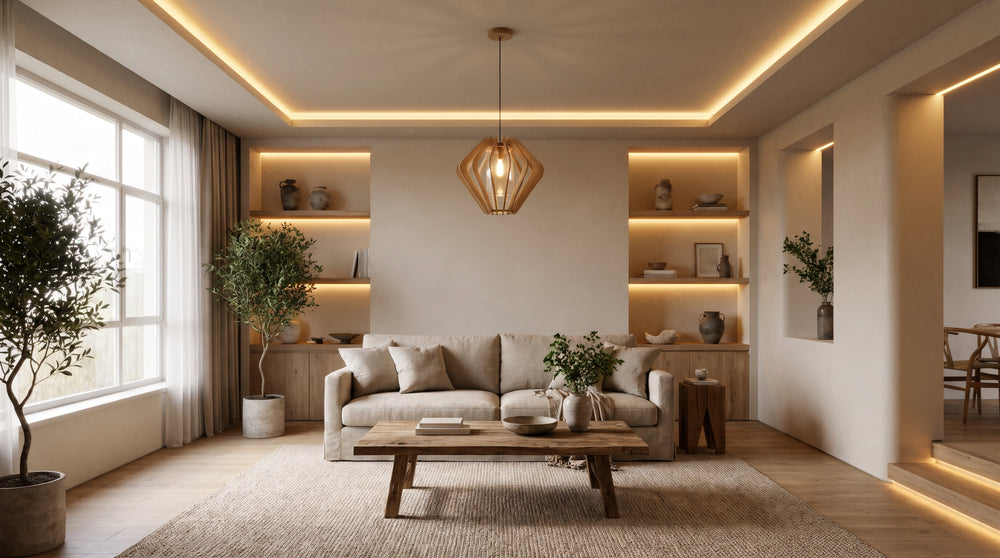
An interior that reflects who you are
Carefully selected pieces, shipped from our warehouses. Our team advises you before you buy, so you choose with confidence.
- Tracked delivery
- Pay in instalments, where available
- 14 days to change your mind
- Advice & showroom in Lyon, France
Stick the strip under the shelf, on the ceiling of a cupboard or above the worktop: it lights without any cable reaching the mains. It is a long, slim luminaire powered by a rechargeable battery or batteries, switched on by hand, by remote control or by motion.
What is a battery LED strip light and what is it for?
It is first used to light a place where running an electrical line would be long, expensive or impossible: inside a cupboard, under a shelf, a stair step, a bathroom cabinet. The luminaire is self-contained, often only a few millimetres to a few centimetres thick, and is installed in minutes.
Its appeal lies in three things: no connection, the ability to move it from one piece of furniture to another, and immediate switching on when your hands are busy. The light itself is a choice: a diffusing model lights widely under a shelf, a narrower profile underlines a line. To compare the available formats, browse all LED strip lights and spot the ones that match your furniture.
| Type of strip light | Power supply | Where to install it | Point to check |
|---|---|---|---|
| Battery LED strip light | Replaceable batteries | Cupboard, drawer, night light | Battery format and replacement frequency |
| Rechargeable battery LED strip light | USB rechargeable battery | Wardrobe, worktop, shelf | Charging cable included and charging time |
| Battery LED strip light with motion sensor | Battery or batteries | Staircase, hallway, garage entrance | Adjustable range and delay |
| 220V LED strip light | Mains connection | Kitchen, workshop, garage | Presence of an electrical supply |
| Waterproof LED strip light | Sealed profile, damp use | Outdoors, cellar, dusty room | IP rating and sealing of the mount |
Battery LED strip light with rechargeable battery
The battery recharges through a USB port, often in a few hours, and the strip light detaches from its mount to go back on the cable. This is the most flexible format for furniture you open every day: no batteries to buy, no cover to unscrew. Look above all at the stated capacity in mAh, whether the cable is in the box and how easily the mount releases. The selection of USB rechargeable models is a good starting point.
Battery LED strip light with switch
A button on the luminaire, sometimes a simple touch, and the light comes on without a remote control or an app. This mode suits cupboards that are rarely opened and cellars, because it uses nothing between two uses. You do, however, need to be able to reach the button: on a high shelf, a switch placed at the end of the profile changes everything. To place these strip lights within the whole range, take a look at our lighting universe.
Where to install a battery LED strip light in the home?
In all the spaces where power is missing and ceiling light arrives poorly: inside a wardrobe, the back of a cupboard, under wall-mounted kitchen units, staircase, hallway, garage, bathroom cabinet. The check to make before choosing is simple: is the place dry, damp or dusty, and can you reach the strip light to recharge it?
A staircase is treated in small touches, a short strip light per step or a single one at the top of the flight, rather than a continuous line that dazzles. A garage needs useful light above the workbench: see the strip lights designed for a garage. In a workshop, the strip light is placed as close as possible to the work area, never in the line of sight.
Battery wardrobe lighting: under the shelf or at the top of the unit
Under the shelf, the light falls on clothes and drawers without dazzling: this is the most useful position. At the top of the unit, it lights the room and serves as a night light. One strip light per bay is enough in most wardrobes, and a sensor model saves you hunting for the switch with full hands. For a wet room, see instead how to equip a wet room.
Battery LED strip light for kitchen and worktop
The goal is to light the chopping board, not the wall. Place the strip light set back from the edge of the wall unit, towards the front, so the light falls on the worktop. A dimmable model lets you lower the intensity in the evening. Check resistance to steam and cleaning, and access to the charging port if the strip light is fixed under a fixed unit. A workshop is treated the same way, with workshop lighting placed near the bench.
How long does a rechargeable battery LED strip light stay on?
It is impossible to give a single figure: battery life depends on battery capacity, the length of the profile, the intensity chosen and the switching mode. A sensor strip light that lights for thirty seconds per pass lasts incomparably longer than a model left on continuously for two hours. Trust the capacity in mAh and whether the charging cable is included.
Be wary of battery lives stated in days without specifying use: they often assume a few activations per day. A strip light used as a daily work lamp recharges about once a week in moderate use; a model used several hours a day far more often.
Battery capacity and real battery life
At equal length, a higher-capacity battery lasts longer, but it makes the profile heavier and lengthens charging. A short, slim strip light with a modest battery is enough for a cupboard. For sustained daily use, compare rechargeable battery strip lights on capacity rather than looks. Charging time also counts: a strip light out of action for a whole night is useful only every other day.
Motion sensor or continuous lighting: what drains the battery
The sensor is the most economical mode: the strip light only draws power during the few seconds of lighting. Continuous lighting drains the battery in proportion to usage time and intensity. In between, a manual switch avoids unnecessary activations. If the strip light stays on several hours a day, a mains-connected model becomes more consistent: see connecting to 220V.
How does a battery LED strip light with motion sensor work?
A passive infrared sensor detects the heat of a moving body, switches the strip light on for an adjustable duration, then off. No contact, no remote control. This is the most comfortable mode on a staircase or in a hallway, provided the luminaire is kept away from areas of constant movement that would trigger it non-stop.
Location matters more than the spec sheet: a sensor facing a window or near a radiator triggers at the wrong time. Point it towards the circulation area, not into the room. Strip lights that switch on as you pass are chosen first for the flexibility of their settings.
Adjusting range and delay
The useful range goes from a few tens of centimetres to several metres depending on the model, and the delay is often set between a few seconds and a few minutes with a small potentiometer. On a staircase, aim for a delay long enough to climb without the light going out on the way. In a cupboard, the opposite: a few seconds are enough and preserve the battery.
Mains-powered battery LED strip light with motion sensor
The mains version uses the same sensor but frees you from recharging, which allows prolonged lighting or higher intensity. It requires an electrical supply nearby, so another installation job. Compare the two approaches on the mains version with sensor before deciding.
How to fix a battery LED strip light without drilling?
Clean the surface, dry it, mark the position with a pencil, then press the adhesive tape or clip the magnetic mount on, pressing firmly for a few seconds. The adhesive cannot be repositioned: a first crooked bond costs you a new strip. Avoid bare wood, fresh plaster and walls exposed to kitchen grease.
On furniture that is regularly cleaned or a strip light often removed for recharging, the magnetic mount changes everything: the luminaire lifts off with one hand and goes back without realigning anything. Conversely, a strip light placed on a staircase must hold without play, because a drop is immediately noticeable.
Adhesive fixing or magnetic mount
Adhesive suits smooth, stable surfaces: laminate, glass, painted metal, tiles. The magnetic mount requires a plate glued or screwed on, onto which the strip light attaches. Both are equal in dry interiors; in damp environments, prefer a mechanically fixed plate so the whole thing does not slide. The product sheet always states the system supplied.
When to screw the mount rather than glue it
Screw as soon as three conditions come together: the surface is uneven, the strip light is often removed, or the place is damp. Two screws are enough in wood or a suitable partition. Once the height is set, measure the length of the profile and the gap between fixings before drilling: a badly aligned mount makes the strip light hang on one side.
Which IP rating to choose for a battery LED strip light?
IP20 is enough in a cupboard or dry unit. As soon as there is humidity or splashing, move to IP44, and to IP65 for outdoors and dusty premises. The rating describes resistance to dust and water, never the quality of the light: an IP65 strip light can very well have poor colour rendering.
| Room or environment | Recommended IP rating | Why |
|---|---|---|
| Cupboard, wardrobe, unit | IP20 | Dry room, no water splashing |
| Kitchen and worktop | IP20 to IP44 | Steam and worktop cleaning |
| Bathroom | IP44 minimum | Humidity and splashes |
| Garage and workshop | IP44 to IP65 | Dust and splashing |
| Outdoors and terrace | IP65 | Rain and dust |
Battery LED strip light for bathroom: which IP rating
Aim for at least IP44 in the wet room, and a sealed profile rather than an exposed circuit. The strip light is placed above the mirror, in a unit or on a niche, never within direct reach of the shower jet. Humidity also affects the fixing: a screwed plate holds better than adhesive on wet tiles. Waterproof versions settle the water question.
Outdoor LED strip light: IP65 and fixing
Outdoors, IP65 is the usual benchmark for resisting rain and dust, but the battery dislikes cold and direct sunlight. Place the luminaire under a canopy, facing the area to be lit. The IP65 selection is a starting point, and for a covered terrace, also see how to light a terrace without wires.
Battery LED strip light or cuttable LED tape: what is the difference?
The strip light is a finished luminaire, ready to install, often self-contained: you take it out of the box, fix it, it lights. LED tape is a flexible roll, powered by a transformer, cut on printed marks to follow a line. The first goes to a precise light point, the second to a continuous line of light.
The choice therefore comes down to geometry, not style: under a short, isolated shelf, the strip light is simpler. Along a low unit or in a ceiling coving, the tape gives a regular line. Note that tape requires a power supply and often hides a transformer to house: see the LED strip light range if you prefer to avoid that step.
Cuttable LED tape: how it works
The tape is cut with scissors, only on the marks printed at regular intervals, never between two marks or you lose the last diodes. The cut portion can be re-powered with a suitable connector, provided the voltage indicated by the manufacturer is respected. Measure the required length twice before cutting; a cut-off cannot be undone.
When to prefer a 220V strip light or a wired wall light
If an electrical supply exists nearby and the luminaire is used several hours a day, the wired version avoids all recharging. A wired wall light suits circulation areas and headboards, a 220V strip light suits worktops. For exposed outdoors, compare the models for exposed outdoors.
Which criteria to check before buying a battery LED strip light?
Line up seven points in this order: length and bulk, colour temperature, diffusion, switching mode, power supply and recharging, IP rating, fixing system. A model that fails on one of these points ends up at the back of a drawer, even if its light is beautiful. Measure the location with a tape before ordering.
Length, colour temperature and diffusion
Allow the available length minus a few centimetres, so it does not knock against a wall. For light, a warm white around 2700 to 3000 K suits bedrooms and wardrobes, a neutral white around 4000 K suits worktops and workshops. A milky diffuser softens the light point and avoids reflections on a worktop. Compare the renderings in all the home's luminaires.
Battery, charging and fixing: the checklist
Check the battery capacity, whether the USB cable is included, the charging time, the switching mode and the type of mount supplied. If the strip light is removed every week, a magnetic or screwed mount is preferable to adhesive alone. Once these points are validated, the choice comes down to finish and length, not the spec sheet.
At Designix, orders are paid securely, shipping is tracked and returns are provided for if the model does not match the measurement taken. Customer service answers dimension questions before purchase, so make the most of it.
Frequently asked questions
What is the battery life of a rechargeable battery LED strip light?
Battery life depends on battery capacity, the length of the strip light and the switching mode: a sensor that lights for a few seconds per pass saves charge, continuous lighting drains it quickly. Compare the stated capacity in mAh and the charging cable included in the box.
Battery LED strip light with motion sensor: how does it work?
A passive infrared sensor detects movement and switches the strip light on for an adjustable duration, then off. Range and delay are often set with a small potentiometer. This is the most battery-efficient mode for a staircase, hallway or cupboard, provided areas of constant movement are avoided.
Can you install a battery LED strip light in a cupboard without a power socket?
Yes, that is the intended use: the strip light runs on a rechargeable battery or batteries and sticks under a shelf or on the ceiling of the cupboard. Simply remove it to recharge via USB, then put it back on its magnetic or adhesive mount.
How to fix a battery LED strip light without drilling?
Most are installed with adhesive tape or a magnetic mount supplied, on a smooth, clean and dry surface. For a durable fixing on bare wood or a painted wall, a screw mount remains safer, especially if the strip light is often removed for recharging.
Which battery LED strip light to choose for a bathroom?
You need an IP rating suited to humidity, at least IP44, and avoid models that are simply IP20, designed for a dry cupboard. A rechargeable strip light is fixed above the mirror or in the unit, without running a cable near water points.




