
Bathroom lampshades
This selection is also available in our French store: Abat jours pour salle de bain
No products in this selection.
- Tracked delivery to your country Tracked delivery
- Secure payment at checkout Multiple payment methods
- 14 days to change your mind 14-day returns
- Secure payment Secure payment
Not sure of your style? Find it in 30 seconds
A few questions, and we will show you the pieces made for you.
Frequently asked questions
How do I choose the right product?
What are the delivery times?
Can I return an item?
Can I pay in instalments?
An interior that reflects who you are
Carefully selected pieces, shipped from our warehouses. Our team advises you before you buy, so you choose with confidence.
- Tracked delivery
- Pay in instalments, where available
- 14 days to change your mind
- Advice & showroom in Lyon, France
In a bathroom, the material decides before the style: glass, metal or coated fabric withstand steam, while rattan and paper stay away from splashes. Then check the fitting, ceiling, wall or mirror lamp, and the socket diameter. Colour comes last, it only sets the feeling of brightness.
Which bathroom lampshade should you choose when the room is damp?
Start from the material, not the shape. This collection currently has no lampshades: we prefer not to announce anything about sockets, protection ratings or dimensions rather than put forward unverified figures. The criteria to watch remain the same: what withstands steam, what protects the bulb from splashes, and what cleans without effort. A closed lampshade shelters the socket, an open model lets more light through but exposes the socket.
In the morning, in front of the mirror, you want a clear light that does not lie about your complexion. In the evening, in the bath corner, you look instead for a low, warm light. The same fixture does not do both: it is often the wall light that handles the first use and the accent lamp that handles the second. To compare the available bases, browse the lampshade guide.
Glass bathroom lampshade: what it brings near the mirror
Glass fears neither steam nor a damp cloth, and it gives a clear light suited to above the sink. It matches light tiles and chrome taps effortlessly, and wipes clean in one gesture with no risk of staining. Slightly frosted glass softens the result if the room is small.
Rattan bathroom lampshade: where to place it safely
Rattan brings warmth and filters light by casting soft shadows. Place it on a shelf, in a dry corner, near a window, never directly above the bathtub. Keep its care dry, with a feather duster or a brush vacuum, because repeated humidity warps it. Fabric models follow the same logic of distance.
Where should you install a lampshade in the bathroom?
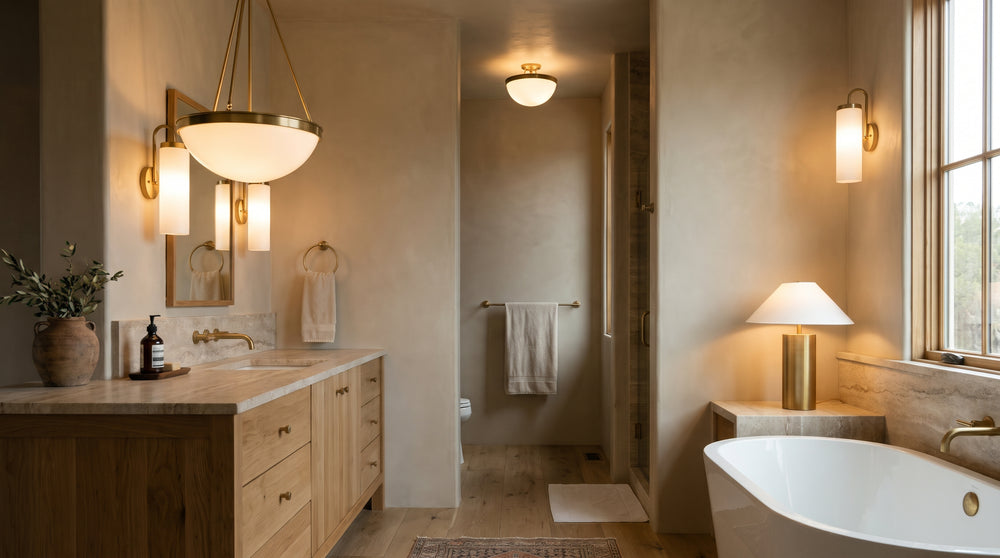
Three locations really work: the ceiling to light the whole room, the wall to light the face, the shelf for evening light. Ceiling and wall keep the fixture out of splashes and free up the vanity surface. A low pendant, on the other hand, gets in the way as soon as the room is narrow.
| Location | Lampshade type | What it changes | To avoid |
|---|---|---|---|
| Ceiling | Closed lampshade or dome | Lights the whole room, clears the furniture | A model that hangs too low |
| Wall above the mirror | Wall light or wall lampshade | Lights the face without cast shadow | Mounting in a splash zone |
| Corner or shelf | Small table lamp lampshade | Evening accent light | A cable trailing on the floor |
| Near the bathtub | Glass or metal model | Ambient lighting | Thin fabric and paper |
Ceiling bathroom lampshade: the choice for a low room
A ceiling light spreads wide and leaves the walls free. In a room under a slope or with little height, prefer a flat dome or a recessed lampshade: what hangs too low catches the eye and blocks movement. The light then falls without glare.
Wall bathroom lampshade: the light above the mirror
Placed at face height, the wall light lights the complexion without shadow under the eyes, which no ceiling light can do. In practice, it connects to an existing box or is added as a cable wall light. The result matters more than the format: see our lighting catalogue and the shapes in a modern style.
Which lampshade material best resists humidity?
Glass and metal age without warping. A coated fabric holds if the room is ventilated. Linen, rattan and paper mark on repeated contact with steam. Also look at cleanliness: what wipes with a sponge stays clean longer than what can only be dusted.
| Material | Behaviour in humidity | Where to install it | Care | Light result |
|---|---|---|---|---|
| Glass | Unafraid of steam | Above the mirror, on the ceiling | Damp sponge then wipe | Clear, slightly diffused light |
| Coated fabric | Holds if the room is ventilated | Wall light, mirror lamp | Dry dusting | Soft light, no reflection |
| Metal | Resists well, watch the fittings | Ceiling, wall light | Soft cloth, non-abrasive product | Light directed downwards |
| Rattan or wood | Keep away from water splashes | Shelf, dry corner, near the window | Regular dusting | Filtered light, play of shadows |
How to recognise a fabric that will withstand steam
A coated fabric has a smooth, slightly satin surface: a drop beads on it instead of being absorbed. If the textile drinks water on first contact, it will mark. Ventilation does the rest: a bathroom with extraction handles a taut fabric, a room without ventilation damages it within a few months.
What ages badly in a wet room
Paper warps, fine linen stains from splashes, untreated rattan warps near the tub. These materials stay beautiful, but they need a well-ventilated room and high mounting. To keep them for a long time, better to move them out of the splash zone: see the lampshade collection and the linen lampshades for dry rooms.
Which lampshade colour for a small, dark bathroom?
In a narrow, dim room, a light colour or translucent glass reflects light and visually enlarges. Black works if it is placed against a light wall with a generous bulb: it adds structure without switching off. Natural rattan warms white walls that seem cold.
Black bathroom lampshade: how to match it without darkening
Black absorbs light: you must therefore compensate with the surroundings. A light wall behind, matte tiles, a mirror that reflects the beam, and the contrast becomes a decorative choice rather than a source of shadow. Avoid black on all four walls, where it weighs the room down. Black colours read better as a wall light than as a ceiling light.
White, clear glass or natural rattan: the brightest
White and clear glass reflect light without tinting it, which suits windowless rooms and small volumes. Natural rattan transmits an amber, warmer light that gives character to a white wall. See the white finishes to stay in clarity.
How to match the lampshade with the decoration of the rest of the house?
Repeating the same family of materials from one room to another gives a coherent home: a linen lampshade in the living room, a version that withstands humidity in the bathroom. Keep a range of shades and a type of light, then adapt the material to the constraints of the room. Continuity shows more than exact repetition.
Kitchen decoration: which materials to repeat?
A kitchen and a bathroom share the same need for washable materials. In the wet room, a glass lampshade cleans with soapy water then dries with a soft cloth, and a neutral-light bulb avoids distorting the complexion in front of the mirror. For dry rooms, see a lampshade for the living room.
Can modern kitchen decor inspire the bathroom?
Yes, on three points: simple lines, washable materials, shared shades. Modern kitchen decor relies on clean shapes and few ornaments, which ages well in a small wet room. The same sobriety comes in lampshades for the bedroom and lampshades for a baby's room when you want a soft light.
How to install and care for a bathroom lampshade?
Before buying, measure the socket and the free height under the ceiling: a lampshade screws or clips onto the existing support. For care, dust dry, wipe glass with a sponge and let it dry before refitting. A clean, well-fitted lampshade lights better and lasts longer.
Changing the lampshade without changing the fixture
Most sockets are E27 or E14: the mounting diameter and the shape of the ring decide compatibility. Also note the floor footprint and the total height once mounted, because a wide lampshade under a low wall light masks the light. Lampshades for pendants and table lamps are chosen on these dimensions.
Cleaning a bathroom lampshade without damaging it
Textile: feather duster or gentle vacuuming, never water. Glass: damp sponge, wipe with a microfibre cloth, dry fully before refitting to avoid marks. Metal: soft cloth, no abrasive product that scratches the finish. Always cut the power before removing the lampshade.
Which light for a bathroom: colour and diffusion?
A lampshade does not light, it filters. An opaque model concentrates light upwards and downwards, a translucent model diffuses it throughout the room. In a bathroom, you look for even diffusion that renders the complexion accurately in front of the mirror, rather than a narrow, contrasted beam.
Light colour for a living room or a bathroom: warm or neutral?
A warm light, around 2700 to 3000 kelvins, suits relaxation: in the evening, before bed. A more neutral white, around 4000 kelvins, helps you see clearly in front of the mirror in the morning. Choose the bulb first according to use: the lampshade only softens that result. See all Designix lighting for the bases.
Opaque or translucent lampshade: the effect on light
The opaque directs the beam upwards and downwards, which creates a dark zone at eye level. The translucent spreads light and erases hard shadows, more comfortable in a small volume. In a wet room without a window, the translucent avoids the cave effect.
Which fixture for toilets and small wet rooms?
In a toilet or a small wet room, a compact ceiling light or a wall light is enough and does not clutter. Choose a washable material, a warm light and high mounting, out of reach of wet hands. If the room has no window, a translucent lampshade completely changes the sense of space.
Can a living room lampshade be used in the toilet?
Technically yes, if the socket matches and the material withstands humidity. A fine fabric or paper, perfect in the living room, marks quickly in a poorly ventilated wet room. Prefer a glass or metal model, mounted high, and keep textiles for dry rooms.
Small room without a window: which light?
A translucent lampshade, a warm white bulb and a light wall are enough to pull a windowless room out of the cave effect. Add a mirror to reflect light and avoid ceiling lights that point too much at the floor. For very small volumes, a wall light advantageously replaces a pendant.
On the ordering side, everything is covered: secure payment, tracked delivery, returns and Designix customer service to help you choose. To broaden your search to other rooms, explore the full lighting range and compare materials before setting your budget.
Frequently asked questions about the bathroom lampshade
How to choose a fixture for the toilet?
In a cramped toilet, a compact ceiling light or a wall light is enough: the light falls without clutter. Choose a closed lampshade to avoid reflections in the mirror, in glass or metal if the room is damp. A warm light makes the space more welcoming than a cold white.
Which light colour for a living room?
A warm light suits relaxation: living room in the evening, bedroom, bath before bed. A more neutral white helps you see clearly in front of the mirror. Choose the bulb first according to use, the lampshade only filters and softens that result.
Can a dining room chandelier lampshade be used in a bathroom?
Yes, on two conditions: check the socket diameter and the material. A fabric chandelier lampshade gives a soft light, but in a damp room a glass or metal model holds up better over time. Measure the footprint before installing.
Does a large chandelier for high ceilings have its place in a bathroom?
Rarely, except in a very large wet room with an island bathtub and a high ceiling. A large chandelier hangs low and clutters an average-sized bathroom. Prefer a ceiling light or a wall light: light is more useful above the mirror than in the centre of the ceiling.
Modern dining room chandelier and bathroom ceiling light: what difference?
For a living room, a central pendant lights the whole room and is chosen according to ceiling height; an accent lampshade, placed on a table lamp or a floor lamp, provides reading light. The two complement each other more than they replace each other.
The dining room chandelier lights a table and is looked at from afar; the bathroom ceiling light lights a short circulation and gets dirty quickly. The first favours shape, the second washable material and light towards the mirror. The style can be identical, use decides.
Dining room fixture and bathroom fixture: the same criteria?
Yes in substance: material, size, light colour. The difference lies in humidity and care. In a dining room, fabric, linen or paper are fine; in the bathroom, prefer what cleans and withstands steam. The mounting also changes: ceiling or wall rather than a low pendant.
Ceiling lampshade or wall light in the bathroom?
The ceiling light lights the whole room and frees the walls; the wall light places the light above the mirror, at face height. In a small bathroom, the wall light is easier to fit than a pendant. The two can coexist: ceiling light for ambience, wall light to see yourself.




