
Aluminum lampshades
This selection is also available in our French store: Abat jours en aluminium
No products in this selection.
- Tracked delivery to your country Tracked delivery
- Secure payment at checkout Multiple payment methods
- 14 days to change your mind 14-day returns
- Secure payment Secure payment
Not sure of your style? Find it in 30 seconds
A few questions, and we will show you the pieces made for you.
Frequently asked questions
How do I choose the right product?
What are the delivery times?
Can I return an item?
Can I pay in instalments?
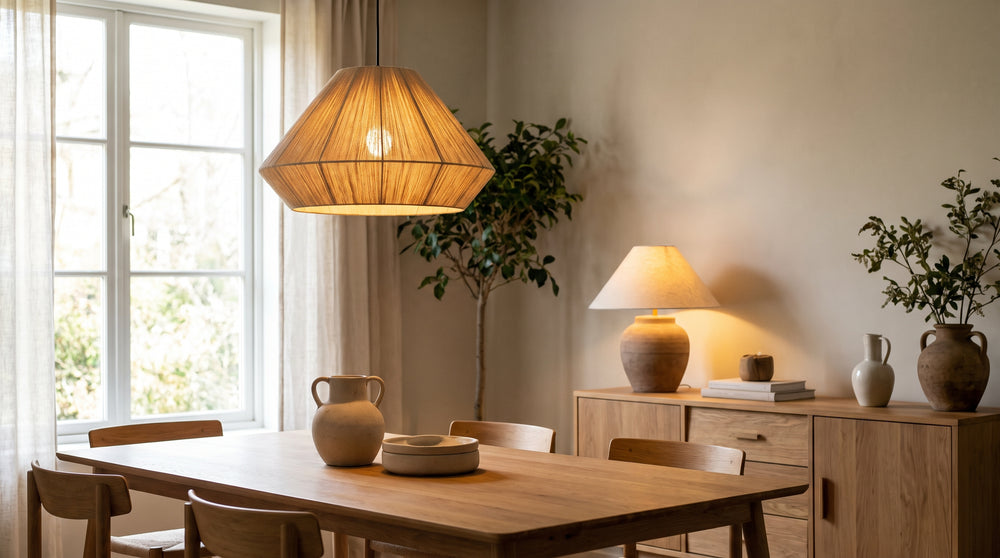
An interior that reflects who you are
Carefully selected pieces, shipped from our warehouses. Our team advises you before you buy, so you choose with confidence.
- Tracked delivery
- Pay in instalments, where available
- 14 days to change your mind
- Advice & showroom in Lyon, France
Check the fitting (socket or frame) and the available diameter, then choose the shape according to the fixture: cone or cylinder for a floor lamp, cone opening downwards for a pendant, compact format for a table lamp. The aluminium light shade keeps a clean line over time, dusts off in one wipe and reflects light without tinting it.
Which type of aluminium light shade should you choose?
The type of light shade depends on the fixture it is dressing: on a floor lamp, a conical or slightly flared shape; on a pendant, a cylinder or a cone opening downwards; on a table lamp, a compact format that leaves the socket accessible. The fitting and the diameter are checked before purchase, never after.
Aluminium light shade for a floor lamp
On a tall stem, the light shade should stay wider than the base to avoid an upside-down mushroom effect. A slightly flared cone casts light downwards and to the sides, which lights a reading corner without glare. A cylinder gives a straighter, more contemporary line. In both cases, measure the diameter of the top of the stem and the height between the socket and the top: that is what determines whether the light shade sits right.
Aluminium light shade for pendant and ceiling light
Above a table, a cone opening downwards concentrates light on the worktop and leaves the top of the room darker. A cylinder spreads it more and suits a hallway or an entrance better. For a ceiling light, choose a low and wide shape that does not crush the ceiling height. Black metal marks the silhouette on the ceiling, brushed aluminium stays more discreet.
| Fixture | Recommended shape | Fitting to check | What to measure |
|---|---|---|---|
| Floor lamp | Conical or cylindrical, wider than the stem | Socket or frame | Stem diameter and available height |
| Table or bedside lamp | Small cylinder or cone | E14 or E27 socket | Height between socket and base |
| Pendant | Cone opening downwards | Socket with ring | Desired diameter above the table |
| Ceiling light | Low and wide shape | Screw-on socket | Distance to ceiling and direction of light |
| Wall light | Half-cylinder or truncated cone | Socket | Depth from the wall |
To compare the available shapes, browse all the light shades in the shop and keep in mind the dimensions you noted at home. If you are also looking for the stem or pendant that will go with it, our lighting universe gathers the compatible bases.
Black or brushed aluminium light shade: which finish should you choose?
Brushed aluminium reflects light gently and hides fingerprints; black aluminium absorbs light and draws a clean, more graphic silhouette. Gold warms up a room in neutral tones. All these finishes are chosen according to the atmosphere you want and the care you accept.
Brushed aluminium light shade: light and fingerprints
Brushed metal has fine streaks that diffract light instead of reflecting it in one block. The result is a soft halo, without hard reflection, which suits a desk where you work in the evening. For care, micro-scratches show less than on polished metal, and a dry cloth is enough to erase hand marks. It is the most forgiving finish in a home where lamps are often touched.
Black aluminium light shade: a more graphic silhouette
Matte black contains light downwards and lets the light shade read as a pure shape, almost a drawing in the room. It matches black metal, smoked glass or dark wood. On the other hand, dust shows faster on matte black than on light brushed metal: regular dusting keeps the whole thing clean. Black finishes also pair very well with a dark kitchen worktop.
If the room is small or dimly lit, a white colour reflects more light and visually lightens the fixture. Gold aluminium remains an occasional option: it warms up an entrance or a bedside without transforming the whole decor.
Which material for a light shade?
Aluminium gives a clean, almost directed light, and dusts off effortlessly; fabric and linen diffuse it and soften it. Glass lets light through while keeping a light silhouette. The choice is therefore made on the desired light effect, the style of the room and the care you accept.
What aluminium changes compared with fabric and linen
With a textile, light passes through the light shade and diffuses into the whole room: it is softer, more enveloping, but also less precise. Aluminium blocks lateral radiation and reflects it downwards: the circle of light on the floor or on the table becomes sharp. In a living room, this draws a real reading corner. In a bedroom, it can be too direct, unless the bulb stays low power. Fabric light shades and linen models therefore remain the references for soft light.
Glass light shade for a bedside lamp or aluminium?
On a bedside lamp, glass lets light filter on the sides, which avoids harshly lighting the open book. Aluminium, more opaque, suits a directional lamp or a reading floor lamp better. Glass requires a lint-free cloth and a glass cleaner; aluminium is happy with a wipe. It is up to you to see which of the two gestures seems most realistic in everyday life.
| Material | Effect on light | Style | Care | Where to use it |
|---|---|---|---|---|
| Brushed aluminium | Clean, reflected downwards | Contemporary, industrial | Soft cloth, soapy water | Living room, desk, kitchen |
| Matte black aluminium | Contained, marked silhouette | Graphic, minimalist | Microfibre cloth | Living room, entrance, reading corner |
| Fabric | Diffuse and soft | Warm, classic | Regular dusting | Bedroom, living room |
| Linen | Softened, textured material | Natural, seaside spirit | Soft brush, avoid humidity | Bedroom, bright living room |
| Glass | Passing through, transparency | Retro, elegant | Lint-free cloth | Bedside, entrance |
Which size should you choose for a light shade?
A light shade should cover the socket without touching it, stay wider than the base of the fixture and let light come out downwards. For a bedside lamp, a compact format is enough; for a floor lamp or a pendant, a more generous diameter balances the silhouette.
Conical or cylindrical light shade: which diameter should you choose?
As a general rule, the width of the light shade is about one and a half to two times that of the base: below that, the fixture looks top-heavy; above that, it becomes massive. Also check the diameter of the collar or ring, which must match the socket. A cone dresses a slim stem without weighing it down, a cylinder structures a wide, straight stem. These proportion guidelines apply to all styles, from the most classic to the most contemporary.
Which height for a floor lamp light shade?
On a floor lamp, the light shade should cover the socket and the bulb entirely, with one or two centimetres of margin above. The bottom of the light shade is generally at shoulder height for a seated person, so that the light reaches the book without passing through the eyes. Place the stem in its final position before measuring: the useful height is not the same near a sofa or in a corner. A light shade for the living room will often be wider than a bedside model, and a model for the bedroom more compact so as not to clutter the bedside table.
How do you install an aluminium light shade?
Installation comes down to three steps: switch off the power, remove the old light shade, then fix the new one onto the socket or the frame. You need to check the type of fitting before buying, tighten without forcing and switch the power back on once the whole thing is stable.
How do you hang a light shade from the ceiling?
For a pendant, the light shade slides onto the socket or screws onto a ring, depending on the model. Switch off the power at the circuit breaker, remove the old one, present the new one without tightening, check it is level, then lock it. A metal light shade is heavier than a textile one: the fitting must be firm, and the cable must stay free. For a wall light, the same logic applies, with the depth from the wall as an extra constraint.
E27 or E14 socket: which fitting should you check?
The bulb base and the socket diameter are not the same thing. An E27 socket takes large bulbs, an E14 small ones. The light shade is fixed by a collar, a ring or a frame: that is the pairing to check. Look at the old light shade and note how it attaches before ordering. The light shade catalogue specifies these fitting methods model by model, and the fixtures to match let you build a coherent set.
Is aluminium heat resistant?
Aluminium conducts heat and spreads it over its whole surface, which avoids concentrated hot spots. In the sun, a metal light shade exposed outdoors heats up to the touch, like any metal surface. Indoors, an LED bulb heats up much less than an incandescent bulb.
Does aluminium heat up in the sun?
Yes, and that is normal: a metal exposed to full sun rises in temperature to the touch, more than a light textile. Behind a picture window, an aluminium light shade can therefore become unpleasant to handle in summer, without this affecting its durability. If the fixture stays outside, it is better to place it in the shade for part of the day. Indoors, near a window, the phenomenon remains limited and has no consequence on the finish.
Hot bulb and metal light shade: which precautions?
With an incandescent or halogen bulb, the heat given off remains significant: leave a space between the bulb and the top of the light shade, and respect the maximum power indicated on the socket. An LED produces much less heat for an equivalent output, which simplifies use in a closed light shade. In a room where you want soft light without heating, a model in light finishes combined with an LED remains the simplest to live with.
How do you care for and make an aluminium light shade last?
A soft, dry cloth is enough for everyday care; a little soapy water takes care of marks, then you wipe to avoid stains. Avoid abrasive sponges and ammonia-based products that dull the finish. Aluminium does not rust, which simplifies care in a kitchen or a bathroom.
How do you clean an aluminium light shade?
Dust first when dry, outside and inside, with a microfibre cloth or a duster. For a stubborn mark, use a damp cloth with a drop of mild soap, then dry immediately following the direction of the brushing. Do not use steel wool or abrasive products: they scratch the surface and leave permanent marks. Once a season is enough in a living room, a little more often in a kitchen where cooking vapours settle.
Aluminium light shade or custom-made light shade: which should you choose?
A standard aluminium light shade goes on straight away and is easy to replace. Custom made becomes relevant when the fixture has unusual dimensions or when the room requires a specific shape. You then need to provide the exact dimensions, the fitting method and the desired finish, and accept a longer lead time. For a baby room, it is better to stick to a simple, well-closed model, easier to clean. Light shades with a modern design already cover many common formats.
Designix reassurance: secure payment, tracked delivery, possible returns and a customer service you can reach to check compatibility before ordering. A doubt about a diameter or a socket? Write to us with the reference of your fixture, we confirm the fitting.
Frequently asked questions about the aluminium light shade
Which size should you choose for a light shade?
The light shade should be wider than the base of the fixture, cover the socket without touching it and let light come down. On a bedside lamp, a compact format is enough; on a floor lamp or above a table, a wider diameter balances the whole. Measure the base and the available height before choosing.
Where can you find light shades?
In lighting stores, decoration shops and specialised online boutiques. Always check the diameter, the fitting and the height before ordering, then compare the material: aluminium stands out for its clean light and easy care, fabric and linen for their softer light.
How can I make a homemade light shade?
You need a frame or a support suited to the socket, a material that reflects light and a template to transfer the measurements. Aluminium is worked in thin sheets, but cutting and folding require tools and patience. A shop-bought light shade avoids these steps and guarantees the fitting.
How do you change the fabric of a light shade?
You remove the old fabric, clean the frame, then glue or sew a new textile stretched over the rings. The gesture requires precision on the edges and a textile that is neither too stiff nor too supple. If the frame is tired, replacing the whole light shade with an aluminium model is simpler and more durable.
What is the price of a custom-made light shade?
The price depends on the diameter, the shape, the finish and the fitting method. A standard aluminium model remains more accessible than a piece made to order. Always ask for a written quote with the chosen dimensions and finish, and compare with common models before committing.
Still hesitating about the shape or the colour? Browse the Designix selection to see complete sets, then come back to the light shade catalogue to make your choice. A more diffusing textile version remains possible if the clean light of aluminium seems too direct for the room.




