
220V LED strip lights
This selection is also available in our French store: Réglettes LED 220V
No products in this selection.
- Tracked delivery to your country Tracked delivery
- Secure payment at checkout Multiple payment methods
- 14 days to change your mind 14-day returns
- Secure payment Secure payment
Not sure of your style? Find it in 30 seconds
A few questions, and we will show you the pieces made for you.
Frequently asked questions
How do I choose the right product?
What are the delivery times?
Can I return an item?
Can I pay in instalments?
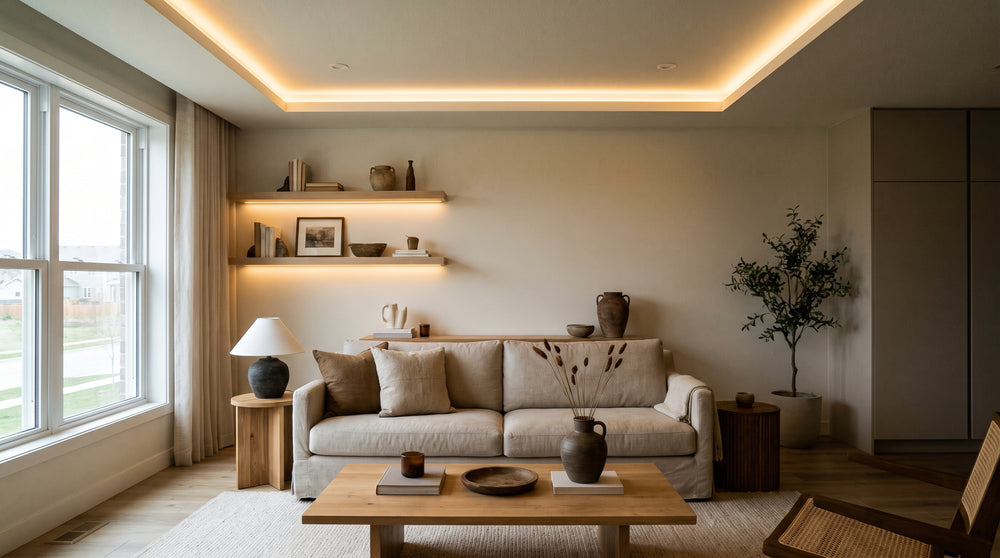
An interior that reflects who you are
Carefully selected pieces, shipped from our warehouses. Our team advises you before you buy, so you choose with confidence.
- Tracked delivery
- Pay in instalments, where available
- 14 days to change your mind
- Advice & showroom in Lyon, France
A 240V LED strip light connects directly to the mains, with no separate transformer to house: it screws under a cabinet, to the ceiling or against a wall, and switches on via a switch or a sensor. First measure the length of the run to be covered, then set the protection rating according to the room where it will be installed.
What is a 240V LED strip light and how does it work?
It is a rigid linear luminaire with built-in electronics: the wires arrive directly on the terminal block, with no power supply to tuck behind a cabinet. The light comes out in a grazing wash, which highlights a worktop or a wall without dazzling when the strip is aimed at the surface. It screws under a shelf, to a hallway ceiling or as a wall light.
Do you need a 240V LED strip light without a transformer?
Yes, that is the very principle of mains voltage: the model plugs into the grid and nothing else hangs behind the cabinet. This absence of an external block simplifies installation in a cupboard or under a worktop, where space is short. The model's technical data sheet is the reference for wiring; browse all our LED strip lights to compare configurations.
240V LED strip light with switch or with sensor: which variants?
The built-in switch avoids running a wall control when the luminaire stands alone in a storage nook. The sensor switches on as you pass and off after a period of inactivity, which suits a hallway or a garage where you go in with your hands full. See 240V strip lights with motion sensor if automatic switching matters more than a switch.
Where to place a 240V LED strip light in the home?
Where the light must stay close to the work surface: under the wall cabinets of a kitchen, above a workbench, in a cupboard or a utility room. Fixed to the ceiling or against a wall, it lights a hallway, a garage or a headboard without taking up floor space. The slimmest models disappear once switched off.
240V LED strip light under a kitchen cabinet
Screwed under the wall cabinet, towards the front, it lights the worktop and removes the shadow of your hands when chopping. It is the change that does most for a kitchen without touching the existing ceiling light. Near the sink, steam calls for a protected model, such as the strip lights designed for bathrooms, also suitable for damp areas.
Cupboard, utility room, headboard and TV unit
In a cupboard, the strip light makes stacks of linen readable without lighting the whole room. At the headboard, it replaces the bedside lamp and frees the nightstand. Behind a TV unit, it sets the screen off from the wall. For these uses, a presence-detection model avoids hunting for the button in the dark; see the models with presence detection.
What length of 240V LED strip light to choose: 30 cm, 40 cm or 60 cm?
The length is chosen according to the surface to be lit: 30 cm for a cupboard or a small run, 40 cm for a short run, 60 cm to cover a whole kitchen worktop. Better a strip light slightly shorter than the surface than a light that spills over the side and leaves a dark zone where you work.
| Format | Lit surface | Where to place it | Point to watch |
|---|---|---|---|
| 30 cm | Shelf, cupboard, storage nook | Under a shelf, above a sink | Check that the light covers the useful area |
| 40 cm | Short run, base unit | Under a narrow wall cabinet, above a desk | Stay within the length of the cabinet |
| 60 cm | Kitchen worktop | Under the wall cabinets, towards the front | Plan the power supply before installation |
| Longer | Hallway, garage, workshop | On the ceiling or as a wall light | Weight and fixing matter more than length |
240V LED strip light 30 cm and 40 cm: the small runs
These formats slip under a bookshelf, above a utility sink or into a storage nook. They light a specific spot, not a room: you multiply them rather than taking one very long one. A short format is also easier to move if the layout changes.
240V kitchen LED strip light 60 cm: for a worktop
A standard worktop calls for a length close to the width of the wall cabinet, without exceeding it. Measure before ordering, then locate the power supply, because a strip light is wired in and does not move like a floor lamp. The buying guide in our lighting catalogue helps you decide between several configurations.
240V LED strip light or cuttable LED tape: what is the difference?
A cuttable LED tape is flexible: it is cut at marked points and stuck onto a profile or under a cabinet. A 240V LED strip light is rigid, screws in and connects directly to the mains. The tape follows curves and corners, the strip light gives a clean straight run, moves less and comes off without leaving adhesive marks.
Cuttable LED tape: how does it work?
The tape carries cut marks printed at regular intervals: cut only on these marks, otherwise the circuit breaks and the following section stays off. It is then stuck under a cabinet or onto a profile, then connected to the power supply intended for its length. A tape too long for its power supply heats up and degrades.
Rigid strip light or flexible tape, which to choose
Take the strip light when the support is straight, it must be screwed in and the luminaire must stay in place for years. Take the tape for a curved niche, bespoke furniture or a run that turns. If no wiring is possible, the rechargeable alternative, with no wiring, is installed and recharged like an accessory.
240V LED strip light, LED ceiling light or wall light: which luminaire for which room?
A strip light lights a run or a work surface, an LED ceiling light lights the whole room, an LED wall light lights a wall or a reading corner, an LED chandelier lights from above. The choice depends on the surface to be covered and the height available under the ceiling.
| Luminaire | Type of light | Installation | Typical use |
|---|---|---|---|
| 240V LED strip light | Linear, grazing | Screwed to cabinet, wall or ceiling | Worktop, cupboard, garage |
| Cuttable LED tape | Flexible linear, continuous | Adhesive on profile or under cabinet | Curves, niches, bespoke furniture |
| LED ceiling light | Diffuse, whole room | Ceiling fixing | Living room, bedroom, entrance |
| LED chandelier | Volume, lighting from above | Pendant | Dining, entrance, room with high ceilings |
| LED wall light | Vertical grazing | Wall fixing | Hallway, headboard, reading corner |
LED ceiling light, LED chandelier and living room LED wall light: the uses
A living room LED ceiling light covers a whole living space and replaces a tired central point. An LED chandelier structures a volume and is installed above a table. A living room LED wall light lights a wall without taking up floor space. These luminaires are chosen on the room's surface area, not on their looks alone. To tell a powerful LED ceiling light or a powerful LED wall light from a standard model, compare the stated lumens and the surface covered.
LED ceiling lighting: when the strip light is not enough
When you need to read on a sofa or cross a room without a dark zone, the strip light is too directional: you need diffuse LED ceiling lighting. Keep the strip light for the technical run and add a general source. Browse the LED strip lights page to see what can be installed as a complement.
Which IP protection rating to choose according to the room?
In a dry room, an ordinary protection rating is enough. In a bathroom, a kitchen near the sink or outdoors, you need a waterproof model, identified by a high IP such as IP65. For a garage or a workshop, dust and impacts matter as much as humidity.
| Room or area | Main constraint | What to check |
|---|---|---|
| Kitchen, under-cabinet | Steam and splashes near the sink | Protection rating suited to humidity |
| Bathroom | Permanent humidity | Waterproof model, high IP such as IP65 |
| Garage, workshop | Dust, impacts, temperature swings | Solid fixing and dust resistance |
| Outdoors, terrace | Rain and frost | Waterproof outdoor strip light only |
IP65 LED strip light and waterproof models: bathroom and outdoors
A high IP rating signals protection against dust and water jets, which changes everything above a bathtub or under a canopy. Compare the references rated IP65 and the waterproof versions for damp rooms before making your choice. Outdoors, install nothing that is not intended for it.
Garage and workshop: what really changes
Under a bonnet or above a workbench, the strip light collects dust, sometimes a tool impact. A fixing screwed into a solid support holds better than adhesive. The garage linear lighting models and the workshop strip lights meet these constraints, and the versions for outdoor use or waterproof outdoor use cover sheltered areas.
How to wire and maintain a 240V LED strip light?
It connects to the mains via a connector block or a junction box, with the power off, respecting the live, neutral and earth markings where they exist. An electrician validates the assembly. For maintenance, a dry cloth is enough: avoid abrasive products on the diffuser, which make it opaque over time.
How can I power an LED at 240 volts?
Switch off the power at the breaker, identify the conductors, connect the strip light to its terminal block then close it up. A strip light intended for 240 volts needs no transformer, but the cable cross-section and the starting point must suit the existing circuit. If in doubt about the markings, call in a professional.
Maintenance and service life
A deposit of kitchen grease on the diffuser reduces the light long before the module wears out: a wipe with a dry cloth every two or three months is enough. Avoid removing the cover, which is not designed to be opened. Each model's technical data sheet states the usage conditions to be respected.
How to choose the light and finish of a 240V LED strip light?
Warm white suits relaxing rooms, neutral white suits the kitchen and work, cool white suits garages and workshops. The profile and finish also matter: a slim profile is barely visible under a cabinet, an aluminium or white finish blends with the rest of the luminaire.
Warm white, neutral white or cool white according to the room
In general, a light around 2700 to 3000 K makes a bedroom welcoming, a tone close to 4000 K keeps colours accurate on a worktop, and a cooler white is reserved for intensive work areas. The exact colour temperature is on each model's data sheet, not in an average.
Profile, material and finish: what shows on the ceiling
A narrow profile disappears under a shelf, a wider profile structures a hallway. Aluminium dissipates heat and ages without yellowing, a white finish blends into a painted ceiling. Also check the length of the power cable: too short, it forces a visible extension lead.
Secure payment, tracked delivery, returns and Designix customer service: you order the right length, and if the measurement was wrong, a return is still possible. To compare the families before making your choice, start again from the parent page of all luminaires, then browse the full collection of strip lights.
Frequently asked questions
What is the best LED strip light?
There is no best strip light in the abstract: the right model is the one that matches the length of the run to be lit, the desired switching mode (switch or sensor) and the humidity of the room. A waterproof strip light for a bathroom or outdoors, a simple strip light for a dry cupboard.
Can a 240V LED strip light be installed under a kitchen cabinet?
Yes, it is one of the most common uses: it screws under the wall cabinet, towards the front, to light the worktop without casting a shadow under your hands. Choose a length slightly shorter than the cabinet and plan the power supply before installation.
What length of 240V LED strip light for a kitchen?
It all depends on the width of the worktop: 30 cm for a small run or a cupboard, 40 cm for a short worktop, 60 cm to cover a standard kitchen worktop. Better to stay a little under the length of the cabinet than to spill over the side.
Is a 240V LED strip light with motion sensor suitable for a garage?
Yes: the sensor switches the strip light on as you pass and off afterwards, which avoids hunting for the switch with your hands full. In a garage or a workshop, also check the resistance to dust and impacts, in addition to detection.
Is there a 240V LED strip light without a transformer?
Yes: strip lights intended for 240 volts have built-in electronics and connect directly to the mains, with no external power supply to house behind a cabinet. This simplifies installation under a worktop or in a cupboard, where there is no room for a separate transformer.




