What LED wattage for outdoor lighting?
This article is also available in French: Quelle puissance led pour éclairage extérieur
What LED wattage for outdoor lighting?
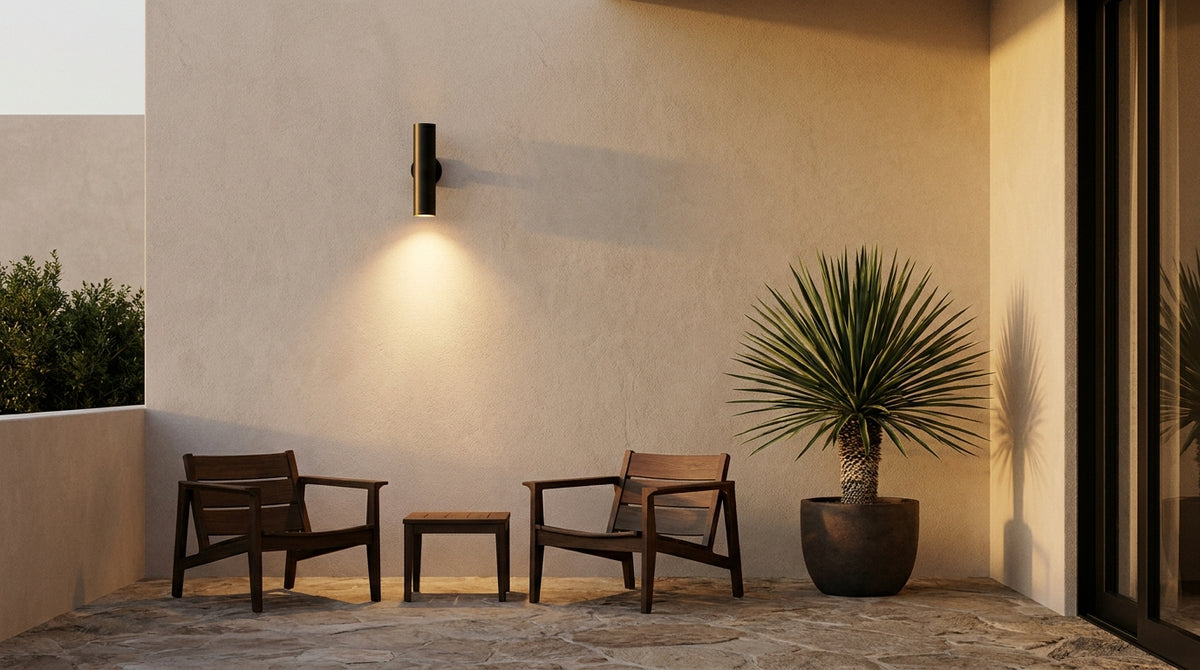
Allow 5 to 10 W to light a path, 15 to 25 W for a 20 m² terrace, 30 to 50 W per floodlight for a facade. The wattage is derived from the surface area and the mounting height. You start from the area to be lit, go through lumens, and watts come last.
A balcony and terrace renovation never starts with wattage. You first draw what must remain readable in the evening: the step, the dining area, the wall.
Our selection of outdoor lighting reads the same way, by use rather than by displayed wattage.
How many lumens for outdoor lighting?
Allow 200 to 400 lumens for an entrance, 800 to 1,200 lumens for a 20 m² terrace, 2,000 to 4,000 lumens for a facade. Two fixtures of the same wattage do not light the same: the difference between lux and lumens explains why flux matters more than the advertised watts.
How many lumens per m² outdoors?
Aim for 50 to 100 lm/m² for an ornamental garden, 150 to 200 lm/m² for a terrace where you dine, 300 to 400 lm/m² for a staircase or an access area. Multiply by the surface area, divide by the number of light points, and you get the expected flux of each fixture.
This division avoids the most common mistake: a single floodlight in the middle of a long terrace leaves both ends in the dark. Two 15 W points spread out give softer light and a terrace and garden enhanced in the evening.
Under a pergola, the reasoning holds, with lower wattages and light that does not go up to the sky.
- Path lighting: 5 to 10 W, 200 to 400 lm, 50 cm from the ground
- Terrace of 15 to 20 m²: 15 to 25 W combined across two or three points
- Entrance or gate: 10 to 20 W, beam directed towards the ground
- Facade, large garden: 30 to 50 W per floodlight, mounted at 3 or 4 m
If your outdoor space requires several coordinated light points, write to us about your project: the choice of wattages is made together, on plan.
What wattage for an outdoor LED spotlight or floodlight?
An outdoor LED spotlight sits between 3 and 10 W for path lighting, 10 to 20 W for a terrace. A floodlight starts at 30 W and goes up to 100 W to cover a courtyard or a car park. The spotlight targets a precise point, the floodlight floods a wide area.
- Path lighting: 3 to 5 W spotlight, narrow beam
- Terrace: two or three 7 to 10 W spotlights
- Courtyard, long path: 30 to 50 W floodlight
- High facade: 50 to 100 W floodlight, directed downwards
What wattage for an outdoor LED spotlight?
3 to 7 W is enough for a recessed ground spotlight that highlights a wall, 7 to 15 W to light a flowerbed or a step. Above 20 W, a domestic spotlight becomes dazzling and casts hard shadows.
Our selection of outdoor LED spotlights is mainly about the beam angle, more than the wattage.
A sensor changes the game: a point that switches on as you pass can stay at 8 or 10 W and only light at the right moment. For this setup, see our guide on outdoor lighting with a sensor.
[[WIDGET:carrousel-extérieur]]What wattage for an outdoor LED floodlight?
Allow 30 W for a 30 m² garden, 50 W for a courtyard, 100 W and more for a manoeuvring area. The range also depends on the angle: at equal wattage, a narrow beam reaches further than a wide beam.
For a path or an access, an 8 to 15 W outdoor post light often replaces two floodlights, with a lower and less aggressive rendering.
What LED wattage for solar outdoor lighting?
The panel caps the useful wattage: 3 to 10 W for a wall light or a bollard, 15 to 30 W only on models with a large panel. Brightness depends mainly on the battery and the hours of sunshine, not on the figure printed on the box.
For a path, an outdoor solar lamp avoids any cable laying.
A solar wall light is better suited to a facade far from the electrical panel.
Which outdoor area do you want to light first?
3000 K or 4000 K: which colour temperature for outdoors?
Choose 3000 K for a home exterior: stone, wood and foliage benefit. Move to 4000 K for a shared path, a car park or a shop, where readability comes first. On a facade, 3000 K ages better.
What is the difference between 3000 K and 4000 K?
Kelvin measures the hue of the light, not its wattage. 3000 K leans amber, 4000 K stays neutral, with neither yellow nor blue.
| Marker | 3000 K | 4000 K |
|---|---|---|
| Hue | Warm white, close to halogen | Neutral white |
| Outdoor use | Terrace, facade, private garden | Shared path, car park, company entrance |
| Evening effect | Atmosphere, warmed materials | Visibility, uniform lighting |
Is 3000 K light warm or cold?
It is warm. 3000 K sits just above a classic halogen bulb, a slightly amber white, never yellow. To place the markers between yellow, warm, neutral and cold, our article on white or yellow light covers the full scale.
Two habits: keep the same temperature on all points in the same space, and be wary of 6000 K, which turns facades blue and hardens materials.
IP44, IP65: which protection rating for an outdoor light?
Remember IP44 under an awning, a covered pergola or a roof overhang. Move to IP65 everywhere else: exposed facade, terrace edge, fixture placed on the ground. For a submerged point, it is IP67.
Can you put an LED bulb in any outdoor light?
No. Out of the 4,589 references of LED wall lights in our catalogue as of 28 September 2026, a survey of 165 product sheets gives the declared protection rating: IP20 in 85% of cases, IP65 in 8%, IP44 in 5%, IP54 in 1%. Barely 14% of this survey is therefore suitable for installation in an exposed outdoor area.
Technology is not the obstacle: on this same survey of 28 September 2026, LED is declared on 99% of the sheets and CE certification on 100%.
The useful habit remains the existing socket: most wall lights and lanterns take E27 bulbs, to be chosen in LED version and warm white to stay consistent with the rest.
- Socket: identical to the bulb being replaced
- Protection rating: at least equal to that of the light
- Temperature: the same as the other points in the space
- Wattage: never above the maximum marked on the socket
Can you use a more powerful LED bulb than the one intended?
Often yes, with two caveats: the socket and the heat. A more powerful bulb heats up more in a closed volume, and some lights indicate a maximum wattage not to be exceeded.
In practice, switching from a 40 W halogen to a 7 W LED is enough to gain light. Our guide to replacing a halogen with an LED gives the equivalents.
For a whole facade or a building, the reasoning changes scale: facade lighting is calculated in cumulative flux and projection distance.
Our teams are in Vaulx-en-Velin, at 12 chemin Maurice Ferréol, and the shop's Google listing can be viewed in one click.
In stock · shipping costs shown at checkout · up to 30% off in your cart


Ready to turn inspiration into reality?
Tell us about your room, your style and your budget, and we will show you the pieces that truly suit your project.
Get guidance in 30 seconds →