LED ceiling fans: how to read reviews before you buy
This article is also available in French: Ventilateur led alisio mantra avis
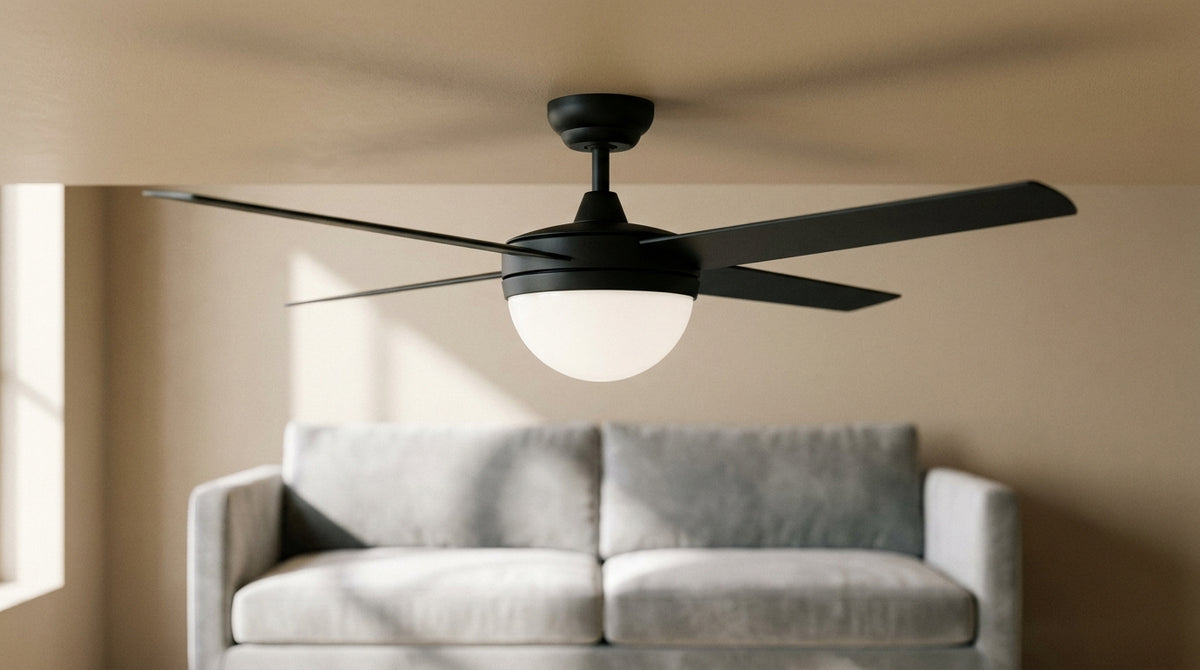
A ceiling fan light is judged on three measurements: the clear height under the blades, the silence at low speed and the light adjustment. A review that does not mention these will not help you choose. Check these three points before reading a single rating.
Are ceiling fans effective?
Yes, as long as you stay in the airflow. The blades do not cool the room: they move the air and lower the perceived temperature without changing the thermometer. A ceiling fan light therefore remains useful where air conditioning is neither possible nor desirable.
What air circulation changes in a room
The gain is not read on a thermometer, it is felt. Moving air breaks up the warm, still layer sitting on your skin.
- Low speed: enough in a living room, and this is the setting where the motor is forgotten
- Downward airflow: the air stays at occupant level instead of stagnating at the ceiling
- DC motor: direct current, reduced consumption over long summer sessions
- Surface mounting: fixed directly to the ceiling, no false ceiling required
A ceiling fan light is chosen like any other ceiling light: the available height dictates the rest.
Our comparison of the ceiling fan with light details the real gain depending on the room's configuration.
Why it is not air conditioning
A fan does not produce cold. No compressor, no refrigerant, no heat extraction: just a motor and blades. Its effect stops when it is switched off, whereas a room closed with the shutters down keeps its cool for several hours.
When the whole room is being rethought, renovating the living room often starts with the question of the ceiling light point.
What are the drawbacks of ceiling fans?
Three, mainly. The ceiling height, which determines the blade diameter and therefore the real comfort. The noise, which varies greatly from one motor to another and is almost never measured in reviews. And the light, often fixed when two moods are expected from the same unit.
Ceiling height, the real constraint
What matters is not the total height of the unit, but what remains between the bottom of the blades and the floor.
| Constraint | What it changes | The workaround |
|---|---|---|
| Clear height | A low unit gets in the way when passing under the blades | Check the dimension before ordering, blades included |
| Large volume | A small diameter forces a higher speed, and therefore more noise | Choose the diameter according to the floor area |
| Low ceiling | Long blades lose their advantage | Prefer a flat, surface-mounted profile |
Noise, maintenance and light to choose
- Noise: the motor is audible at high speed, never at low speed on a good model
- Maintenance: dust the blades once a season, and a closed housing avoids nooks and crannies
- Colour temperature: warm white in the evening, cooler white for working, this is a choice
- Ingress protection: IP20 in dry rooms, IP44 and above in damp rooms
To decide between the two moods, our guide white or yellow light explains what each temperature changes in everyday life.
Out of a sample of 250 references in the Luminaire Led collection as of 29 September 2026, 94% declare an IP20 ingress protection rating. In other words: in a damp room, look for the mention explicitly, it is not the norm.
Brightness adjustment, for its part, is prepared before purchase. Our article on dimmable LED recalls what a dimmer requires in terms of compatibility.
Which ceiling fan is most effective for your room?
The one whose diameter matches the floor area, nothing more. Blades that are too short force a higher speed, and therefore more noise. Blades that are too long circulate air poorly and take up the whole ceiling. The floor area gives the diameter, the height gives the mounting method.
Blade diameter and floor area: the simple rule
- Small room: a compact diameter is enough, at low speed most of the time
- Living room: aim for a unit that circulates air across the whole area without spinning fast
- High ceilings: a downrod version lowers the unit into the useful zone
- Low ceiling: stay with a flat profile, surface-mounted
A short-bladed unit with integrated light looks like a classic living room ceiling light, which changes everything in a lounge where you do not want a visible propeller.
Remote control, dimmer: what to check
A remote control saves running an extra wall switch. Check that it manages the two functions separately: blade speed and light brightness.
From the same sample of 250 references as of 29 September 2026, 35% declare brightness dimming. The function is common, not systematic: it is read on the spec sheet, not in a photo. For light alone, our selection of LED ceiling lights gathers the models with adjustable brightness and temperature.
Ceiling lights and fan lights from the selection


Which room do you want to equip with a LED ceiling fan light?
Our guide on which ceiling fan light to choose takes this reasoning room by room.
How to read reviews before buying a LED ceiling fan light?
Look for three pieces of information, not a rating. The noise at low speed, the height of the unit including blades, and the type of light adjustment. A review that does not mention these describes a delivery, not a unit.
Reviews of a ceiling fan: what they really say
Most feedback concerns the installation, the delivery or the visual effect. Useful, but silent on the silence at two in the morning and on how the motor holds up after three summers. Our article on judging a ceiling fan light before buying details this reading.
Reviews should be read in series. Three people reporting the same whistling at high speed carry more weight than an average rating.
The three pieces of information no review gives
- The clear height: it depends on your ceiling, not your neighbour's
- The real noise level: it depends on the speed you will run it at
- Dimmer compatibility: it is checked on the spec sheet
These three points are settled beforehand. The rest, the finish, the shade, the shape, is judged from photos and discussed with buyers. Designix's Google review profile remains available online to gauge how seriously follow-up is handled.
If the room and the light are now clear to you, but a doubt remains about the height or the blade diameter, ask the team: they answer based on your actual configuration.
Which setting for a heatwave, which mode for winter?
Downward airflow in summer, upward airflow in winter, never both at the same time. The winter position reverses the direction of rotation and pushes the warm air accumulated at the ceiling down to the floor. In summer, you speed up. In winter, you run slowly.
Circulating warm air in winter
Heating rises and stays at the ceiling. In the winter position, the unit detaches this warm air and sends it back to the living zone, at low speed to avoid the feeling of a draught.
- Direction of rotation: reversed compared with summer, visible on the remote control
- Low speed: circulation without a perceived cooling effect
- Continuous operation: useful in a large volume or under a mezzanine
Style matters too. Our article on the 2026 ceiling light trend shows how a flat profile blends into a contemporary ceiling.
The case of bedrooms and sleep
The bedroom is the room where noise costs the most. A correct unit at low speed is forgotten, a poorly chosen unit is heard all night. Light plays a secondary role there, often more important than air circulation.
To size the room's lighting, our article on how many lumens for a bedroom gives the benchmarks to follow.
In stock · shipping costs shown at checkout · up to 30% off in your cart


Ready to turn inspiration into reality?
Tell us about your room, your style and your budget, and we will show you the pieces that truly suit your project.
Get guidance in 30 seconds →