Track lighting: choosing the right light for each room
This article is also available in French: Rail de spots
What is a ceiling track lighting system?
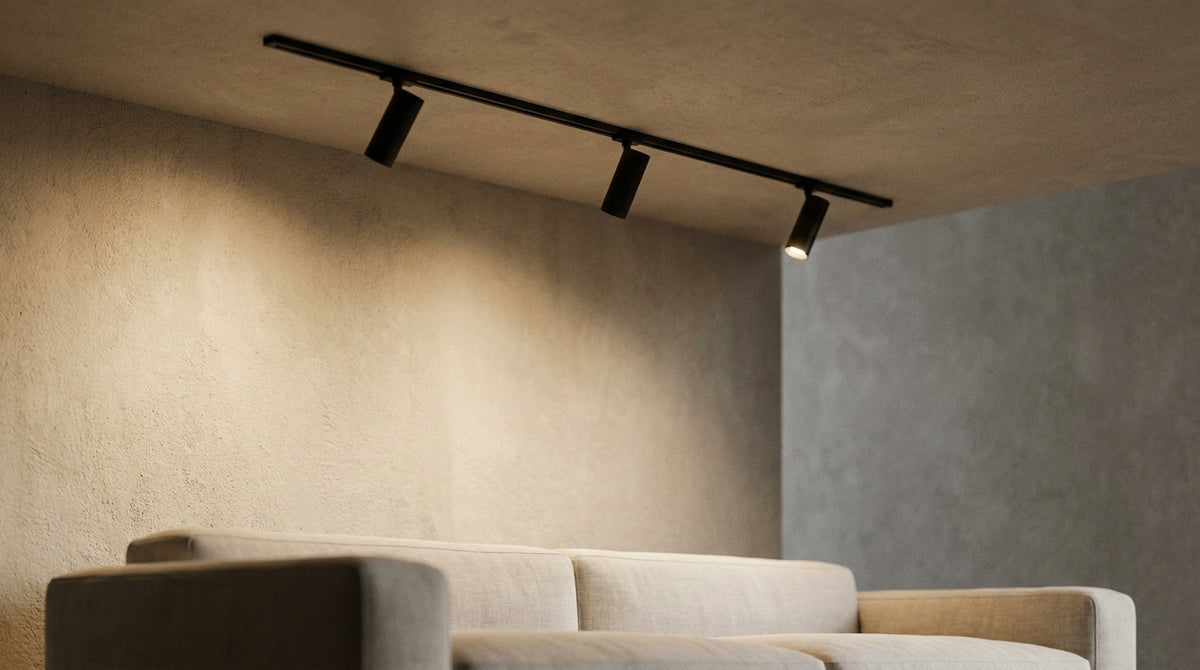
A track lighting rail is a metal profile screwed to the ceiling or wall, onto which adjustable spotlights are clipped. It connects to the existing electrical supply, then each head is adjusted independently. The profile comes bare: it is the spotlights that create the effect.
The same track can graze a brick wall, focus a beam on a worktop or bathe a table in a soft halo. This scenario is planned before buying, and a living room lighting project helps to determine the number of zones to control.
Once the profile is installed, the luminaire clipped onto it decides the effect: a wide spotlight to illuminate, a narrow head to highlight.
Single-phase or three-phase track: what changes day to day
Single-phase turns on all the spotlights with one gesture. Three-phase divides the track into three separate circuits: you keep the background lit without lighting the table. The profile is more technical, installation remains the same.
- Single-phase: one circuit, overall control by the switch
- Three-phase: three separate circuits, several moods on one track
- Dimmer: possible on both, with compatible spotlights
Ceiling spotlight track: how to recognise it before buying
Three details decide: the profile section, the adapter type and the spotlight base. The ceiling spotlight track is fixed to an existing supply, provided these three points match what you want to clip on.
- Standard adapter: check compatibility before mixing two ranges
- GU10 base: replaceable bulb, flexibility over time
- Integrated LED module: flatter, replacement by the manufacturer
How many spotlights on a track, and at what distance should they be spaced?
Allow one point every 60 to 80 cm for an even wash of light, and only two to mark a worktop. The higher the ceiling, the further apart the heads. The how many spotlights per m² method gives a starting point, to be adjusted afterwards to actual use.
LED spotlight on track: density according to the room
An LED spotlight on a track has two decisive settings: beam angle and colour temperature. 2700 K warms a living room, 3000 K keeps a worktop readable. The number of heads follows the surface, not the aesthetics.
- Living room: one wide head every 80 cm approximately
- Kitchen: two or three heads close together over the worktop
- Corridor: a tight alignment, directed towards the walls
In an open kitchen, direct the beams towards the back of the worktop rather than towards the floor. Kitchen and dining room lighting often comes down to this single line of light, completed by a kitchen luminaire if the room is a through room.
Spotlight spacing follows the same rule everywhere: if two distinct cones appear on the floor, the heads are too far apart.
Mini LED spotlight on track: when it does better than a large one
The mini LED spotlight on track takes over when the light must be precise. Tight beam, discreet head, it slips along a wall without drawing the eye. On a painting, a splashback or a bookshelf, it picks out the object instead of bathing the room.
Its limit lies in its depth: it gives little light. The right balance mixes three or four mini accent spotlights with a wide spotlight that carries the mood.
How do you install spotlights on a track?
The track is fixed to the ceiling at two or three anchor points, then connected to the electrical supply. Installation time depends mainly on the condition of the existing wiring. The habits of installing spotlights on the ceiling also apply here: identifying the wires, fixing suited to the support, checking before switching the breaker back on.
Fixing the track: ceiling, wall or cable
On solid concrete, a hammer-in plug is enough. On plasterboard, aim for the frame. It is the support that decides, not the weight of the track.
A wall track replaces the wall light when the wall must be lit from top to bottom, and a long luminaire suits narrow corridors. Under a sloped ceiling, the track follows the slope and the heads are adjusted afterwards, one by one.
Connection: what must not go wrong
Three points decide success: identifying the wires before dismantling, the quality of the connections and the circuit load. A track is connected as a spur from the supply.
- Earth: never cut, even on a painted profile
- Cable cross-section: to be checked before adding points
- Identification: live, neutral and earth noted before disconnecting
Beware the opposite habit: wiring spotlights in series is not the right approach on a track, each point runs back from the supply.
What are the different types of track, and which one for your room?
Three families coexist: the recessed track, invisible once installed, the surface-mounted track, which asserts its line, and the cable track, tensioned between two walls. The choice depends on ceiling height and style, not on the size of the room.
What use do you want to make of your track lighting rail?
| Use | What it produces | Where it is used |
|---|---|---|
| Mood | Wide wash, low intensity, 2700 K | Living room, bedroom, mezzanine |
| Functional | Beam directed onto a working area | Worktop, desk, dressing room |
| Accent | Tight beam, marked contrast | Painting, brick wall, niche |
- Recessed track: disappears into the panel, to be planned during the works
- Surface-mounted track: quick installation, no suspended ceiling constraint
- Cable track: no ceiling fixing, useful on concrete or under a glass roof
Ceiling track lighting in a living room or main room
In a living room, ceiling track lighting replaces the central ceiling light without losing power. The principle: run the track along the sofa rather than centring it over the empty space.
The living room ceiling spotlights are then divided into two groups: two wide heads towards the conversation area, one tight head towards the bookshelf. If the track covers only part of the living room, an LED ceiling light completes the whole without breaking the unity.
Designer track lighting: choosing the style
A designer track lighting rail is either noticed or disappears, never in between. A slim profile painted the colour of the ceiling to fade away, or a deliberate matte black with its exposed spotlights to draw a graphic line.
The rest comes down to the furniture. Designer luminaires chosen in the same metal family as the track unify the room, a contrast of materials wakes it up.
What is the price of a light point on a track?
The budget is counted per light point, not per metre of profile. The track weighs little in the bill, the spotlights decide: an adjustable aluminium head costs more than a fixed module, and a replaceable bulb changes the bill over time.
If you prefer to start from a plan rather than fumbling between lengths, come talk about your project: we will tell you which track holds the light.
What makes the budget vary
- Number of points: each added head counts, the profile stays the same
- Spotlight type: adjustable or fixed, wide or narrow
- Bulb: a GU10 track is replenished with GU10 bulbs
- Control: circuit control, present from three-phase onwards
See the effect before ordering
A product photo does not say whether the light will suit you: you need to see the materials and the beam tint in real life, with the spotlights switched on side by side. Our contact point in Vaulx-en-Velin allows this test, and the store's Google listing gives opening hours and directions.
On the same subject
In stock · shipping costs shown at checkout · up to 30% off in your cart


Ready to turn inspiration into reality?
Tell us about your room, your style and your budget, and we will show you the pieces that truly suit your project.
Get guidance in 30 seconds →