Touch wall light: the light that obeys your finger
This article is also available in French: Applique murale tactile
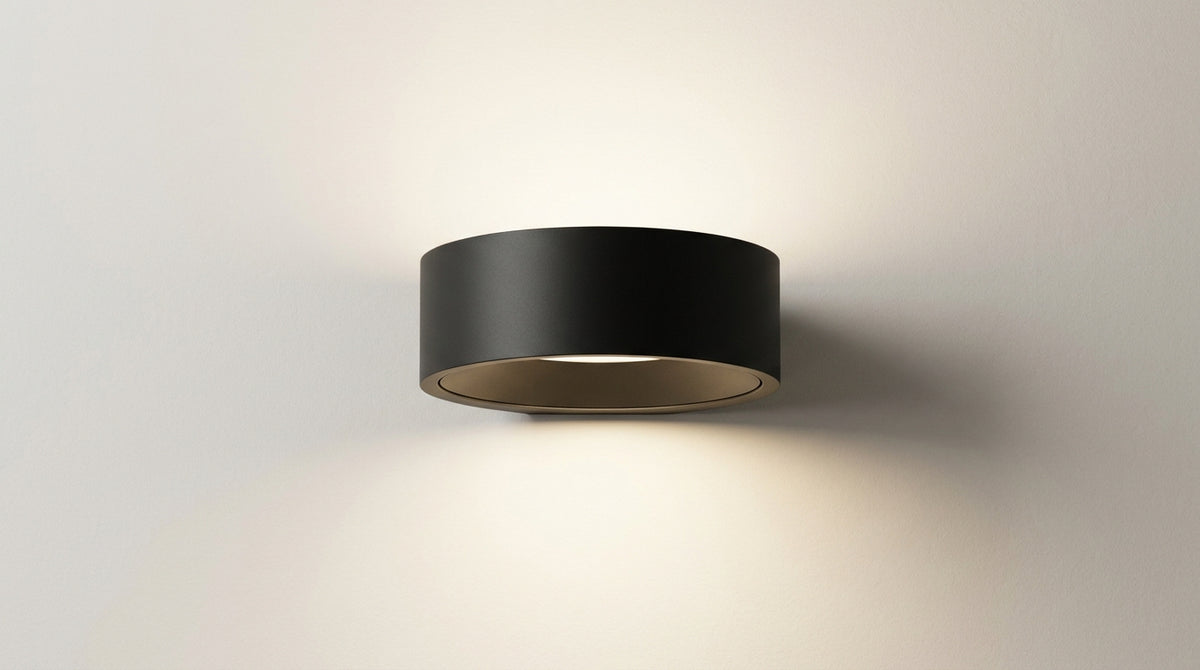
As of 5 October 2026, our collection includes 278 touch wall light references. The gesture fits in one sentence: you brush the base, the light comes on, and the wall does without a switch. First choose the room, then the mounting, then the colour temperature.
Which lamps turn on at the touch?
A touch wall light turns on when the hand touches a conductive area: the base, a ring, sometimes the edge of the diffuser. A capacitive sensor replaces the button, and a sustained press varies the intensity. No remote control to find, no cable to run to the other wall.
Our selection of touch wall lights brings together these models, classified by room and type of mounting.
Touch wall lights: the selection to look at first


Redoing an entire room changes the game: when several light points coexist, the bedroom and office lighting project takes shape before purchase, to avoid duplicates.
Touch control, dimmer, remote control: what changes at the finger
Three controls coexist, and the choice comes down to a single gesture: the one you make when you wake up.
| Control | Gesture | Where it excels |
|---|---|---|
| Simple touch | a brief press | hallway, entrance, child's bedside |
| Touch and dimming | brief press, then sustained press for intensity | reading in bed, adult bedroom |
| Touch and remote control | finger on the wall, remote for the rest | large bedroom, mezzanine, bed for two |
What touch does not do
- Move a light point: the sensor is added where the wall is free, it does not replace a central ceiling light.
- Light widely: a wall light remains a local light, to be reserved for a specific area.
- Vary intensity if the model does not provide for it: the function is read on the spec sheet, not on the photo.
If finger control does not suit the whole family, a wall light with switch remains the most straightforward solution for a busy hallway.
Where does a touch wall light change usage the most?
In three places, the gesture replaces everything else: the bedroom, where you do not want to wake the other person; the child's room, where the light must stay on the wall; the hallway and staircase, where the hand finds the contact before the foot finds the step.
Touch wall light bedroom: read without waking the other
A brief press turns on, a sustained press lowers the intensity to reading level. The beam falls on the book, not on the neighbour's face. It is the gesture that changes the night, not the power.
For a headboard, the adult bedroom wall light is chosen adjustable: the flow is directed towards the page and the wall keeps a clean line.
- Orientation: the reflector directs the light towards the book.
- Intensity: dimmable models cover both reading and nightlight.
- Space: the bedside shelf remains free.
If drilling is not possible, a floor lamp brings the same light without touching the wall.
Child's touch wall lamp: the light that stays on the wall
At child height, anything hanging ends up falling. A wall light fixed away from the bed, with a simple press, lets the child manage bedtime alone without playing with a socket.
- Out of reach of blankets and away from the bed.
- Low intensity for the evening ritual.
- Closed diffuser: nothing to move, nothing to break.
The softest renders are found in the wall lamp selection with integrated LED, where the flow remains homogeneous over the entire surface.
Hallway, staircase, entrance: the gesture before the step
In a hallway, the hand seeks the wall before the eye. A touch wall light placed at hip height turns on without having to aim for a button, and turns off on the way back.
- Two points minimum in a long hallway, a third at a turn.
- Constant height along the whole route, so the hand finds it without thinking.
- IP20 is enough in a dry interior.
The wall light is then chosen discreet, aligned with the line of the staircase.
How does a wireless wall light work?
It carries its own battery and its own touch control. It is fixed to the wall without running a cable, recharged on a socket or by detaching it, and it lights until the next charge. The intensity level chosen decides everything: a nightlight lasts longer than a full-power reading session.
Wireless touch wall lamp: battery, recharging, runtime
Runtime is read on the model's spec sheet, and it then varies with three parameters: the selected intensity, the daily lighting duration, and the age of the battery. No single value applies to all uses.
- Low intensity: the charge lasts the longest.
- High intensity: reserved for reading moments.
- Recharging: on socket, sometimes without detaching the support.
The possible setups are detailed in the guide on the wireless wall light.
At what height should a touch wall light be placed?
At shoulder height in a hallway, lower above a headboard. The hand must find the sensor without raising the arm, and the light must not fall into the eyes when seated.
The complete reference, room by room, is explained in our article on the height of a wall light.
Where should your touch wall light serve first?
How to install a touch wall light without drilling?
Three solutions exist: the rechargeable version is fixed with an adhesive or two points in an existing support, the wired version hooks onto an existing flush box, and the exposed cable model is content with a discreet conduit. The choice is made before purchase.
Wired or rechargeable: decide before drilling
| Criterion | Wired | Rechargeable |
|---|---|---|
| Power | existing 230 V supply | internal battery |
| Installation | flush box or DIP | adhesive or direct fixing |
| Recharging | none | cable or base, depending on model |
| To prefer | conduit already installed | wall without electrical supply |
On flush box, on DIP, or simply fixed to the wall
- Flush box: the existing support serves as anchor, the installation remains clean.
- Surface DIP: the control is surface-mounted when the conduit is already in place.
- Direct fixing: for a rechargeable model, two points are enough, with no visible cable.
If your wall has no electrical supply, it is time to talk to our team: describe the room, and we will tell you what works. One message is enough to discuss your project with the team.
Which wall light for good lighting?
Three criteria decide the result: the source, replaceable or integrated, the colour temperature, and the ability to vary intensity. The rest is a matter of style. A wall light is judged in the evening, never in broad daylight in a shop.
E27 base or integrated LED: what decides
The E27 base lets you change the bulb and set power and hue yourself. The integrated LED imposes its source, but offers a finer line and a more homogeneous flow. In a hallway, the LED goes unnoticed; above a book, the replaceable base catches up.
Both families coexist in the home's design lighting, which allows comparison at equal design.
2700 K or 3000 K in a bedroom: the result on waking
2700 K leans towards amber and accompanies waking without aggression. 3000 K remains whiter, sharp for reading or working. In a bedroom, the first almost always wins; in an office, the second preserves contrasts.
- 2700 K: bedroom, bedside, evening hallway.
- 3000 K: office, entrance, corner where you write.
- Dimming: a model with variable intensity softens both.
Intensity is adjusted by touch or at the source depending on the model: our article on the dimmable wall light details what can and cannot be controlled.
Last technical reference, the reassuring one: IP20 is enough for a dry interior, the rating only concerns humidity. The warranties shown on catalogue spec sheets range from 2 years to 5 years depending on the model. The touch selection is commented on by buyers on our reviews page, and the Google listing lets you check feedback in one click.
In stock · shipping costs shown at checkout · up to 30% off in your cart


Ready to turn inspiration into reality?
Tell us about your room, your style and your budget, and we will show you the pieces that truly suit your project.
Get guidance in 30 seconds →