Changing a ceiling light: the step-by-step method
This article is also available in French: Changer luminaire plafond
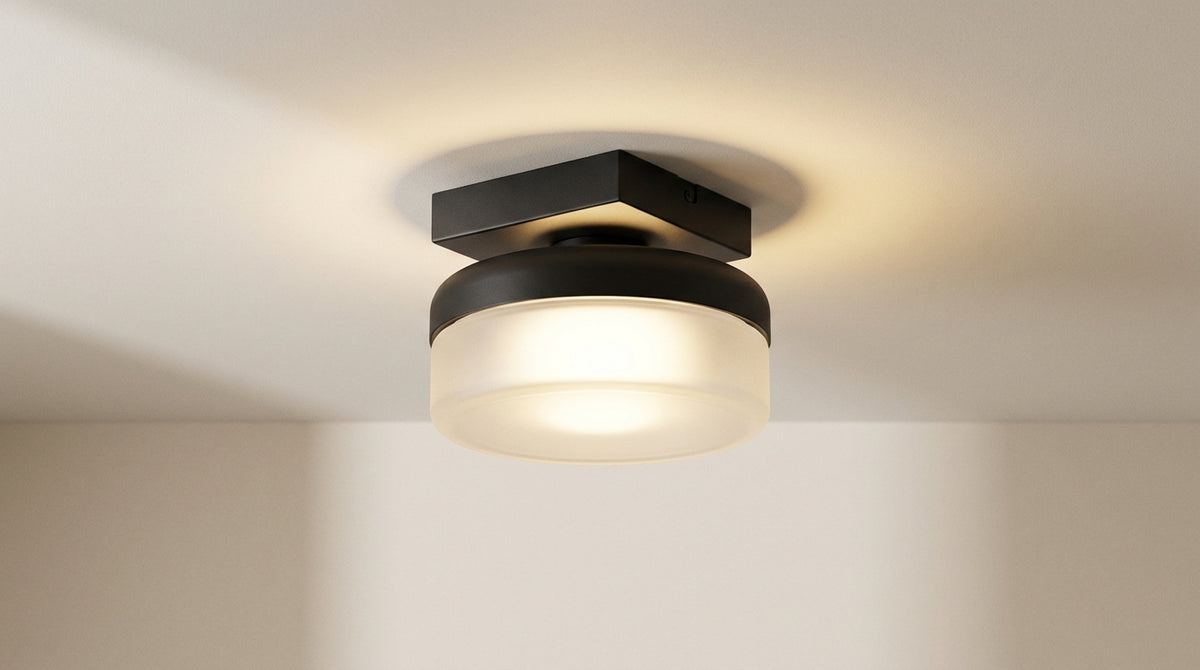
Switch off the breaker at the consumer unit, unscrew the diffuser, note where the wires go before unclipping them, then fit the new fixture on the same fixing point. Decide the height before you climb the stepladder: 75 cm above a table, 210 cm of clear passage in a hallway, and nothing to adjust for a surface-mounted ceiling light.
How do you change a ceiling light?
Three steps are enough: cut the power, unscrew the old bracket, reconnect the new fixture to the same box. Allow twenty minutes for a screw-mounted ceiling light and an hour if the bracket has to be plugged into an old ceiling. The rest comes down to choosing the model, not the technique.
That choice is made before installation. Our collection of design lighting can be filtered by room, by socket and by colour, which avoids buying a diameter too wide for a 90 cm hallway. Look at the footprint first, the look second.
How do you cut the power before working?
Cut at the breaker, never at the switch alone. A badly wired switch can leave the live wire energised, and that is the contact that catches you out. Check every wire with the tester before touching the connector blocks, and leave the breaker down until the fixture is fully back in place.
- Main breaker down, not just the one for the room
- Voltage tester applied to each wire before unscrewing
- Stable stepladder on clear floor, never a rolling stool
- Marker on the earth wire with masking tape, ten minutes saved on reassembly
How do you connect a light: 2, 3 or 4 wires?
The number of wires depends not on the fixture alone, but on the ceiling outlet. Earth connects only to a class I device with a metal chassis. A glass and acrylic model, class II, does without it entirely.
| Wires at the ceiling | Common colours | What it changes |
|---|---|---|
| 2 wires | blue and brown or red | Neutral and live only, double-insulated device |
| 3 wires | blue, brown, green yellow | Most common setup, earth on the metal chassis |
| 4 wires | blue, brown, black, green yellow | Two separate circuits, for example two rows of spotlights |
The detail of connector blocks and wire colours is covered step by step in our guide to wiring a ceiling lamp. Once the connection is mastered, the question becomes decorative: redoing the light in your living room changes the atmosphere more than a coat of paint.
DCL box or direct outlet?
The DCL box is that small white three-hole base screwed to the ceiling, with its cover. It provides a standard connection point and unclips with a quarter turn. Without it, the wires come straight out of the ceiling and you have to work with connector blocks in hand.
- DCL box present: the light plugs into the connector, no tools needed
- No DCL: plan for connector blocks and a little more time
- DCL hook: it unscrews from the base, it is never cut off
- Earth: it stays connected to the box even if the new fixture does not need it
The full step-by-step is in our article on installing a light on a DCL box.
A surface-mounted ceiling lamp dresses a hallway or entrance without eating height, where a pendant transforms a dining table. The choice often comes down to that single difference in use.
If the old fixture was held by a screw collar, replacement takes ten minutes longer. Our method for changing a ceiling light details the three fixing systems you most often come across.
How do you remove a ceiling light?
Cut the power, remove the diffuser or globe, unscrew the two screws holding the bracket, then unclip the wires. Put the fixture in a cardboard box rather than straight on the floor: frosted glass breaks more often during removal than during installation.
How do you remove the cover of a ceiling light?
Three systems coexist, and forcing never helps. First work out how the cover is held, then act in the right direction.
- Bayonet cover: a quarter turn anticlockwise
- Cover with side screws: two or three small screws around the rim
- Clipped cover: press on the edge and pull gently downwards
- Globe held by a ring: the ring unscrews, the globe comes free on its own
How do you remove the globe of a ceiling light?
A glass globe unscrews like a bulb, but it quickly weighs a kilo. Keep one hand under the globe while the other turns, and work in pairs if the diameter exceeds 30 cm. The rest of the removal follows the same logic as removing a ceiling light, screw after screw, without forcing the fixing.
How do you hang a chandelier from the ceiling, with or without a hook?
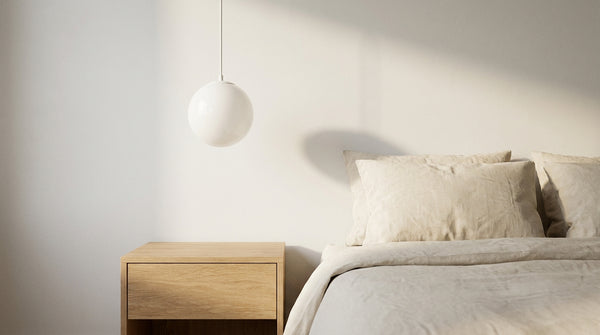
With a hook, installation is limited to hanging it and adjusting the chain. Without a hook, you reuse the plugs of the existing box. In both cases, the height is decided before drilling, not after.
How do you hang a chandelier from the ceiling with a hook?
Check that the hook holds in the slab, not just in the plaster. Give it a good sharp pull before hanging anything on it: a plastic plug hook gives way under 10 kg, a toggle hook holds far more.
| Location | Height to aim for |
|---|---|
| Pendant above a table | 75 cm between the shade and the table top |
| Chandelier in a hall | clear passage at 210 cm minimum |
| Surface-mounted ceiling light | flush with the ceiling, no adjustment |
The hanging step, shortening the chain and housing the cable, is explained on our page on hanging a chandelier. A dining room chandelier is chosen first by its width: one third of the table top, never more.
If you are still hesitating between a surface-mounted ceiling light and a pendant, ask the team before drilling: advice on height and socket saves an unnecessary hole. The Vaulx-en-Velin workshop also lets you see the light switched on before getting the drill out, which settles many doubts about the colour of the light.
How do you hang a heavy chandelier from the ceiling?
Beyond about fifteen kilos, you move from a toggle hook to a chemical fixing or a through plate. Have the load carried by a plate screwed into the slab, not by the electrical box, which never bears the fixture.
- Toggle hook: light fixtures, up to about ten kilos
- Chemical fixing: solid or concrete ceiling, clearly superior hold
- Through plate: large pendants and XXL chandeliers
- Adjusted chain: the weight rests on the hook, never on the wires
How do you hold a light on the ceiling without drilling?
A light ceiling light, under three kilos, accepts a quality adhesive mount applied to a clean, dry ceiling. Beyond that, the adhesive weakens with the heat of the lamp. A pendant light, even a short one, still has to be fixed by drilling.
Our guide to fixing a light to the ceiling without drilling details the real limits of this type of mount, weight by weight.
How do you change a ceiling bulb or a spotlight without a bezel?
A screw or bayonet bulb is replaced by hand, with the power off. A spotlight without a bezel is removed by pulling on the collar, after cutting the power. An integrated LED, on the other hand, cannot be replaced: the whole fixture is changed.
How do you change an integrated LED bulb?
It cannot be replaced, the LED module is soldered to the driver, and the whole ceiling light has to be taken down. On a sample of 157 references from our catalogue as of 28 September 2026, 85% are IP20 and 10% are IP44: the second category remains the only valid one in a wet room, outside the shower zone.
- Integrated LED: long service life, no replacement possible
- E27 or E14 socket: interchangeable bulb, including smart versions
- GU10 and G9: spotlights and small pin bulbs, to be unclipped
- IP44: essential near a water point, IP20 is enough everywhere else
Before ordering, note the socket and the colour temperature on the box of the old bulb. Our guide to changing a ceiling bulb covers the steps, socket by socket.
How do you change a spotlight bulb without a bezel?
The spotlight is held by two side springs. Spread the collar with your fingers, or with a thin spatula, and the whole unit comes down. Cut the power first: the springs give way suddenly and the spotlight can fall.
What lighting for a low ceiling?
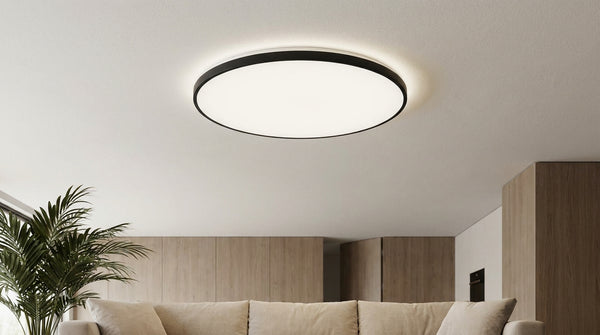
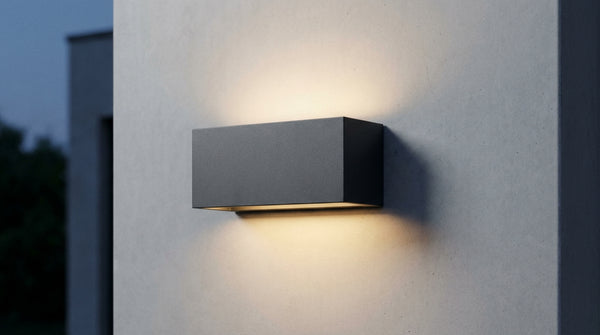
A flat surface-mounted ceiling light, under 8 cm thick, or a wall light that lifts the light without hanging anything. A living room or bedroom ceiling light 40 cm in diameter lights 12 m² generously without hanging down, provided you choose a wide diffusion rather than a directed spotlight.
An LED ceiling light remains the simplest choice under 2.40 m: no bulb to change, no height to adjust, and even light that does not create shadows in the corners.
Ceiling lights worth a closer look
 Applique Boule Salle de Bain Moderne | Luminance
 Applique salle de bain tube ovale | Fiye
 Applique Salle de Bain ZAMBELIS 20W CCT IP44 DESIGN Blanc Sable 25457
 Applique salle de bain dimmable | Qilo
 Spot orientable salle de bain rond | Lisio
 Applique mural noir salle de bain | Calix
See the whole selection: Bathroom Lighting, Ceiling, Wall or Mirror Lighting
Which ceiling should you equip first?
On the same subject
In stock · shipping costs shown at checkout · up to 30% off in your cart


Ready to turn inspiration into reality?
Tell us about your room, your style and your budget, and we will show you the pieces that truly suit your project.
Get guidance in 30 seconds →