Remote-controlled lighting: the right light, room by room
This article is also available in French: Luminaire télécommandé
First check what the remote actually controls: on/off only, dimming or colour temperature. A living room needs dimming, a bedroom needs recall from the bed, a hallway is fine with a sensor. Then check the socket, E27, E14 or GU10: it decides the rest.
What are the advantages of a remote-controlled light?
The gain is not decorative, it is practical. You dim the light from the sofa, you light the hallway with your hands full, you switch everything off with one gesture before going upstairs. Three habits that explain why a well-chosen control stays with you for years.
The real question is what the control drives. On/off alone quickly shows its limits: three sources rising and falling together change a room more than a more powerful chandelier. That is the spirit of a living room lighting project carried out source by source.
- Dimming: going from 100% to 20% without changing the bulb.
- Colour temperature: staying at 2700 K in the evening, going up to 4000 K to work.
- Scenes: one gesture for dinner, another for a film.
- Safety: lighting the hallway before opening the door, switching off from the bedroom.
A remote-controlled floor lamp placed behind the sofa sorts out the reading corner without adding a cable to the floor. The rest of the room follows the same principle: one source, one control, one use.
How does a bulb with a remote control work?
A remote sends a radio, infrared or Bluetooth signal to a receiver housed in the bulb or in the light. That receiver turns the command into current: on/off, brightness, sometimes colour. Without a receiver compatible with the transmitter, the remote controls nothing.
Remote, Wi-Fi or Bluetooth: what is the difference day to day?
The difference lies in range and obstacles. Radio goes through a wall, infrared requires a line of sight, Bluetooth covers one room, Wi-Fi goes through the router and follows the whole house.
| Control | Range | What it allows |
|---|---|---|
| Radio remote | goes through walls | on/off and dimming, no network |
| Bluetooth | one room | settings from the phone |
| Wi-Fi | the whole house | scenes, timers, voice control |
The two often complement each other in the same light: the simple gesture stays on the wall, the scenes live in the phone. That is the territory of smart lighting, where the control becomes a scenario rather than a button.
How can I trigger the light remotely?
From a phone, provided the bulb is on the same network or connected to a gateway. The app sends the command, the router passes it on, the light responds in a fraction of a second.
- App: the most direct control, bulb by bulb.
- Voice control: handy when your hands are busy, via a smart speaker.
- Scheduling: timetables that repeat every evening.
When the home is empty for several days, you can turn the light on remotely with your phone to simulate a presence. A presence sensor does even better, since there is nothing to operate: a motion-sensor bulb switches on by itself as you pass, which suits hallways and entrances.
What to do when you have lost the remote for your LEDs?
You look for the module's instructions, not the casing. Most controlled bulbs keep their last state and remain accessible from the app, or revert to standard wall operation. A lost transmitter-receiver pair can be replaced, but rarely on its own.
Taking back control from the app
Three options, in this order:
- Manufacturer's app: the bulb remains visible if it is already paired.
- Gateway: it keeps the scenes and the names given to the rooms.
- Reset: a sequence of quick switch flips resets the module, the procedure is in the instructions.
Keeping the wall switch as a backup
A wall control point remains the best insurance: a wall light with a switch works without batteries, without a network and without an app, even if the remote has disappeared. It is the detail that saves you from buying everything again.
How to choose a remote-controlled light room by room?
By the gesture you want to make, not by style. A living room wants dimming from the sofa, a bedroom wants recall from the bed, a kitchen wants worktop lighting. A kitchen pendant is controlled when you carry the dishes, an entrance is fine with a sensor.
Remote-controlled lights and smart bulbs
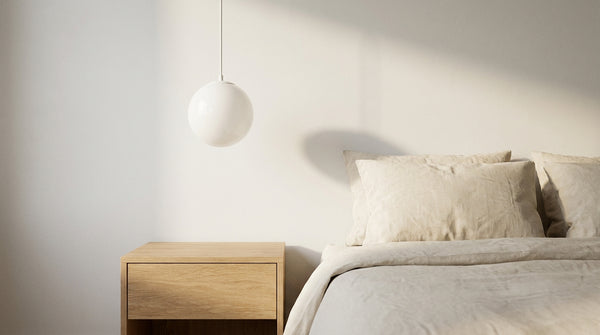
 Pendant light | Bravara
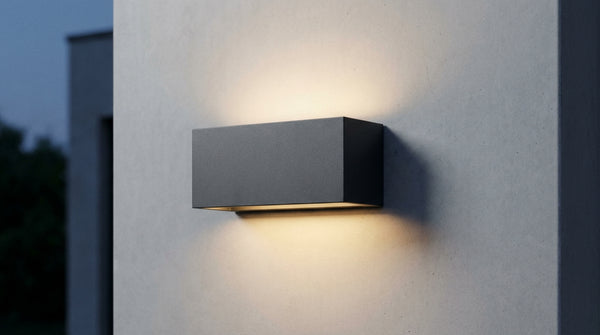
 Pendant light | Harmonie Florale
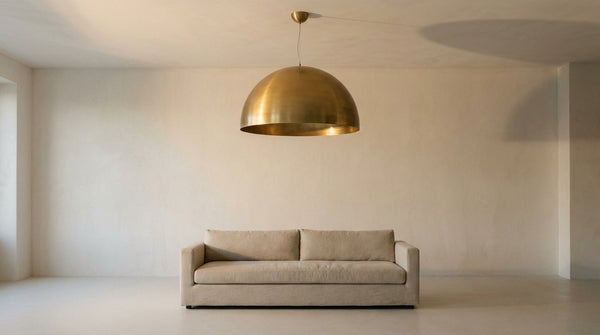
 Pendant light | Mirdanissa
 Ceiling light | Dorica
 Ceiling light | Cylira
 Living room floor lamp | Foglia
See the whole selection: Alternative to Luminaire.fr: designer lighting shop | Designix
Which room do you want to control the light in remotely?
- Living room: dimming and scenes, two or three sources together.
- Bedroom: control from the bed, low brightness.
- Kitchen: hands-free switching, lit worktop.
- Hallway and corridor: detection or wall control.
Remote-controlled bedroom light: what matters
Recall from the bed, first. Then colour: warm light at 2700 K lets sleep stay undisturbed, and a few pointers on which light colour to sleep with help you avoid mistakes.
The bedroom lighting selection can be filtered by room, colour and shape, which saves you from choosing from a photo.
Remote-controlled ceiling light: which control?
An LED ceiling light accepts dimming provided the bulb and the module share the same minimum brightness. Out of a sample of 250 references from our catalogue on 5 October 2026, 94% are rated IP20: for a damp room, aim for a higher rating.
When the hesitation is about the house rather than the model, the Designix Google listing shows real customer reviews.
If you are still unsure between a dedicated remote and a bulb controlled from the phone, the team answers your questions before you order: get in touch with the team.
How to install a smart bulb?
You screw in the bulb, switch it on, follow the app. No wires to run: the control is in the bulb or in a module slipped behind the existing switch. Allow a few minutes per light point, plus time to name the rooms.
Do you need to redo the electrical installation?
- Existing socket: nothing to change, you screw in and pair.
- Old dimmer switch: check it, the electronics may hum or flicker.
- Module behind the switch: the wall remains the control point, the remote comes on top.
The signal sent to the bulb is the same everywhere, and it is detailed here: how a smart bulb works, from the gesture to the current received.
Before ordering a whole series, it is better to settle on the colour and the format, which our advice and inspiration help you decide room by room.
E27, E14 or GU10 socket: check it before ordering
The socket is read on the lampholder, never on the photo of the light. Out of a sample of 250 references from our catalogue on 5 October 2026, E27 accounts for 26% of the sample, the LED mention 21%, E14 14% and GU10 11%.
| Socket | Where you find it | What to check |
|---|---|---|
| E27 | pendants, ceiling lights, floor lamps | the large screw socket |
| E14 | wall lights, small lamps | the bulb and lampholder pair |
| GU10 | adjustable spotlights | the pins and the depth of the holder |
GU10 deserves one extra check, because holders vary from one model to another. The GU10 bulb collection groups the references intended for these spotlights.
What is the lifespan of a smart bulb?
The LED lasts for years, the control electronics and the remote's battery wear out before it. On the same sample of 250 references on 5 October 2026, LED technology is stated on 189 listings and covers 76% of the sample, while 89% show a 2-year warranty.
A mains-powered control, or a wall light with a switch, removes the battery question. The rest follows usage: a bedside bulb lasts longer than a hallway bulb that is always on.
On the same subject
In stock · shipping costs shown at checkout · up to 30% off in your cart


Ready to turn inspiration into reality?
Tell us about your room, your style and your budget, and we will show you the pieces that truly suit your project.
Get guidance in 30 seconds →