How many lumens to light a terrace or garden?
This article is also available in French: Combien de lumens pour éclairage extérieur
Allow 40 to 50 lumens per m² for moving around outside, 80 to 100 lm/m² for dining on a terrace, 100 to 150 lm/m² for reading a face at the entrance. These figures only hold with a luminaire whose protection rating matches the location, and a beam aimed at the ground, never at the eye.
How many lumens per m² for an outdoor space?
An outdoor space is sized by use, not by total surface area: 40 to 50 lm/m² for a pathway, 80 to 100 lm/m² for an area where people sit, 150 lm/m² and more for an entrance you want crisp. Spread these lumens across several points rather than a single floodlight.
A 2,000 lumen floodlight above a terrace flattens everything. Three 700 lumen sources placed lower define the table, the wall and the walkway.
How many lumens to light a path or a garden?
A path needs little: 40 to 50 lm/m² on the ground, in low and closely spaced points, to be drawn on a plan just as when you set out to renovate a balcony or a terrace.
- Bollards: 300 to 500 lumens each, spaced 2 to 3 m apart.
- Height: at 60 cm from the ground, the step is lit without glare.
- Beam: 60° to 90°, to avoid the isolated pool of light and the dark gap beside it.
Outdoor garden luminaires are chosen first on this mounting height.
How many lumens for an outdoor terrace?
On a terrace, 1,200 to 1,800 lumens in total are enough for dining, that is 80 to 100 lm/m² over the table area. The rule holds if the light comes from two or three places: a single central point flattens the scene and leaves faces in shadow.
- Table: 500 to 700 lumens, 70 cm above the tabletop.
- Wall: 400 to 600 lumens from a wall light, to push the facade back.
- Ground: two or three 200 lumen bollards, which outline the edges.
- Decor: 100 to 200 lumens per metre with LED string lights, as a complement only.
Three layers are enough: low points on the ground, a recessed wall, a source near the table. Outdoor lighting for the terrace and garden is decided there, not in raw power.
Lumens, lux, watts: what each unit really measures
The lumen measures the light produced by the luminaire, the lux the light arriving on the surface, the watt what it consumes. You choose in lumens, you check in lux, you pay in watts. Confusing the three leads to buying a unit that is too powerful and badly aimed.
Lumens: what exactly is it?
A lumen is a quantity of emitted light, independent of distance. An 800 lumen model with a 24° beam sends far more light onto a step than the same 800 lumens at 120°: same figure on the box, opposite result on the ground. Lux, on the other hand, includes distance, and halving the distance quadruples the lux received. Our page on the difference between lux and lumens details this calculation.
How many watts per m² outdoors?
Allow 1 to 2 W per m² in LED for ambience, 3 to 5 W/m² when you really need to see. Watts serve to check consumption and the circuit, not the quantity of light.
- Ambience: 1 W/m², around 100 lumens per m² on a terrace.
- Circulation: 2 W/m², path and steps.
- Security: 3 to 5 W/m², entrance, gate, parking.
An LED gives around 100 lumens per watt, a halogen five times less: 3,000 lumens require about 30 W in LED against 150 W in halogen. For cap-by-cap equivalences, see choosing the LED wattage for outdoor lighting.
If you prefer to have your wattages checked before ordering anything, the team answers sizing questions: you can have your wattages checked by an adviser.
How many lumens for a floodlight, a spotlight or an outdoor wall light?
A floodlight is chosen between 1,000 and 2,000 lumens for a gate or an entrance, a spotlight between 300 and 600 lumens per point, a wall light between 400 and 800 lumens on the wall. The difference does not come from the figure but from the angle: the tighter the beam, the further the light carries.
| Type | Recommended lumens | Beam | Mounting height |
|---|---|---|---|
| Floodlight | 1,000 to 2,000 lm | 30° to 45° | 2.5 to 4 m |
| Spotlight | 300 to 600 lm per point | 15° to 36° | On the ground or recessed |
| Wall light | 400 to 800 lm | 60° to 120° | 1.8 to 2.2 m |
How many lumens for an outdoor floodlight?
1,000 to 2,000 lumens are enough for an entrance, a gate or a corner of a garden, provided the light is aimed at the ground or the wall. Beyond that, the light goes up to the sky. An outdoor floodlight with a motion sensor is set first on the useful range, then on the lumens.
- Entrance: 1,500 to 2,000 lm, 30° to 45° beam, at 2.5 m.
- Grounds: 2,000 lm and more, aimed downwards, at 3 or 4 m.
- Wall: 1,000 lm per level, in grazing light.
How many lumens for an outdoor spotlight?
A spotlight lights a specific object, not an area: 300 to 600 lumens per point, 15° to 36° beam. The number of spotlights follows from what you want to highlight, a trunk, three steps, a hedge. Adjustable LED spotlights are set one by one, and that is where the crispness of the garden is won.
How many lumens for an outdoor wall light?
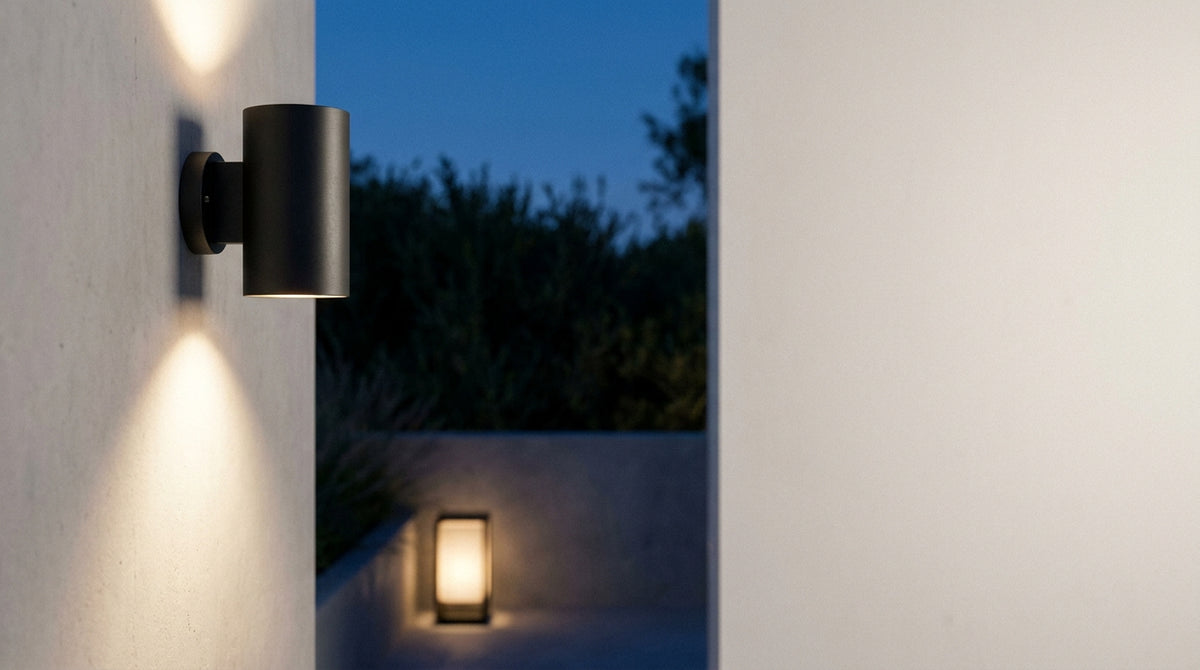
A wall light lights widely: 400 to 800 lumens, mounted between 1.80 m and 2.20 m from the ground, with a beam directed downwards to avoid glare. This model, sometimes called an outdoor wall lamp, is enough to handle an entrance on its own. With no cable to run, solar wall lights cover wall corners that a trench cannot reach.
How many light points on a circuit?
A circuit protected by a 10 A breaker supports 2,300 W in theory at 230 V, and is sized at 80 %, so around 1,840 W. With LEDs of 10 to 30 W, wattage is never the limiting factor: it is the number of points, which common practice caps at eight per circuit.
To calculate the lighting you need, start from the number of points, then the watts, not the other way round.
Outdoor luminaires for terrace, path and facade
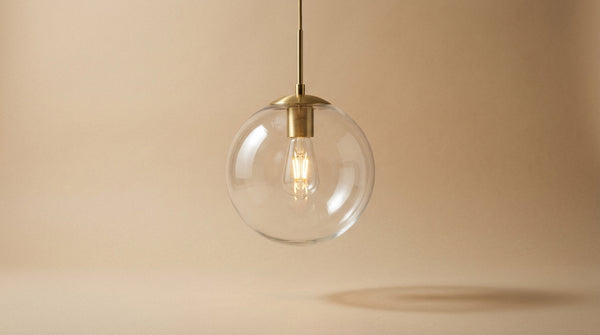
 Basic form Gold pendant light
 Basic form Gold pendant light
 Basic form Gold pendant light
 Velora Brown outdoor luminaire
 Bobi 2-light pendant light, black
 Gentor 4-light pendant light, white
See the whole selection: Lighting, Home Lighting, Online Lighting Store
Choosing an outdoor luminaire: IP rating, colour temperature, beam
The protection rating decides whether the luminaire survives outside, the colour temperature sets the mood, the beam sets the use. These three criteria matter more than the number of lumens printed on the packaging. A beautiful luminaire with poor protection will not make it through winter.
IP44 or IP65: which to choose for outdoors?
IP44 withstands water splashes, IP65 resists jets and dust. Under a canopy, IP44 is enough; fully exposed, choose IP65. The first digit concerns solids, the second water.
- IP44: sheltered wall, under a canopy, water splashes.
- IP65: part exposed to rain, jets and dust.
- IP67: recessed in the ground, occasional immersion.
On a survey of 250 references in our catalogue as of 29 September 2026, 94 % are declared IP20, 4 % IP65 and 2 % IP44. An indoor luminaire does not become outdoor because you put it outside: look for the IP rating on the product sheet. Our lighting collection gathers 25,578 references on the same date.
To light a facade, two small points in grazing light are worth more than one large floodlight. If any doubt remains about a reference, the public Google listing for Designix can be checked in one click.
Which colour temperature for outdoor lighting?
2,700 to 3,000 K for a terrace where people linger, 4,000 K for an entrance you want to keep an eye on. Warm light flatters stone and wood, cool light lights passage areas more sharply. Do not mix the two on the same wall: the gap between a 3,000 K wall light and a 6,000 K floodlight is immediately visible.
Outdoor post lights and bollards come in both shades, keep the same family everywhere. For a bed with no power supply, a solar outdoor lamp with no trench lights one point, with a consistency that depends on the season.
Which outdoor space do you want to light tonight?
In stock · shipping costs shown at checkout · up to 30% off in your cart


Ready to turn inspiration into reality?
Tell us about your room, your style and your budget, and we will show you the pieces that truly suit your project.
Get guidance in 30 seconds →