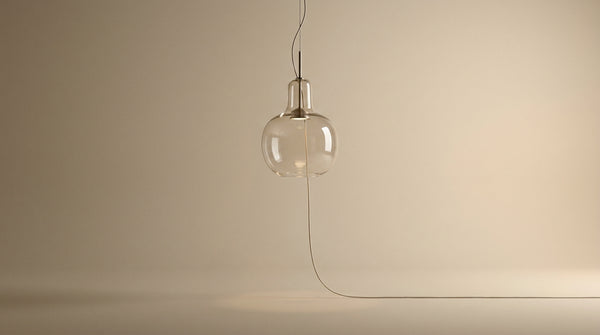
Brown lighting: the shade that warms every room
This article is also available in French: Luminaire marron
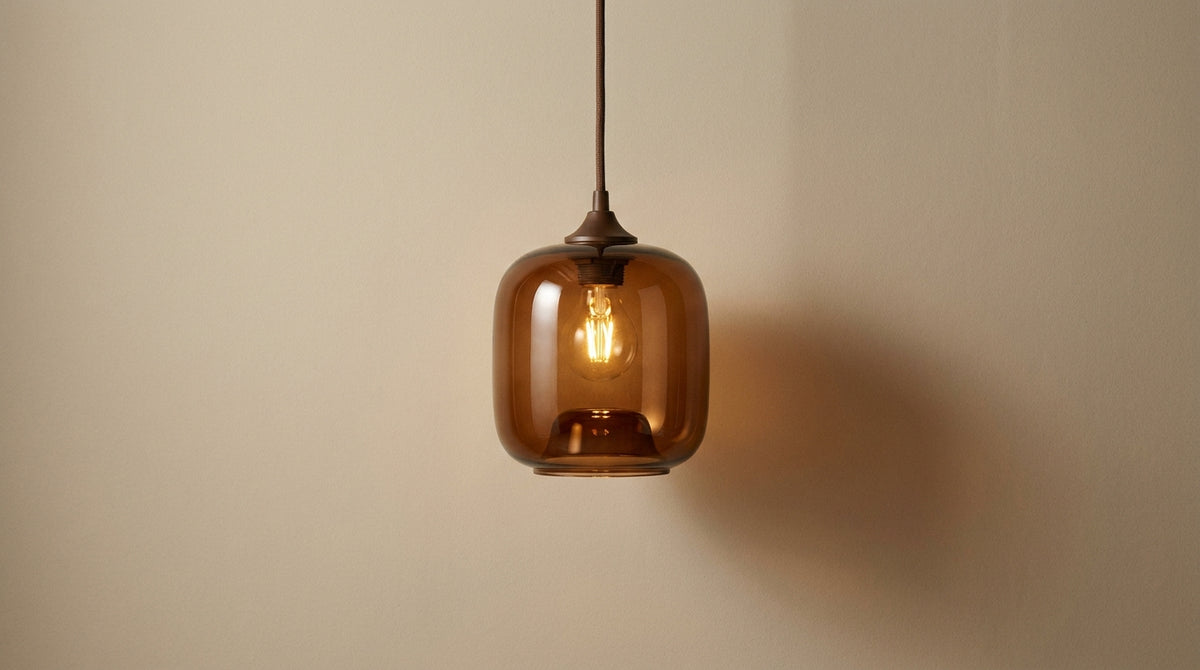
Choose the shade before the shape. A light brown (rattan, pale oak, wicker) brightens a dark room; a walnut or solid bronze gives it structure and darkens it. Then check the shade material: that is what gilds or dims the light. The colour matters less than what it lets through.
What does a brown light fitting change in a room?
It warms whites and greys without yellowing them. Brown absorbs part of the light and reflects it back tinted: a cognac shade gives an amber halo, an oiled wood a flatter finish. This effect shows before the shape and before the style.
In a living room, two or three brown sources spread around work better than one large ceiling light: each has its use, reading, dining, sofa corner. That is the principle of a living room lighting plan built by zones rather than by symmetry.
Light brown or dark brown fitting: which one does not darken?
Light brown, without hesitation, if the room lacks daylight. Rattan, pale oak or raw linen reflect more and blend into a beige wall. Dark brown is still possible, provided you place it low and switch it on only in the evening.
- Light: rattan, wicker, oiled oak, it brightens and forgives white walls
- Medium: walnut, teak, cognac, it frames the room without closing it in
- Dark: bronze, mahogany, chocolate brown, it gives structure to a large volume
- Dark room: stick to the first two families, never chocolate on the ceiling
A chocolate brown pendant above a coffee table works because it is low and close to the eye: you perceive the halo, not the shade. Brown-toned shades are chosen in that order, height first, nuance second.
The shade is judged switched on, never off
A brown shade switched off often leans grey or russet. Switched on, it changes sides: the same fabric turns honey with a 2700 K bulb, it turns dull brown with a 4000 K one.
Two checks before buying: the socket (E27 or E14) and the maximum wattage accepted. An opaque matt brown shade eats light, an amber glass gilds it. The same brown therefore does not look the same from one room to another.
Which material gives a warm brown?
Tinted glass for golden light, wood and rattan for a brown that breathes, brown metal for a clean brown. The material decides more than the shade written on the product sheet, and it is the first thing to look at.
Brown glass light fitting: amber, smoked or clear?
Amber gilds the light and warms it frankly. Smoked softens it while keeping contrast. Clear lets everything through: it only plays the role of a warm brown on a tinted frame.
In a living room, amber remains the safest choice. An amber glass pendant pairs with pale wood as well as with a terracotta wall.
Smoked glass has the edge in an already bright room, where you want a clean outline rather than orange light. A smoked glass pendant keeps the brown visible without gilding faces.
To compare the two finishes, the glass lighting selection brings them together on one page.
Wood, wicker, rattan: the brown that breathes
These materials reflect an irregular brown, with grain and gaps that cast shadows on the ceiling. It is the liveliest brown, and the most forgiving with furniture already in place.
- Rattan: light, graphic, perfect above a table
- Wicker and willow: honey brown, warm, ideal in a living room
- Oiled walnut: deeper, best kept for high ceilings
- Bamboo: even, contemporary, it holds up well in a kitchen
A solid wood lamp ages and darkens slightly over time: in a bright interior, that is an advantage.
For a more even finish, wooden shades offer the same brown without the upkeep of a one-off piece.
Brown metal and bronze: the brown that structures
Brown metal and bronze give a clean brown, with no transparency: the light stays white, the object carries the colour. These finishes hold up best in a busy room.
Brown or bronze metal shades direct light downwards, which suits above a worktop or a reading table.
For the base, industrial style lamps embrace rust brown and raw iron without turning black.
Hesitating between a light rattan and a deeper walnut? Send a photo of the room and we will decide with you in a few minutes: ask the team your question saves a parcel going back and forth.
Which brown light fitting for which room?
The living room calls for a warm, low brown, the bedroom a soft, softened brown, the kitchen a clean brown that is easy to wipe. The same colour does not look the same depending on the mounting height and the time spent in the room.
The living room: a warm brown, from a low source
Look for the halo at seat height, not general lighting: walnut floor lamp, large rattan table lamp, brushed brass wall light. A brown wall light near the sofa replaces a second floor lamp when space is short.
The bedroom: the softest brown possible
Rattan, linen, smoked glass: three materials that cast no harsh glare. A brown bedside lamp at 2700 K with adjustable brightness is better than a prettier but too directional model.
The placement guidelines on each side of the bed are detailed in the article on bedroom lighting.
The kitchen and dining room: a matt, washable brown
Metal, oiled wood or tightly braided cord, never a light fabric above the hob. Above a table, a dark wood or bronze dining room chandelier does the job without darkening the plates.
Over an island, a low pendant is enough: the brown is seen up close, it does not weigh on the room.
Which brown light fitting for your room?
Brown and black, brown and beige: which colours to pair it with?
With black for the outline, with beige for softness, with off-white to gain light. Brown acts as a binder: it accepts both extremes provided it stays a minority in the room.
Contrast with black
Black hardens outlines and stops brown from turning russet. A black frame with a light brown shade gives a readable result, even in a small room.
- Brown and black: clean contrast, effective above a table
- Brown and beige: blended, perfect in a bedroom
- Brown and off-white: higher light, bigger room
- Brown alone: limit it to one source per room
The soft beige version
Beige makes brown almost neutral: it is the choice for rooms where you want wood without the cabin effect. A beige light fitting placed next to a walnut creates a soft transition between the two shades.
At what height should a brown light fitting be hung?
Allow 75 to 85 cm between the bottom of a pendant and a table top, 1.60 m to 1.80 m from the floor for a wall light, and 2.10 m of clearance in a walkway. These three dimensions settle most of the result.
- Pendant: measure from the table top, never from the floor
- Wall light: at shoulder height to light, lower to read
- Floor lamp: shade below seated eye level, around 1.20 m
- Wet room: IP44 minimum, outside shower zones
Above a table
Too high, the pendant lights the room; at the right height, it lights faces and the tablecloth. A brown shade lowered by ten centimetres changes the mood more than a change of bulb.
On the wall and on the floor
A wall light is placed according to use, a floor lamp according to seated eye level. In a wet room, check the IP rating before the finish: a brown fabric shade stays out of reach of splashes, metal holds up better over time.
In stock · shipping costs shown at checkout · up to 30% off in your cart


Ready to turn inspiration into reality?
Tell us about your room, your style and your budget, and we will show you the pieces that truly suit your project.
Get guidance in 30 seconds →