Bathroom chandelier: choosing one without fearing humidity
This article is also available in French: Lustre salle de bain
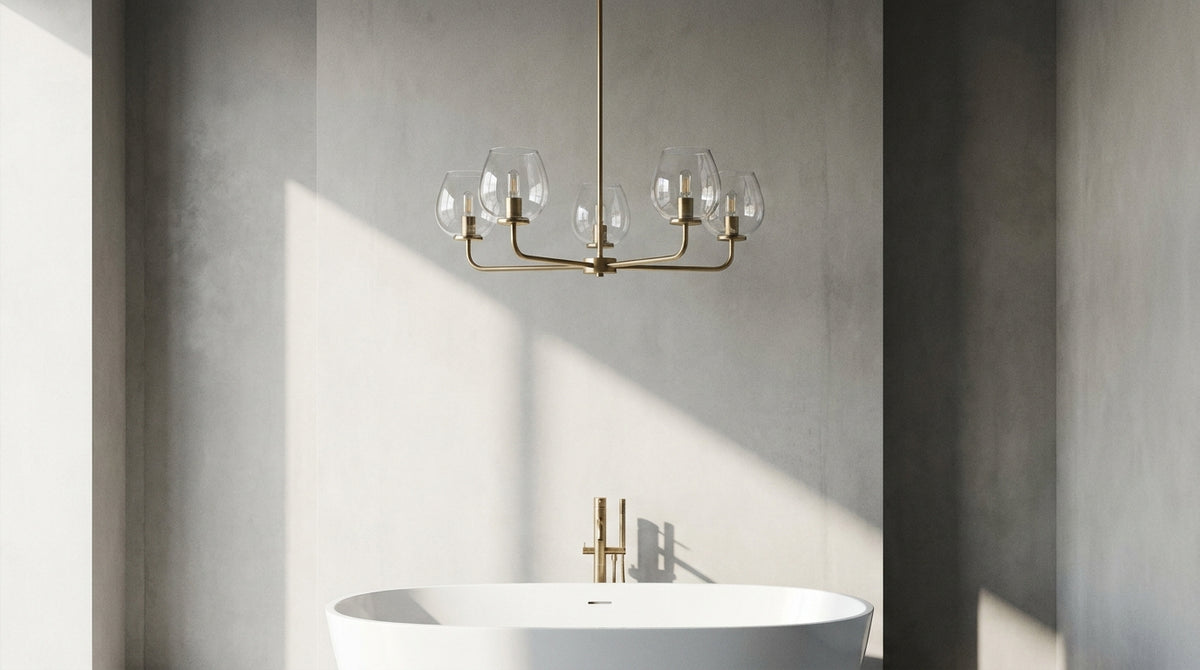
Check the protection rating stated on the product page: aim for IP44 at minimum, IP65 near the jet. Then install. Allow 80 to 90 cm above the vanity top for a wall version, 2.10 m from the floor for a pendant. A closed model, in glass or brass, holds up without problem in a ventilated wet room.
Which chandelier should you put in a bathroom?
A wall model or a small closed pendant, in glass, brass or metal, with IP44 minimum and an E27 or G9 socket. The open crystal-drop chandelier remains reserved for very well ventilated rooms and high ceilings.
The vocabulary is confusing. To distinguish a chandelier from a pendant light, remember this: the chandelier multiplies light points, the pendant carries only one. In a wet room, this difference decides everything, because each light point is one more entry point for humidity.
Which wall-mounted bathroom chandelier should you choose?
The wall version is the safest, and the catalogue confirms it: out of a survey of 92 references on 5 October 2026, 99% are declared as wall-mounted. It installs at mirror height, wipes clean in one gesture and frees the ceiling.
- Two wall lights framing the mirror for frontal lighting without shadows on the face
- A double wall light if the vanity top is narrow and the available wall is short
- An adjustable wall light to direct the flow towards the vanity or the bathtub
- A model in brass or glass among the IP44 wall lights for the bathroom, which age better than painted finishes
If you prefer the pendant version, there is only one rule: a closed diffuser, never a dust trap above the bathtub. The details of the criteria for choosing a bathroom pendant come down to the material at the bottom of the pendant, the part that receives the steam.
Modern or classic bathroom chandelier?
Contemporary dominates by far: 88% of the product pages surveyed carry this mention, 85% the modern mention. In other words, slim mounts in tube or ball form, black, white or gold, make up most of the available offer.
| Style | What it brings | Where it works best |
|---|---|---|
| Contemporary | Clean lines, little material | Small bathroom, low ceiling |
| Modern | Metal and glass, geometric shapes | Large-format tiled room |
| Classic | Crystal, drops, worked brass | Spacious room, height above 2.60 m |
Is a wooden bathroom chandelier realistic?
Yes, provided you keep it away from the shower area. Wood thrives in a well ventilated room, with a running extractor fan, and it brings a warmth that no metal gives. Just check that the product page states the material and the protection rating, otherwise you are installing blind.
The most represented shapes in our survey go for the simplest: 40% tube shapes, 30% ball shapes. A vertical cylinder in smoked glass or a sphere in clear glass crosses trends effortlessly.
Chandeliers and light fixtures that hold up in a bathroom


Can you install any light fixture in a bathroom?
No, and the gap is clear. Out of a survey of 92 references in our catalogue on 5 October 2026, 77% declare IP20, a rating intended for dry air. Only 11% state IP44, 7% IP54 and 3% IP65. Without this mention on the product page, you are installing a fixture that has no place in a wet room.
What does the IP44 or IP65 protection rating mean?
| Rating | What it withstands | Where to place it |
|---|---|---|
| IP20 | Dust only | Bedroom, living room, hallway |
| IP44 | Water splashes | Bathroom, outside the shower zone |
| IP54 | Dust and splashes | Close to the vanity top |
| IP65 | Water jets | Near the shower or bathtub |
A chandelier in a dry zone is satisfied with IP44. Above a bathtub, aim higher. The mistakes to avoid before buying almost all come down to this confusion between ambient humidity and direct splashing.
Glass, brass, metal: which materials hold up in humidity?
Glass and treated metal come out on top in the survey: 57% glass mentions, 83% metal mentions, 42% iron mentions. These materials do not fear water, unlike fabric lampshades and fragile lacquered finishes.
- Clear or smoked glass for clean light and immediate cleaning
- Brass that patinates over time without deteriorating
- Powder-coated metal in black or white, the two shades most present on the product pages surveyed (63% black, 51% white)
- Aluminium for damp rooms and adjustable models
A complete project, with several sources and an installation plan, is built more calmly by first framing the bathroom lighting project before ordering anything.
And if no rating is stated on the product page?
You move on to the next model. A complete product page states the rating, the material and the socket, which lets you decide instead of guessing. It also states the warranty: in the same survey, 95% of the references carry 2 years. CE certification is declared on the entire sample.
At what height and on what fixing should you install a bathroom chandelier?
Allow 2.10 m from the floor minimum for a pendant model above a passage, and 80 to 90 cm above the vanity top for a wall version. The fixing goes into the structural support, never into hollow drylining without a plug suited to the actual weight of the fixture.
Should you fix it to the ceiling or the wall?
The wall remains the safe bet. It places the light at the right level, in front of the mirror, and removes the risk of bumping your head in a room where you move around often. The ceiling is only justified in a large volume, when the room has at least 2.60 m of clear height.
- Wall light at mirror height, 80 or 90 cm from the vanity top
- Short pendant only in the centre of a spacious room
- Ambient light point near the bathtub, in IP65 if the jet can reach it
- Dedicated switch, or dimmer, to turn on the ambience without waking everyone up
Before drilling, the question of ceiling height and choosing a chandelier is settled with one measurement. A 2.40 m ceiling supports a wall light, not a crystal-drop chandelier.
If your ceiling is high and your vanity top wide, the quickest way is to describe the room: the team replies on the contact page, with the height and the fixing to plan for.
What is the ideal lighting for a bathroom?
Three sources are better than one powerful source: diffuse general lighting, two frontal points on each side of the mirror, and a low ambient light. The temperature sits between 2700 K and 3000 K for comfort, with a more neutral exception in front of the mirror.
- General layer on the ceiling, diffuse, to move around without harsh shadows
- Functional layer around the mirror, for shaving and make-up
- Ambient layer near the bathtub or a niche, in low light
- Dimmer on at least one of the three, to go from waking up to the evening bath
Should you choose warm or cool white LED?
Warm white lights less white, cool white lights more white, and that is the only difference that matters when choosing. A 2700 K leans golden and relaxes; a 4000 K renders skin tones accurately in front of the mirror. In a wet room, one rule holds: nothing above 4000 K anywhere other than in front of the mirror.
| Temperature | Rendering | Where to use it |
|---|---|---|
| 2700 K | Warm white, golden | Bathtub ambience, evening light |
| 3000 K | Neutral warm white | General lighting of the room |
| 4000 K | Neutral white | In front of the mirror, skin tone accuracy |
The available sockets follow this logic: 26% LED modules, 25% E27, 14% G9 and 13% G4 on the product pages that state this information. LED bulbs for the bathroom allow you to correct a colour temperature without changing the fixture.
How should you light the mirror to apply make-up?
The light must come from the front, not from the ceiling. A source above the mirror creates shadows under the eyes, two side sources erase them. To fine-tune the setting, lighting for make-up is worked at face height, with neutral rendering and enough intensity not to squint.
What are the lighting trends for the bathroom in 2026?
Slim mounts, smoked glass and brass are back in force, often combined with a single well-placed source rather than a central ceiling light. Gold appears on 50% of the product pages surveyed, almost on par with black. The general idea is simple: fewer fixtures, but better chosen.
This approach matches the one described in our guide to lighting your bathroom like a spa, where ambience takes precedence over power. A successful wet room is judged in the evening, with the low light on.
The rest comes down to the choice of the fixture itself, and to the way the three layers interact. If you are still hesitating between several directions, designer wall lights for the bathroom offer a clear starting point, with slim mounts that suit almost all tiles.
In stock · shipping costs shown at checkout · up to 30% off in your cart


Ready to turn inspiration into reality?
Tell us about your room, your style and your budget, and we will show you the pieces that truly suit your project.
Get guidance in 30 seconds →