LED chandeliers for living room
- Tracked delivery to your country Tracked delivery
- Secure payment at checkout Multiple payment methods
- 14 days to change your mind 14-day returns
- Secure payment Secure payment


Not sure of your style? Find it in 30 seconds
A few questions, and we will show you the pieces made for you.








Frequently asked questions
How do I choose the right product?
What are the delivery times?
Can I return an item?
Can I pay in instalments?

An interior that reflects who you are
Carefully selected pieces, shipped from our warehouses. Our team advises you before you buy, so you choose with confidence.
- Tracked delivery
- Pay in instalments, where available
- 14 days to change your mind
- Advice & showroom in Lyon, France
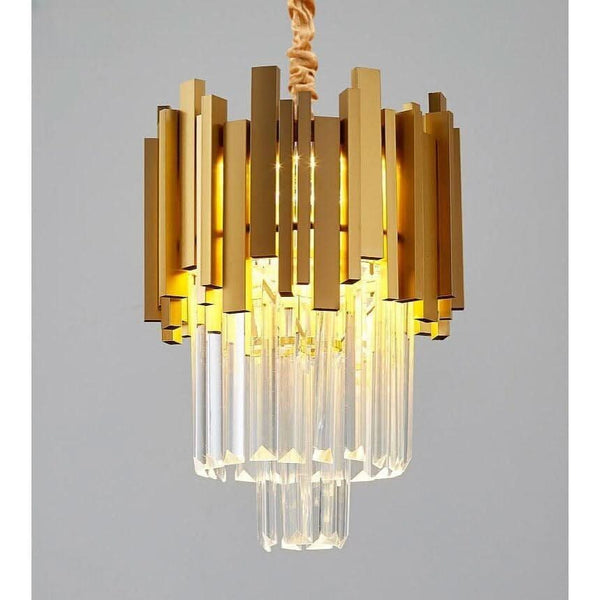
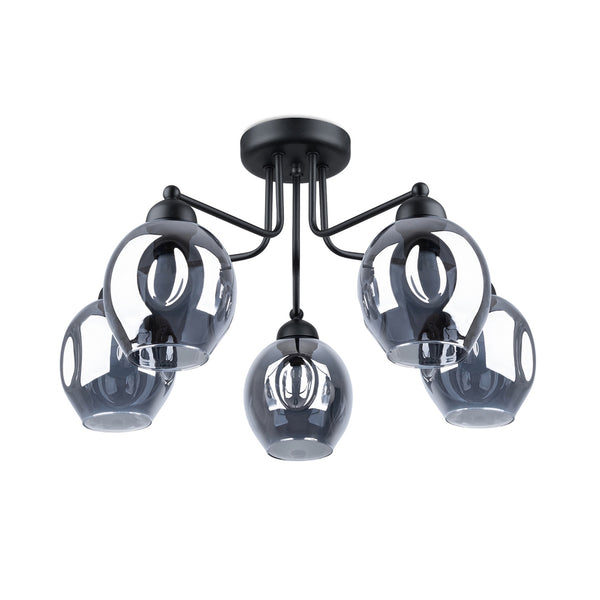
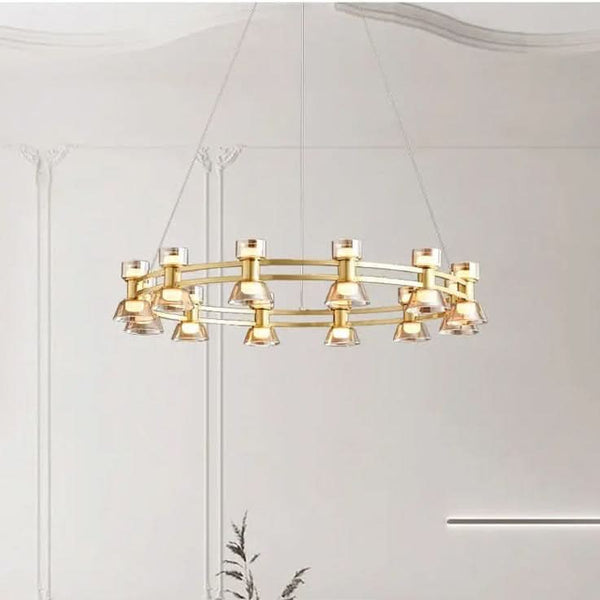
Start by counting the ceiling space and locating the fixing point: these two markers decide the format before the style. The LED chandeliers for living room gathered here range from the 78 cm round to the large 110 cm round, from the 60 to 80 cm square to the 130 cm linear profile, all in IP20, all in LED, with E27, E14, G4 or G9 sockets depending on the model.
- Which LED chandelier should you choose for a living room?
- Pendant or chandelier: what is the difference?
- What light for the living room?
- Lighting trends 2026
- The drawbacks of LED lamps
- Choosing the size of a large living room chandelier
- Installing and hanging the light fixture
- Matching the chandelier to the decor
- Frequently asked questions
Which LED chandelier should you choose for a living room?
Measure the room, note the ceiling height and look at the support already in place: these three points rule out half the formats. A living room of 15 to 20 m² is fine with a 78 cm round or an 80 cm square; beyond that, a large format takes over without overwhelming the room.
LED chandelier for living room: where to start?
The fixing point dictates the acceptable weight and the number of light points. An existing support takes an aluminium piece such as the TUULA L 3000K pendant, 130 cm long and 40 wide, whose cable adjusts up to 150 cm. For a squarer room, the RIO 2 of Ø 78 cm covers a sofa or a table without weighing it down.
Integrated LED or bulb with a socket?
Some models run on integrated LED, with no bulb to plan for: the temperature is set at the factory and the silhouette stays slim. The others take a screw-in bulb, mostly E27, then E14, G4 and G9, like the NOX 4L and its E14 socket. The socket lets you choose the light colour and replace the source; the selection of modern LED chandeliers for living room shows both approaches side by side.
LED pendant for living room or chandelier: what is the difference on the ceiling?
A pendant comes down from a single point and throws a pool of light onto a precise area, often above a table or a sofa. A chandelier spreads the light over several points or along a long profile. Here, the linear profiles measure 100 to 130 cm long and the rounds 78 to 110 cm in diameter.
Chandeliers for the living room: round, square or linear?
The round suits a square room: the large round NELYA L at 110 cm structures an open living area. The square, like the ODA 80 at 80 by 80 cm, marks out a dining corner. The linear follows an elongated living room: the TUULA L in neutral white lights lengthwise, handy in an L-shaped room or above a large coffee table.
At what height should you hang a pendant in a living room?
Above a table, allow generally 75 to 85 cm between the top and the bottom of the fixture. Over a walkway, clear at least 2.10 m from the floor so you do not obstruct the passage. The cables in this collection adjust up to 150 cm, 120 cm or 80 cm depending on the reference. A model intended for the dining room table follows the same rule.
What light for the living room: warm white or neutral white?
Warm white, from 2700 to 3500 K, gives a soft, restful light in the evening: it is the most common here. Neutral white, from 3500 to 4500 K, renders colours more sharply and suits living areas open to the kitchen. Cool white, above 4500 K, remains rare in this collection.
| Light | Temperature | Associated socket | Living room mood |
|---|---|---|---|
| Warm white | 2700 to 3500 K | Integrated LED, E27, E14, G4 | Cosy, pleasant in the evening |
| Neutral white | 3500 to 4500 K | Integrated LED | Sharper colours, living area open to the kitchen |
| Cool white | 4500 to 6500 K | Integrated LED, E27 | Crisp rendering, better for work rooms |
Warm white or neutral white: which to choose for the living room?
On a model with integrated LED, the temperature is decided when you order: the RIO 3 at 4000 K leans neutral, the ODA 80 at 3000 K leans warm. On an E27 or E14 socket, the bulb decides and you can change your mind later. A living room mainly used in the evening calls for warm light; a range of modern LED chandeliers often offers both temperatures on the same shape.
LED chandelier and halogen: what changes?
Halogen runs hot and leans yellow; LED runs cooler and covers a wider range, from warm to cool. On models with integrated LED, you do not choose the bulb, the colour is fixed. On a socket, the same fitting takes an LED bulb of the temperature you want. To keep the character of an older living room, the vintage look remains an option.
What are the lighting trends for the living room in 2026?
The references in this collection lean towards fine lines in aluminium or steel, in black, white or gold, with integrated LED and round, square, ball or tube shapes. Warm white remains the majority, neutral white is gaining ground in open spaces, and only a small share of the models come with a dimmer.
Which chandelier style for a modern living room?
The modern style dominates by far, followed by minimalist: slim profiles, little visible material, spread light. For a modern living room, look for a model in black or white aluminium, round or square. A contemporary style for the living room allows freer cut-outs, while the Scandinavian inspiration stays on light tones and soft shapes.
Do gold and black have their place in a current living room?
Black accounts for the vast majority of colours, with white and gold close behind. A black chandelier disappears against a dark ceiling and highlights a white one; gold warms a living room with light walls, like the RIO 78 polished gold. Green and beige, rarer, serve as a nod to a textile or a wall.
What are the drawbacks of LED lamps?
On a chandelier with integrated LED, the source cannot be replaced: when it dies, the whole fixture has to be changed. LED light is directional and leaves shadow zones if the fixture hangs low. Some entry-level models flicker or lean blue, and cool white hardens a living space.
Integrated LED or bulb: which lasts longer?
A bulb with a socket is replaced in seconds, the fixture stays in place. An integrated LED cannot be taken apart, but it removes the weak point of a badly screwed socket or a poorly chosen bulb. The manufacturer warranty is stated on the product page: it weighs in the decision on a fixture that cannot be dismantled.
Is an LED chandelier dazzling in a living room?
A flat model, set close to the ceiling like the VECTOR 8, lights widely and dazzles little when you are seated. A strongly downward model, hung low above a table, is more likely to be looked at. For a sofa, prefer upward or side diffusion and keep a lower secondary source.
How do you choose the size of a large living room chandelier?
A large chandelier is judged by its footprint on the ceiling before its power. Here, the rounds go from 78 to 110 cm in diameter, the squares from 60 to 80 cm per side, and a narrow profile like the NOX 4L, 14 cm wide by 122 cm, fits an elongated living room without overhanging the passage.
| Format | Measured dimensions | Recommended room | What it changes |
|---|---|---|---|
| Compact round | Ø 78 cm, cable up to 150 cm | Living room, dining room, bedroom | Lights a table or a sofa without weighing it down |
| Large round | Ø 110 cm | Large living room, open living area | Covers a wide area and structures the room |
| Square | 80 x 80 cm | Square living room, open kitchen | Spreads light above a dining corner |
| Long linear | 40 x 130 cm | Elongated living room, large coffee table | Lights lengthwise, handy in an L-shaped room |
| Narrow linear | 14 x 122 cm | Narrow living room, hallway, entrance | Sits near a wall without blocking the passage |
| Flat industrial style | 56 x 103 cm, H 15.5 cm | Living room, kitchen, low room | Stays close to the ceiling and does not cut the view |
What diameter of chandelier for a living room?
A 78 cm round fills a living room of 15 to 20 m² well. Beyond 25 m², or in a living area open to the kitchen, a 110 cm fills the volume without looking lost. A modern chandelier for the dining room follows the same rules, with a diameter matched to the length of the top.
Large living room chandelier: where on the ceiling?
Centre the fixture on the area to be lit, not necessarily on the room: the centre of the table above a dining table, the centre of the sofa or the rug in a living room. The rest of the family, from the ceiling light fixture to the floor lamp, is browsed by shapes and by rooms. A narrow profile like the NOX 4L with its E14 socket runs along a wall and lights a bookcase without taking up the passage.
How do you install and hang an LED chandelier in a living room?
Cut the power at the breaker, fix the mounting plate to the existing light point, adjust the cable length then connect. All the references in this collection are IP20: they are installed indoors, protected from water splashes, in a living room, bedroom or hallway, never in a bathroom.
How do you hang a heavy chandelier from the living room ceiling?
A large steel or aluminium format is fixed to a mounting plate, screwed into the existing support. If the ceiling is hollow, a plug suited to the material is essential. Get help holding the piece during connection, and check the stated maximum height (150, 120 or 80 cm) before cutting the cable.
Do you need a dimmer for an LED chandelier?
The dimmer is only stated on a minority of references, like the RIO 3 chandelier in neutral white. On the others, a poorly chosen dimmer switch makes the LED flicker. Check compatibility before fitting one, or keep a simple two-way switch and add a secondary lamp with its own dimmer.
Modern living room chandelier: how do you match it to the decor and the other rooms?
The match is played out on colour and material: black and aluminium for a sober interior, gold to warm a bright living room. Many references are listed for several rooms, which lets you carry the same family into an open living area, a bedroom or a hallway without breaking the unity.
Modern living room decor: pairing chandelier, materials and colours?
A low ceiling copes badly with a thick fixture: a flat model stays discreet. For the rest, let the metal of the fixture converse with the handles, the furniture legs or a skirting board. Metal and glass create reflections, steel shows its structure, iron keeps a raw look. A glass chandelier suits bright rooms, and the same handwriting runs on to a bedroom to light without dazzling or to a modern kitchen decor.
An original living room fixture: where to place it without overloading the space?
A LED chandelier with a freer design goes above a coffee table or a sofa and becomes the focal point of the volume. Keep the rest sober then, one strong piece per room. When the ceiling is not enough, a hallway version extends the style, and an entrance model welcomes without competing with the living room.
Chandelier, wall light or floor lamp: which to choose first?
Three layers light a living room: the ceiling for general light, the wall for a painting or a bookcase, the floor for an armchair. A living room wall light completes a chandelier without duplicating it. A ball floor lamp or a living room floor lamp brings a low, mobile light near the sofa. Paint colour matters too: a bright living room starts with white or beige walls that bounce the light, while a dark shade absorbs it and calls for a more generous fixture.
To decide, start from the format: an 80 cm square or a 78 cm round covers most living rooms, and the slimmest models slip under a low ceiling. Secure payment, tracked delivery, returns and Designix customer service accompany every order.
Frequently asked questions about LED chandeliers for living room
How do you choose a chandelier for a living room?
You look first at the fixing point and the floor area, then at the light you want. Models with integrated LED sit alongside chandeliers with E27 and E14 bulbs here, in rounds from 78 to 110 cm in diameter or in linear profiles, all IP20 for indoor use.
Modern living room chandelier: how do you recognise one?
It plays on fine lines, simple geometric shapes and sober colours. The references in the collection are in aluminium or steel, in black, white or gold, with round, square, ball or tube shapes and a warm or neutral white light.
LED or halogen chandelier in a living room: what is the difference?
An LED chandelier lights with an integrated source or an LED bulb, with no incandescent filament, and runs cooler than a halogen. The temperatures listed here mostly range from 2700 to 3500 K, a warm light where halogen leaned yellow.
Can you add a wall light alongside a chandelier in the living room?
Yes, and it is often useful: the chandelier lights the centre of the room, the wall light lights a wall, a bookcase or a painting. The two complement each other without competing, provided you keep the same light family, warm or neutral depending on the mood you choose.
Do you need a floor lamp in addition to the chandelier in the living room?
A floor lamp brings a low, mobile light, useful near an armchair or a sofa, where the chandelier does not reach. It completes an integrated LED chandelier without changing the main lighting, and moves as the living room is rearranged.