GU5.3 LED spotlights
This selection is also available in our French store: Spots LED GU5
- Tracked delivery to your country Tracked delivery
- Secure payment at checkout Multiple payment methods
- 14 days to change your mind 14-day returns
- Secure payment Secure payment


Not sure of your style? Find it in 30 seconds
A few questions, and we will show you the pieces made for you.
No products in this selection.
Frequently asked questions
How do I choose the right light output?
At what height should the light be installed?
What type of bulb?
Compatible with LEDs and dimmers?
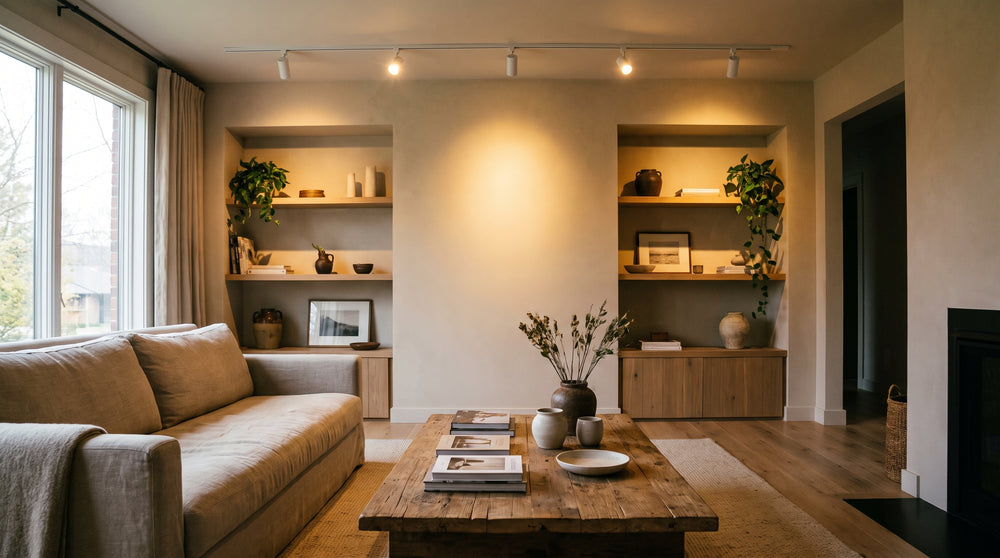
Light changes everything
From statement chandeliers to discreet wall lights, we help you choose the right brightness, height and style for every room.
- Tracked delivery
- Pay in instalments, where available
- 14 days to change your mind
- Advice & showroom in Lyon, France
Check your fixture's voltage first: a GU5.3 LED spotlight is recognisable by its two pins spaced 5.3 mm apart and usually runs on 12 V behind a transformer, in the MR16 format of around 50 mm in diameter. Once the voltage is confirmed, the choice comes down to the ceiling cut-out, the tilt of the spotlight and the colour of light.
What is a GU5.3 LED spotlight and how do you recognise it?
A GU5.3 LED spotlight is a small spotlight with a two-pin base, the pins spaced 5.3 mm apart, often called MR16 when its reflector measures around 50 mm in diameter. It usually runs on 12 V behind a transformer and is fitted in a ceiling, a niche, a step or a piece of furniture.
MR16 LED bulbs: a two-pin base
The base is easy to read at a glance: two thin pins, set side by side, with no lugs or bayonet fitting. That 5.3 mm gap gives it its name and sets it apart from screw fittings. The GU5.3 marking and the expected voltage are printed on the base or the packaging, to be read before ordering a replacement bulb.
GU5.3 LED spotlight 12 V or 230 V: check the voltage first
The same spotlight format can exist in two voltages. The 12 V version needs a transformer, the 230 V version connects to the mains. Confusing the two damages the bulb or the power supply. Note the voltage printed on the transformer or on the old bulb before browsing our tiltable LED spotlights or a recessed tiltable version.
Recessed GU5.3 LED spotlight: the format that sits in the ceiling
Recessed, the spotlight disappears into the surface and shows only its trim. You therefore need a cut-out and a depth compatible with the panel or ceiling. Access to the transformer matters too: if it stays hidden above the ceiling, plan a hatch or access panel to replace it one day.
What is the difference between GU10 and GU5.3?
GU10 connects to the 230 V mains with two lugs, whereas GU5.3 uses two thin pins and usually runs on 12 V behind a transformer. The spotlight format is similar, but the fixture, the wiring and the replacement are not interchangeable without adaptation.
Base and voltage: what changes at the connection
The number of volts dictates everything else. A 230 V fixture has no transformer, a 12 V fixture has one, often housed in the ceiling or in the spotlight body. The table below sums up what is at stake before buying.
| Base | Supply voltage | Format | Power supply needed | Where you find it |
|---|---|---|---|---|
| GU5.3 | 12 V most often | Spotlight with a reflector of around 50 mm (MR16) | 12 V transformer | Recessed ceilings, niches, furniture |
| GU10 | 230 V mains | Spotlight of around 50 mm | None, direct connection | Living rooms, kitchen, hallways |
| GU5.3 sold as 230 V | 230 V | Varies with the model | None or supplied driver, to be checked | Depends on the product, check before buying |
Can you switch from GU10 to GU5.3 in the same light fitting?
Rarely without work. Changing the base means changing the socket, and switching to 12 V means adding a transformer. Conversely, a 12 V fitting will not take a 230 V spotlight. The simplest solution is to replace the spotlight with a model using the same base, or to change the whole light fitting.
Where to install a GU5.3 LED spotlight in the home?
The GU5.3 spotlight suits anywhere you want focused light: a kitchen worktop, accent lighting in a living room or bedroom, a stair step, a niche or a display case. The key point is to choose the colour of light and the tilt according to the intended use.
Spotlights for the kitchen and the worktop
Above a worktop, the spotlight lights your hands and the chopping board without casting shadows. Allow one point roughly every 60 to 80 cm along the worktop, tilted towards the wall rather than towards your eyes. The spotlights dedicated to the kitchen and the recessed kitchen spotlights are fitted under a panel or in a dropped ceiling.
Spotlights to light a living room or a bedroom
In a living room, a few well-placed points are better than many points everywhere. Two or three spotlights tilted towards a wall or a bookcase are enough to set a mood, alongside a main light source. To light a living room or serve as bedroom accent lighting, aim for a warm white and a tilt that avoids direct glare.
Stairs and circulation: guiding without dazzling
On a staircase, the spotlight is there to show the step, not to light the room. Tilt it towards the nose of the step and keep a moderate output so the eye adjusts as you climb. Stair spotlights are placed in small numbers, evenly spaced.
| Room | Use | Recommended white | Point to check |
|---|---|---|---|
| Kitchen | Worktop and preparation | Cool or neutral white | Recessing and tilt |
| Living room | Focused lighting, mood | Neutral or warm white | Number of points and dimming |
| Bedroom | Reading, accent lighting | Warm white | Glare, tilt |
| Stairs and hallway | Guiding footsteps | Neutral white | Fixing and accessibility |
| Bathroom | Localised lighting | Neutral white | Suitable IP rating |
Recessed GU5.3 LED spotlight: how do you choose according to the ceiling?
For a recessed GU5.3 spotlight, you first look at the planned ceiling cut-out and the available depth, then at the tilt, fixed or adjustable. A thin ceiling, a sloped ceiling or insulation calls for a model compatible with the surface.
Cut-out and depth: measure before drilling
The cut-out is the diameter of the hole to drill in the panel. It must match that of the spotlight, with no play. The available depth matters just as much: above a thin panel or an insulated ceiling there is sometimes little room for the spotlight body and the transformer. Measure, then compare.
Fixed or tiltable spotlight: which setting for which use?
A fixed spotlight lights straight below it, which suits circulation areas and even surfaces. A tiltable spotlight can be aimed at a worktop, an artwork or a wall, and lets you correct the angle after installation. The bulb can generally be replaced on its own in both versions, provided you keep the same voltage and the same base.
Dimmable GU5.3 LED spotlight: how do you get adjustable light?
A dimmable GU5.3 spotlight is adjusted with a compatible dimmer: at 12 V, it is often the transformer that must accept dimming, otherwise the light flickers or will not go down. So you check the dimmable marking on the spotlight and on the power supply before installing the set.
Dimmer and transformer: compatibility first
The dimmer acts on the power supply, not directly on the bulb. At 12 V, the transformer must be designed for dimming, otherwise the result is disappointing even with a compatible spotlight. The simplest approach is to replace a complete set rather than a single part: see the dimmable models and the recessed dimmable spotlights.
How does a 12 V spotlight behave when you lower the output?
Well designed, the set dims gradually with no flickering or buzzing. Poorly matched, it cuts out at the bottom of the range, flickers at mid-power or leaves a slight noise. If in doubt, test a single point before fitting out a whole room.
Which colour of light should you choose for a GU5.3 spotlight?
Cool white gives a very white light, suited to work areas; neutral white and warm white make the mood softer in a living room or bedroom. It is better to keep the same family of white in a room to avoid visible differences from one point to another.
Cool white suits work areas
Generally, a cool white sits above 5,000 K and sharpens contrasts: handy for reading a recipe, chopping or DIY. In a relaxation room, it looks harsh and tires the eye in the evening. Keep it for the kitchen, the workshop or the garage.
Warm white and neutral white for living rooms
Around 3,000 K, warm white leans towards amber and sets a restful mood, suited to the living room and the bedroom. Around 4,000 K, neutral white gives a balanced rendering, useful in a hallway, a staircase or a bathroom. Compare the spotlights with a white finish and the spotlights in black for the colour of the body.
Colour, material and style: which GU5.3 LED spotlight should you choose?
The colour of the spotlight is chosen with the ceiling: a white one fades into a light surface, a black one shows and underlines the line. The material and the design also change the effect, between a discreet body and a spotlight that becomes a decorative detail in its own right.
White or black: matching the spotlight to the ceiling
On a white ceiling, a white spotlight disappears once switched off, which keeps a clean surface. On a dark ceiling, a black body blends in better than a white trim that would stand out. Look at the white recessed spotlights for a discreet effect, and the black recessed versions for a dark ceiling.
Metal, designer or modern spotlight
A metal body brings a cool, clean finish, visible even when switched off: it is the choice of an assertive metal finish. A spotlight can also become a graphic element, between a crafted design and a modern line that follows the decor of the room.
Spotlights, ceiling light or wall light: which LED ceiling lighting?
A spotlight, a ceiling light and a wall light do not do the same job: spotlights light in a focused way and are multiplied to cover a room, the ceiling light spreads widely from a single point, and the wall light completes at wall level. The two sources are often combined.
Ceiling light and chandelier: a single source for the whole room
A ceiling light lights a whole room from a central point, without multiplying cut-outs. A chandelier brings the same overall light with a more decorative object at the centre. These solutions are fitted on an existing fixing point, often more simply than a series of recessed spotlights. Compare them in our full range of light fittings.
Wall light and spotlights: completing existing lighting
A wall light lights from the wall, often at eye or shoulder height, and serves as a complement in a hallway or near a bed. Spotlights complete at the ceiling by targeting a worktop, a step or an object. The two combine well, with one switch per zone to adjust. Find the families in the Designix lighting catalogue, then refine your choice according to the room to be lit.
Frequently asked questions about GU5.3 LED spotlights
What is the difference between GU5.3 and MR16 bulbs?
GU5.3 refers to the two-pin base with pins spaced 5.3 mm apart, while MR16 refers to the format of the spotlight with a reflector, around 50 mm in diameter. In practice, the two terms often go together: an MR16 bulb is most often fitted on a GU5.3 base.
GU5.3 LED spotlight 220 V or GU5.3 LED bulbs 12 V: how do I know which I need?
You look at what powers the existing fixture: a 12 V transformer requires a GU5.3 12 V bulb, a direct mains connection implies a 230 V version. If in doubt, the voltage shown on the transformer or on the old bulb settles it.
What does dimmable GU5.3 LED spotlight mean?
It means the spotlight can have its output adjusted by a dimmer. At 12 V, dimming also depends on the transformer: if it is not compatible, the light may flicker or not go down. Spotlight and power supply must therefore both be designed for dimming.
Cool white GU5.3 LED spotlight: which rooms should it go in?
Cool white suits places where you want to see precisely: kitchen worktops, a workshop, a garage, a DIY area. In a living room or a bedroom it looks harsher; a neutral white or a warm white is preferred there.
Living room LED ceiling light, LED chandelier or GU5.3 spotlights: how do you choose?
A ceiling light or chandelier gives overall light from a single point, handy for lighting a room widely. GU5.3 spotlights light in a focused way and are spread across the ceiling. Many living rooms combine the two according to the areas to be lit.
The choice therefore comes down to three steps: note the voltage of the fixture, measure the cut-out, then settle the colour of light. Once those markers are set, the rest is down to style. To choose, compare the lumens and watts shown on each product page, and adapt the number of points to the surface of your room. The collection has 121 spotlights.