LED garden spotlights
This selection is also available in our French store: Spots LED pour jardin
- Tracked delivery to your country Tracked delivery
- Secure payment at checkout Multiple payment methods
- 14 days to change your mind 14-day returns
- Secure payment Secure payment


Not sure of your style? Find it in 30 seconds
A few questions, and we will show you the pieces made for you.
No products in this selection.
Frequently asked questions
How do I choose the right light output?
At what height should the light be installed?
What type of bulb?
Compatible with LEDs and dimmers?
Light changes everything
From statement chandeliers to discreet wall lights, we help you choose the right brightness, height and style for every room.
- Tracked delivery
- Pay in instalments, where available
- 14 days to change your mind
- Advice & showroom in Lyon, France
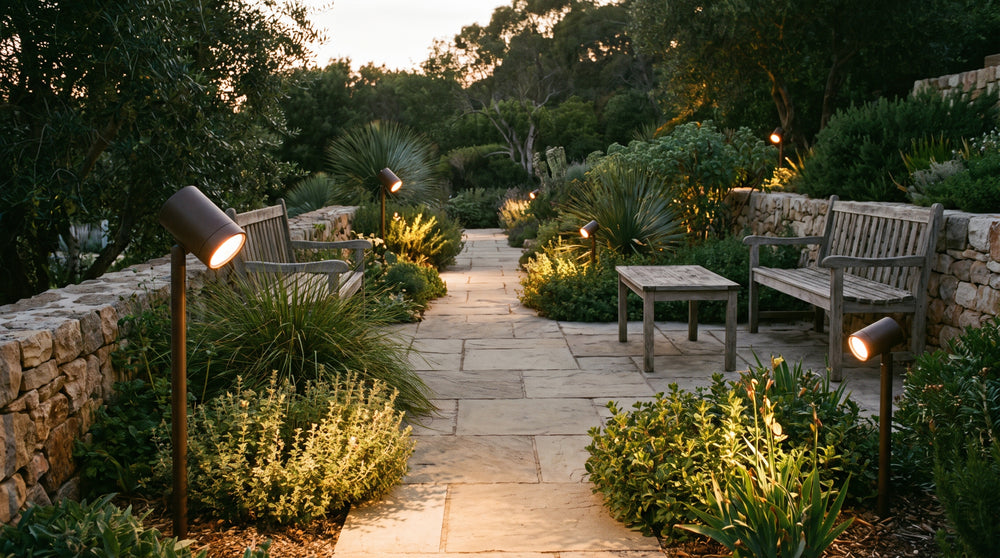
Count your light points before choosing: a ground-recessed fixture to mark a path, a spike spotlight at the base of a flowerbed, a floodlight for a facade or a large tree, a wall light near the door. What you want to illuminate decides the format, the mounting and the light colour.
Which outdoor LED spotlights should you choose to light a garden?
Start from the effect: drawing a path, bringing out foliage, securing an access or highlighting a wall. The format follows, then the material and the mounting method. An aluminium or stainless steel housing ages better outdoors than thin plastic, and tempered glass can be cleaned without scratching.
Garden LED spotlight or garden LED lamp: what is the difference?
A spotlight is a directional luminaire: its beam focuses on a precise point, on the ground, a trunk or a wall. A garden LED lamp lights more broadly, as ambient light. The spotlight draws, the lamp bathes. The two complement each other, and our selection of outdoor LED spotlights covers these approaches.
Recessed outdoor LED spotlight or wall-mounted?
A recessed model sits flush with the ground: ideal for a path, a terrace or the edge of a flowerbed, provided drainage is properly handled. A wall-mounted model is installed higher up, near a door or on a garage wall. For this second use, see how to light the entrance of the home without glare.
Adjustable, fixed or spike LED spotlight: which should you choose?
An adjustable model can be set after installation, handy for aiming at growing foliage. A fixed model marks without adjustment. A spike spotlight is planted directly in a flowerbed, at the right distance from the plant. Recessed adjustable models and garden spotlights with refined design cover the first two cases.
| Spotlight type | Where to install it | What it lights | What to check |
|---|---|---|---|
| Ground-recessed spotlight | Path, terrace, edge of flowerbed | Low-level marking, guiding light | Moisture resistance, drainage |
| Spike spotlight | Flowerbed, low plant, border | Close-range lighting of a plant | Spike length, orientation |
| Floodlight | Facade, large tree, back wall | Wide and diffuse beam | Power, orientation, glare |
| Wall light and wall spotlight | Entrance, wall, garage door | Access and highlighting of a wall | Mounting, IP rating, installation height |
| Standalone solar spotlight | Corner far from a socket | Ambience without wiring | Exposure, unobstructed panel |
How many lumens are needed to light an outdoor space?
No single figure applies: the surface, the distance and the desired effect change everything. A path or a flowerbed is satisfied with low, soft light; an access, a gate or steps require a more directed beam. Better to spread several adjustable points than to overexpose a single luminaire, which causes glare and leaves dark zones. Installation height matters as much as power: a spotlight placed low, a few tens of centimetres up, grazes the ground and lengthens shadows; placed higher, it lights more broadly but loses modelling. The values shown on each product page give the power and the real rendering of the model. To adjust intensity in the evening, dimmable spotlights can be set according to use, and the whole of our lighting catalogue allows you to harmonise outdoors and indoors.
Which IP rating for a garden LED spotlight?
The IP rating indicates the luminaire's resistance to dust and water. The higher it is, the better the spotlight withstands watering, rain and humidity rising from the ground. Note the value shown on the product page, match it to the installation area, then check the intended supply voltage.
Can an LED spotlight be installed near a watered flowerbed or a pool?
Yes, with a housing designed for water splashes and connections kept out of water. Near a pond or pool, exposure is stronger: aim for the highest rating in the range. White outdoor spotlights blend well into a light environment, and black recessed spotlights disappear into dark ground or a dark wall.
Garden LED spotlight in 12 V or 230 V: what is the difference?
12 V goes through a transformer: the voltage is low, the installation more flexible for a series of small spotlights, but cable length matters. 230 V connects directly to the mains, suited to floodlights and wall lights. In both cases, the connection remains the sensitive part: it must be protected from water.
Solar LED garden lamp: in which cases should you choose it?
Solar suits garden corners far from a socket: flowerbed border, path, base of a wall. The spotlight captures light during the day and turns on in the evening, with no cable to run or trench to dig. The season's sunshine and the panel's orientation make the difference in rendering.
Garden LED floodlight or solar LED lamp: which should you choose?
Solar remains more modest than a connected model. It excels at marking a border or occupying a blind spot, where running power would be heavy. For a facade, a large tree or an access to secure, a wired model gives a more constant rendering. Compare the two in solar garden lighting.
Where should you place a solar spotlight so it captures light?
Clear the panel: a shadow cast by a shrub or wall is enough to reduce the day's charge. Point it south when possible, tilt it slightly, and avoid proximity to public lighting that would trigger standby. Cleaning the panel from time to time maintains performance.
Outdoor LED floodlight: what use in the garden?
The floodlight projects a wide beam: facade, large tree, back wall or work area. It is mounted as a wall light or on a post, often adjustable. For a decorative result, several small spotlights are better than one large one, and for security a light directed at the access is enough.
Powerful LED wall light: to light a wall or an entrance?
A powerful wall light suits a facade wall to highlight or an entrance to mark. Facing down, it lights the passage without glare; washing a wall, it reveals the material and texture. The same model is often available across the whole lighting range to stay consistent around the home.
Facade LED spotlight: how should you distribute the light points?
Space the spotlights evenly, at step or eye height, and cross the beams rather than aligning them. Two low crossing points model better than one central point. For an access or steps, lighting placed low, close to steps and stairs, guides the foot without glare.
What are the drawbacks of LED lamps?
On the downside, LED can give light considered too cold depending on the model, it suffers from poorly dissipated heat and its electronics can fail before the diodes. Outdoors, humidity, frost and a dirty lens quickly degrade the rendering if the luminaire is not suited or maintained. The solutions are simple: aim for a protection rating consistent with the area, prefer a metal housing that dissipates heat, and keep the diffuser clean. A correctly sized power supply also protects the electronics. Adjustable floodlights and spotlights can be set to avoid sending light towards a window or a passage.
Which light colour and which finishes for garden lighting?
In the garden, a warm white light remains the softest for flowerbeds and terraces, while neutral white is better suited to accesses and work areas. Colour temperature values are read in kelvins on the product page, and the housing comes in white, black or anthracite depending on the series. The idea is to harmonise with the interior: the same spotlight families are available for the entrance, hallway or kitchen, creating visual continuity.
| Colour temperature | Ambience | Rather for |
|---|---|---|
| Very warm white | Amber light, very soft | Evenings, terraces |
| Warm white | Discreet warmth, close to a flame | Flowerbeds, facades, terraces |
| Neutral white | Clear rendering, less yellow | Paths, accesses, work areas |
| Cool white | Sustained white light | Security, functional lighting |
| RGB and RGBW | Variable colours, scenes | Decoration, changing ambience |
Should you choose RGBW garden spotlights?
RGBW serves the scene: ambient colour for a reception, a discreet hue to highlight a flowerbed. It does not replace a fixed warm white for daily use, which is more understated and readable. Reserve RGBW for the points you want to vary, and keep the rest in constant white.
How do you keep consistency with modern kitchen decor and the rest of the home?
Use the same lighting families outdoors and indoors: an anthracite or black finish outside continues with black finishes indoors. For modern kitchen decor, a neutral white under the cabinets echoes path lighting, and the living room ambience in warm white responds to that of the terrace.
How do you install and maintain LED spotlights in the garden?
Ducts and connections are laid before backfilling, connections are kept out of water and everything is tested before closing up. Then a gentle cleaning of the lenses twice a year is enough to keep the same rendering. Power is cut before any work on the circuit.
Do you need a transformer for outdoor LED spotlights?
Only for low-voltage models: the transformer lowers the voltage and is placed in an accessible, dry location. 230 V models do without it. In all cases, respect the voltage indicated on the product page and keep splices sheltered from water.
How do you clean an outdoor LED luminaire?
Cut the power, then wipe the lens and diffuser with a soft cloth and a little soapy water, without abrasive products. Remove leaves and cobwebs that retain moisture. The same applies to hallway spotlights and bedroom spotlights, where dust dulls the output.
Secure payment, tracked delivery, possible returns and Designix customer service: you choose the format and the light colour, we follow the order through to installation.
Frequently asked questions about garden LED spotlights
Which garden LED spotlight should you choose for a flowerbed?
A spike spotlight or a recessed model placed at the base of the plants gives low light that draws the foliage without glare. Choose an adjustable model whose housing withstands watering, and keep it away from flowers and foliage so as not to heat the vegetation.
Can a garden LED floodlight be plugged into an outdoor socket?
Yes, on two conditions: the housing must be designed for outdoor use and the connection protected from water. Low-voltage models go through a transformer, the others connect directly. The product page indicates the voltage and the protection rating to respect.
Does a solar LED garden lamp light as much as a connected spotlight?
No, a solar spotlight remains more modest: it depends on the day's sunshine and the orientation of its panel. It excels at marking a border or a corner far from a socket. For a facade or a large tree, a wired model or a floodlight is more suitable.
How do you clean an outdoor LED luminaire?
Cut the power, then wipe the lens and diffuser with a soft cloth and a little soapy water, without abrasive products. Remove leaves and cobwebs that retain moisture, and check that seals and connections remain properly in place.
Should garden lighting be left on all night?
Nothing requires it: a garden can be lit for a few hours in the evening, then turned off. A timer or a twilight sensor avoids lighting an empty area. For security, a light point can be kept on the access, directed towards the ground to avoid glare.