Designer LED floor lamps for living room
- Tracked delivery to your country Tracked delivery
- Secure payment at checkout Multiple payment methods
- 14 days to change your mind 14-day returns
- Secure payment Secure payment


Not sure of your style? Find it in 30 seconds
A few questions, and we will show you the pieces made for you.








Frequently asked questions
How do I choose the right product?
What are the delivery times?
Can I return an item?
Can I pay in instalments?

An interior that reflects who you are
Carefully selected pieces, shipped from our warehouses. Our team advises you before you buy, so you choose with confidence.
- Tracked delivery
- Pay in instalments, where available
- 14 days to change your mind
- Advice & showroom in Lyon, France
Start by measuring the available height in the room and the actual use: a 153 to 185 cm floor lamp lights a sofa, a compact model with an adjustable shade sits next to an armchair, and an arc lamp only works if you have space behind it. This collection brings together designer LED floor lamps made for the living room, in metal, glass, wood or fabric, all IP20, with E27, E14 or integrated LED sources and a dimmer on some models.
- Which designer LED floor lamp should you choose for a living room?
- How do you light a living room with a designer LED floor lamp?
- What height and format of floor lamp for a living room?
- Which socket and bulb for a designer LED floor lamp?
- Which materials and colours to match the floor lamp to the living room?
- Floor lamp, chandelier or ceiling light: how do you compose living room lighting?
- How do you install and maintain a designer LED floor lamp?
- What are the lighting trends for the living room in 2026?
Which designer LED floor lamp should you choose for a living room?
Designer LED floor lamp for living room: which criteria to look at first?
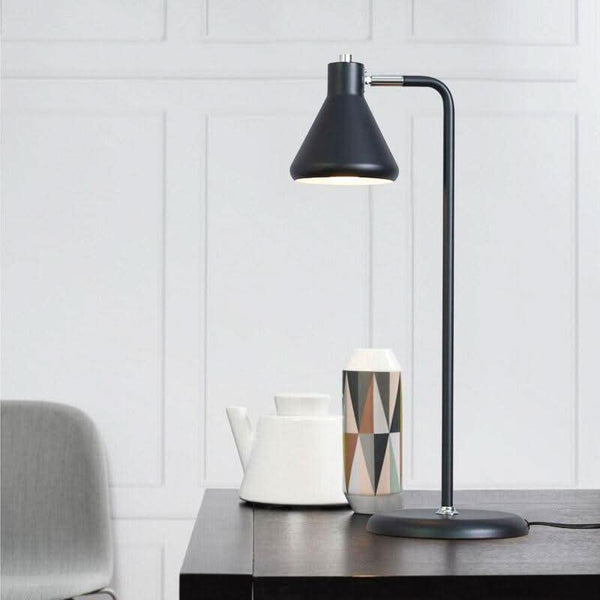
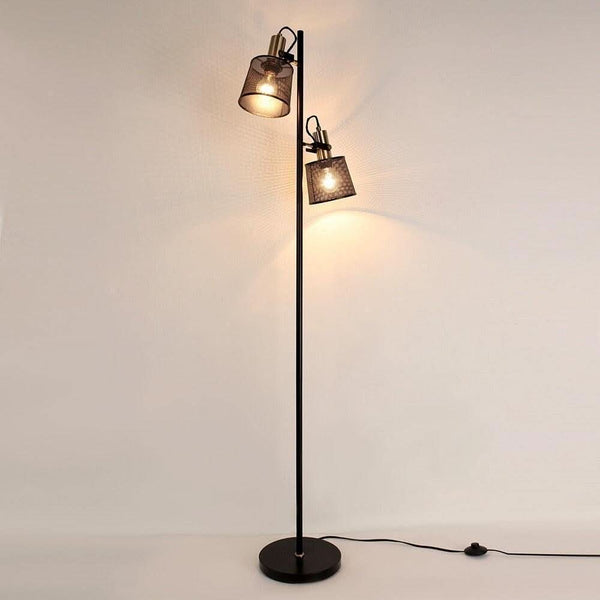
Look at four points in this order: the clear height under the ceiling, the material that picks up a detail from the decor, the source (E27, E14 or integrated LED) and whether there is a dimmer. The whole selection is IP20, so indoor use only. The Trigo floor lamp with adjustable shade is 47 cm high, with a conical shade of 12 x 14 cm: it sits on a piece of furniture or on the floor next to an armchair. A Lumitube with an oval tube of 40 or 60 cm structures a contemporary living room, and a Norvik with a 33 cm ribbed sphere on a tripod gives a softer light.
Designer LED ceiling light for living room or floor lamp: which source for which light?
The ceiling light illuminates the whole room and is chosen according to the surface area; the floor lamp lights a specific zone and moves as you wish. In a living room, the two complement each other: a high source in the centre, a low source near the sofa. If you are only looking for a freestanding model, browse the designer LED floor lamps and compare floor footprints before deciding.
How do you light a living room with a designer LED floor lamp?
Where should you place a designer LED floor lamp in the living room?
Place it about 60 to 80 cm from the sofa or armchair, on the opposite side to the hand holding the book, so your shoulder's shadow does not fall on the page. An adjustable model lets you aim at the wall and turn direct light into indirect light, softer in the evening. The black version blends into a dark decor, while gold reflects the light. Ceiling spot layout in the living room is useful for circulation areas, not for reading.
Living room wall light: how do you complement the floor lamp?
A living room wall light adds extra light without using floor space: it lights a section of wall, a bookcase or a picture. Choose it in the same material family as the floor lamp, metal or glass, so the composition stays clear. A large living room can take three sources: ceiling light, wall light and floor lamp. A small living room often needs only one well-placed floor lamp.
What height and format of floor lamp for a living room?
Tall floor lamp or compact floor lamp: what should you choose for a small living room?
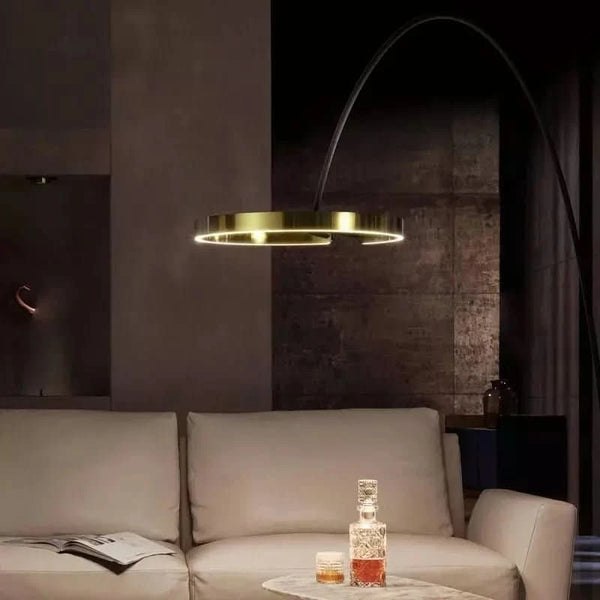
A small living room benefits from a compact model: Trigo and its 47 cm slip into a corner, onto a console or a low unit, and take up almost no floor space. Formats of 153 to 161 cm, such as Norvik or Crépuscule Chic, light a sofa from the floor without overwhelming the room. Beyond that, you need ceiling height and space behind: an arc of 185 cm, such as Yala, extends its shade far from its base and needs clear space.
Large living room chandelier or floor lamp: what height for a large volume?
In a large volume, a large living room chandelier hangs about 2.10 m from the floor above a table, and higher above a walkway. The floor lamp stays on the floor and imposes no fixing constraints. A Lumitube of 210 x 195 cm occupies the space differently, with a wide footprint on the floor rather than hanging above.
| Space | Recommended format | Source | Material | What to check |
|---|---|---|---|---|
| Living room of 20 m2 | Floor lamp of 153 to 161 cm or compact adjustable model | E27, E14 or integrated LED | Metal, glass or fabric | Floor footprint and dimmer |
| Large living room | Arc floor lamp of 185 cm or large format | E27 or LED | Metal, iron, glass | Space needed behind and stability |
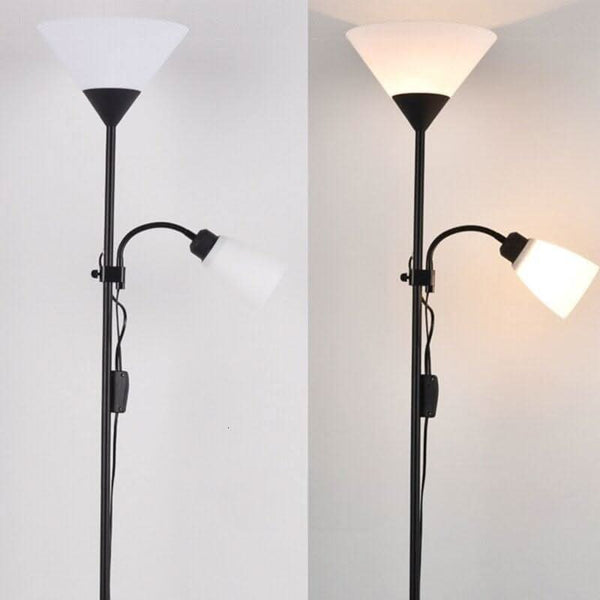
| Reading corner | Adjustable shade or flexible arm | E27 or integrated LED | Metal, acrylic, glass | Beam direction and power |
| Home office | Compact floor lamp with cylindrical shade | E27 or LED | Metal, wood | Seat height and direct lighting |
| Bedroom | Floor lamp with soft light and dimmer | E27 or LED | Fabric, wood, bamboo | Dimmer and brightness |
Which socket and bulb for a designer LED floor lamp?
E27 or E14 socket: what is the difference for a living room floor lamp?
The E27 socket is the standard format: you freely choose the colour temperature and power of the bulb, and you replace it without tools. The E14 socket fits slim formats, such as the compact shade of Trigo. For comfort, a living room generally sits around 2700 to 3000 kelvins, a warm light that does not tire the eyes in the evening; an office is closer to 4000 kelvins. Always respect the maximum power indicated on the light fitting.
Integrated LED: should you choose a floor lamp without a bulb?
Integrated LED gives a uniform beam, with no hot spot and no bulb to change. In return, it cannot be replaced: the module lasts, but if the light does not suit you, you have to change the floor lamp. This is the case with Sormilica and its double smoked glass shade, with Magni, or with the Lumitube and Nessa tubes. A floor lamp with a socket remains the safe choice if you like adjusting the mood.
| Source | What it changes | Maintenance | Examples |
|---|---|---|---|
| E27 | Replaceable bulb, choice of temperature and power | Change the bulb without tools | Yala, Kanoa, Norvik, Crépuscule Chic, Équinoxe Élégant |
| E14 | Slim format for a compact shade | Small-diameter bulb | Trigo |
| Integrated LED | Uniform beam, no bulb to change | Clean the diffuser | Lumitube, Nessa, Sormilica, Magni |
Which materials and colours to match the floor lamp to the living room?
Designer metal floor lamp or wooden floor lamp for the living room?
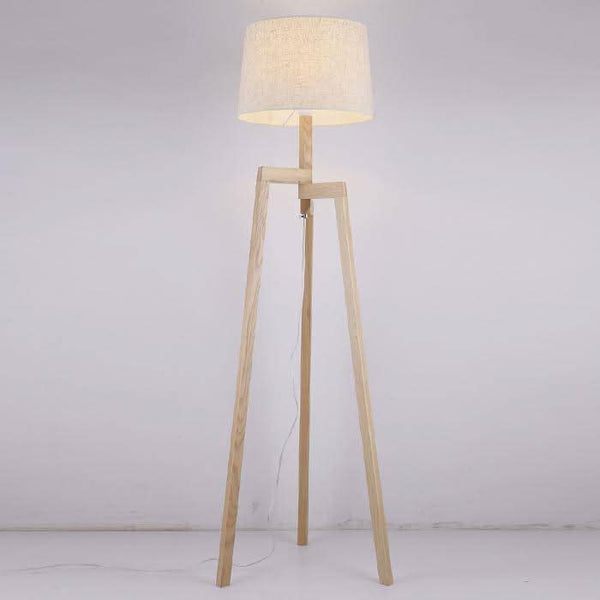
Metal and iron dominate the selection, often combined with glass, fabric or steel. A designer metal floor lamp suits contemporary interiors and dusts off in one stroke. Wood and bamboo warm up the room: Kanoa, on a bamboo tripod with a cylindrical fabric shade, plays that card. For a more graphic look, a glass floor lamp for the living room diffuses a soft, filtered light. The same spirit runs through modern kitchen decor, where light wood and black metal coexist.
Black, gold or beige floor lamp: which colour for a bright living room?
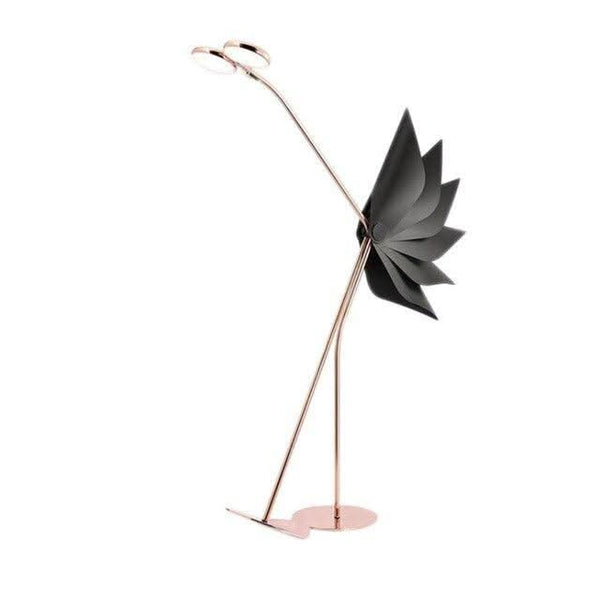
Black and gold finishes remain the most common, followed by beige, white and a touch of red. Black structures, gold reflects light, beige and white lighten a bright interior: a gold designer floor lamp brings out a beige wall. For a bright living room paint colour, go for an off-white or beige and let the floor lamp carry the accent. An original living room light fitting, such as Nessa and its fan-folded shade, is chosen as much for its shape as for its tone.
Floor lamp, chandelier or ceiling light: how do you compose living room lighting?
Designer LED living room chandelier: when should you prefer it to a floor lamp?
A designer LED living room chandelier lights the whole room from the ceiling and becomes the focal point of the volume. Prefer it when the living room is large, the ceiling is high and you want general light without multiplying floor fittings. The floor lamp then takes over for reading and mood. In a home where drilling the ceiling is not possible, the floor lamp remains the simplest solution.
Large living room chandelier or modern living room chandelier: what role?
A modern living room chandelier or a designer model takes on the role of main source, while a floor lamp accompanies and modulates. The two combine without competing as long as you avoid stacking two very powerful sources on the same axis. Match the finishes: a Scandinavian floor lamp for the living room in light wood works better with a understated chandelier than with a very busy piece.
How do you install and maintain a designer LED floor lamp?
How do you assemble and stabilise a living room floor lamp?
Installation is limited to assembling the base, screwing on the shade and plugging it in. Place it on a flat floor, away from a walkway, and check that the cable is not taut: a taut cable can tip over a model with a narrow base. A large arc such as Yala, 185 cm, needs some space behind and a base that sits perfectly flat. All models in the collection are IP20: indoor use only, never on a balcony or near a source of humidity.
How do you clean a metal, glass, wood or fabric floor lamp?
Metal and glass are dusted with a soft cloth, slightly damp for glass, without abrasive products. Wood and bamboo are cleaned dry, with a dry cloth so as not to mark the grain. Fabric is brushed or vacuumed on a gentle setting; Équinoxe Élégant combines metal, glass and acrylic, so one cloth is enough for the whole thing. Always unplug before handling a shade.
What are the lighting trends for the living room in 2026?
Designer LED floor lamp: why does the dimmer change how you use it?
The dimmer turns a floor lamp into a mood tool: high light for reading or entertaining, low light in the evening, without switching on a second source. It features on about four models out of ten in the selection, including Norvik, Kanoa, Nessa and Trigo. It is the criterion that most justifies the gap between two floor lamps of comparable size. Simply check that the dimmer actually works on the intended source.
Designer floor lamps for living room: which shapes are trending?
Tube shapes dominate the selection, followed by spheres, ovals and a few original silhouettes. The contemporary style is everywhere, carried by natural materials such as wood and bamboo. References to designer halogen style are becoming more discreet, replaced by wide diffusers and integrated LEDs. Graphic lines remain the safe bet: a clean outline ages better than a very pronounced detail.
Reassurance and moving to order
At Designix, payment is secure, delivery is tracked and returns are possible. Customer service answers dimension questions before purchase, which avoids choosing the wrong size. Browse all Designix light fittings to compare the families, or go straight to all our living room floor lamps if your choice is already made. For a small living room, the Trigo with adjustable shade settles the question of volume; for a large room, the Lumitube with oval tube occupies the space with a clean line; for a reading corner, the Norvik with ribbed sphere and its dimmer make the difference. Then complete the look with a wooden floor lamp for the living room or a bamboo floor lamp for the living room depending on the warmth you want to give the room, and keep LED floor lamps for the office in mind if the same room is also used for working.
Frequently asked questions
What are the drawbacks of LED lamps?
LEDs use little energy and last a long time, but their light can seem cold if the colour temperature is poorly chosen. They are often integrated and cannot always be replaced. On a living room floor lamp, favour a model with an E27 socket if you want to be able to change the bulb.
Living room chandelier or designer LED floor lamp: what should you choose?
A chandelier lights the living room from the ceiling and structures the room; a designer LED floor lamp brings mobile, localised light. For a large living room, combine a chandelier or ceiling light with a floor lamp near the sofa. The floor lamp remains simpler to install and move.
Which designer LED floor lamp should you choose for a living room?
Choose according to the room, the height and the source. A compact model with an adjustable shade suits the space next to an armchair, a floor lamp of 153 to 185 cm lights a sofa, and an arc needs more space behind. Check the material, the E27 or E14 socket or integrated LED, and whether there is a dimmer.
Designer LED living room ceiling light or floor lamp: what should you prefer?
The ceiling light illuminates the whole living room, the floor lamp targets a zone. Both can coexist: ceiling light for general light, floor lamp for reading or mood. In a small living room, a single well-placed floor lamp can be enough as an extra source.
Living room wall light: should you complement a floor lamp?
A wall light adds extra light without cluttering the floor. It complements a designer LED floor lamp placed near the sofa well, especially in a large living room. Choose a wall light consistent with the material and colour of the floor lamp, preferably metal or glass.
To go further, compare the lighting catalogue for the home and the vintage floor lamps for the living room if you are looking for a more retro silhouette. The rest is decided on site, at the right height.