How to Calculate the Amount of Lighting Needed in a Room?
This article is also available in French: Comment Calculer la Quantité d'Éclairage Nécessaire dans une Pièce ?
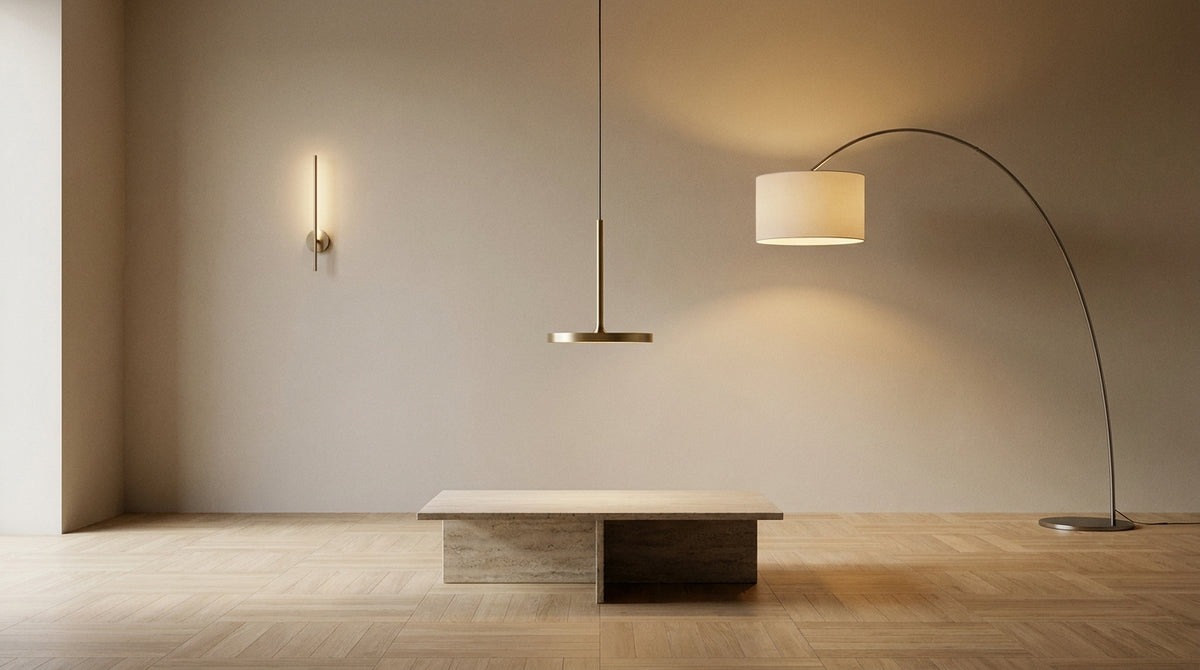
Lighting is a complex subject often considered reserved for specialists. Every room in the house requires specific lighting. For example, the kitchen or the bathroom requires more light than the living room or the bedroom, with distinct rules and specifications.
Get inspired
The amount of lighting required for a space depends on several parameters: the type of room, the desired ambiance, and its surface area. Lumens, watts, or kelvins—these units of measurement can be confusing. Here are the key elements to understand and estimate the amount of lighting required for each room and become a lighting expert!
Some Lighting Concepts
To effectively light an area of your home while creating a pleasant space, it is important to master a few lighting concepts. Good lighting highlights desired areas, such as the dining room table, the living room coffee table, the sofa, or the kitchen island.
The room's decor style also influences the lighting effect. A minimalist living room with light flooring and white wooden furniture will look very different from a living room with imposing furniture and dark flooring, even with the same lighting. Furthermore, the lighting power must be adapted to the activities: bright lighting for work or meal preparation, and diffused, dimmed lighting for reading or watching television.
Finally, the color of the lighting affects our mood. A cold and direct light suggests energy, ideal for work. A warm light is perfect for relaxation, evoking comfort and calm.
Technical Data
To fully understand your lighting, you need to know and master the technical data. Here are three essential elements found on the packaging of bulbs and light fixtures:
Watts (W)
This unit measures the electrical power consumed by the light source. With LED and compact fluorescent bulbs, this measurement no longer indicates light efficiency but electrical consumption: the higher the number of watts, the more electricity the bulb consumes.
Lumens (Lm)
This unit measures the quantity of light emitted by a bulb, i.e., the luminous flux. It is the key criterion for the brightness produced. For example, the higher the number of lumens, the more effectively the bulb lights up a space. Here are some benchmarks for the amount of lumens recommended per space:
- Main lighting for a living room, dining room, or hallway requires approximately 100 lm/m².
- Main lighting for a kitchen or bathroom requires 300 lm/m².
Kelvin Degrees (K)
This unit measures the color temperature of the light. Paradoxically, the higher the value, the colder (bluer) the light, and the lower the value, the warmer (oranger) the light. Here are some benchmarks:
- Very warm light: orange appearance, approximately 1500 K.
- Warm light: yellow-orange appearance, approximately 2700 K.
- Soft light: neutral white appearance, approximately 4000 K.
- Cold light: bluish appearance, close to daylight, approximately 6500 K.
Today, light sources are mostly found between 2700 and 3000 kelvins, corresponding to the temperature of old incandescent bulbs, neither too warm nor too cold.
Lux (Lx)
Lux measure the lighting efficiency, i.e., the luminous flux received by a surface. They are calculated from the lumens and the surface area in square meters to be lit. One lux corresponds to 1 lumen per m², provided that the surface reflection is good.
Our Tips
The layout and characteristics of your interior light sources should be thought out based on four criteria:
- The type of room to be lit
- The desired ambiance
- The appropriate color temperature
- The distribution of lighting to optimize each space
Here are some benchmarks to guide you in your choices:
| Room and desired ambiance | Light intensity | Recommended color |
|---|---|---|
| Living room, dining room, adult bedroom. Dimmed, intimate ambiance. | 25-50 lux | Warm white |
| Living room, dining room, kitchen, adult bedroom, office. Convivial ambiance, moments of relaxation. | 100-150 lux | Warm white |
| Office, library, child's bedroom, playroom. Work or play ambiance. | 200-250 lux | Neutral white |
| Technical ambiance: high-activity areas (office, workshop) and circulation areas (hallways, entrance) | 350-500 lux | Cold white |
Determining the Amount of Lighting Needed in Your Room
Simplify your life with this quick and easy method: lumens/m² = lux!
Let's take the example of furnishing a 15 m² bedroom, equipped with 9W low-energy bulbs producing 350 lumens. For a lamp with this bulb, the calculation is as follows: 350 lm/15 m² = 23 lux of illumination.
Next, multiply the amount of lux produced by one light source by the number of light points of the same type in the room. With two bedside lamps equipped with this 350 lm bulb, you get an illumination of 46 lux, corresponding to the recommended lighting for a bedroom with an intimate ambiance. If you want a less dimmed ambiance, use bulbs with a higher luminous flux (more lumens) to increase the illumination.
Let's take the example of a 25 m² living room, equipped with 1000 lm LED bulbs: 1000 lm/25 m² = 40 lux of illumination. This is obviously not enough to light the entire room.
How do you calculate the number of light points needed to obtain satisfactory lighting? Divide the recommended light intensity in lux by the lux produced by the light source. You will then get the number of lamps needed to properly light your room: 150 recommended lux / 40 lux produced by your LED bulb = 3.75. This means that about 4 light points are required in this specific case.
In stock · shipping costs shown at checkout · up to 30% off in your cart
Ready to turn inspiration into reality?
Tell us about your room, your style and your budget, and we will show you the pieces that truly suit your project.
Get guidance in 30 seconds →