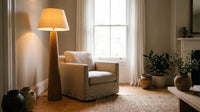
Japanese pendant light
- Tracked delivery to your country Tracked delivery
- Secure payment at checkout Multiple payment methods
- 14 days to change your mind 14-day returns
- Secure payment Secure payment


Not sure of your style? Find it in 30 seconds
A few questions, and we will show you the pieces made for you.




Frequently asked questions
How do I choose the right product?
What are the delivery times?
Can I return an item?
Can I pay in instalments?
An interior that reflects who you are
Carefully selected pieces, shipped from our warehouses. Our team advises you before you buy, so you choose with confidence.
- Tracked delivery
- Pay in instalments, where available
- 14 days to change your mind
- Advice & showroom in Lyon, France
Start with the room you need to light: a japanese pendant light of Ø 11 to 15 cm is enough in a bedroom or hallway, while a linear bar of 98.4 to 138.4 cm covers a worktop or a long table. The collection brings together metal and glass pendants, often round or ball-shaped, in black or white, with warm light and an adjustable cable height. Our lighting store in Lyon welcomes you to its showroom and offers a lighting clearance sale in Lyon.
What is a Japanese pendant light?
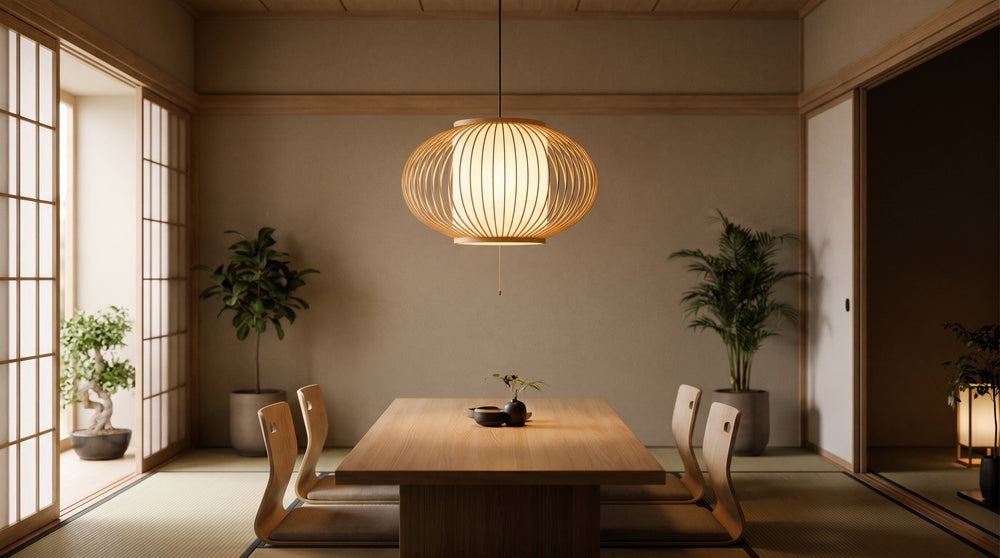
A japanese pendant light is a hanging light that borrows the codes of Japanese style: round or ball shapes, low volumes, clean lines, understated materials such as metal, glass, sometimes wood and paper. It often gives off a warm light and sits alone above a surface or a table.
Japanese pendant light: where does this clean style come from?
This look comes from interiors where few objects are kept and where light lands in touches rather than from the ceiling, with the restraint of a Japanese garden. Here, it mostly means metal and glass, blacks and whites, ball or round shapes. Two ways to go further: our glass models and our wood pendants.
Japanese chandelier pendant or Japanese pendant lamp: what is the difference?
The difference lies in the number of light points. The Japanese pendant lamp lights from a single point, often a ball of Ø 15 to 20 cm, while the Japanese chandelier pendant lines up several points or a long bar. Both families coexist in our pendant lights, to be chosen according to the volume to cover.
How to choose a Japanese pendant according to the room and format?
The choice depends first on the volume of the room and the surface to light. A wide room around a table takes a linear bar of 90 to 138.4 cm, while a kitchen corner or a small bedroom is fine with a Ø 11 to 15 cm. Ball or dome shapes are the most common.
| Room | Common format | Type of light | Protection rating | Example from the collection |
|---|---|---|---|---|
| Kitchen | Linear bar of 98.4 to 138.4 cm | Warm white or neutral white | IP20 | SENKEI B pendant |
| Living room | Ø 20 cm or a 90 cm set | Warm white | IP20 | KUUL G pendant |
| Dining room | L 90 cm adjustable | Warm white | IP20 or IP44 | SUGURI A pendant |
| Bedroom | Ø 11 to 20 cm | Warm white | IP20 | KUUL F pendant |
| Office | Linear bar of 98.4 to 120 cm | Neutral white | IP20 | YOTTSU B pendant |
| Hallway or corridor | L 90 cm or Ø 11 cm | Warm white | IP44 possible | SUGURI A IP44 pendant |
For the kitchen, browse lighting a kitchen. For the bedroom, see the bedroom pendant.
How to get an original living room light with a Japanese pendant?
For an original living room light, go for a bold shape placed alone in the centre of the room, or a composition of several light points. In the collection, the metal and glass models come in black, white or red, with diameters from 11 to 20 cm and an adjustable cable height.
Original hanging light: which shapes stand out?
Balls, domes and long bars make more of an impact than a flat light. A Ø 20 cm ball in metal and glass, like the KUUL G model in Ø 20 cm, holds the centre without cluttering. The black versions go with almost any wall.
Several pendants above a large living area: how to align them?
Align the points on the same axis, with regular spacing, and set the same height for each. Three points light better than one large volume in a long living room. For bolder choices, look at the pendants with a strong design.
Which Japanese kitchen pendant to choose above an island or a worktop?
Above an island or a worktop, a linear bar lights the whole length without multiplying fixing points: the collection offers lengths from 98.4 to 138.4 cm. For cooking, a neutral white makes colours easier to read; warm white stays softer for a dining corner.
Kitchen pendant: a linear bar or several light points?
The bar suits long surfaces and ceilings with no reservation, like the one on the YOTTSU B light bar in metal and aluminium. Several small points, on the other hand, spread around a square island. Both solutions work in a kitchen as well as an office.
Warm white or neutral white above a worktop?
Neutral white, around 3500 to 4500 K, shows food and shades accurately during preparation. Warm white, around 2700 to 3500 K, warms up a dining corner or a living space. Some models of the LED lighting range offer both temperatures depending on the setting.
At what height should you hang a pendant above the dining table?
These pendants are adjusted after installation: the cable often goes up to 150 cm, and SUGURI comes in 52, 82, 112 and 142 cm heights. First position the light in the centre of the table, then adjust the height so that the way through stays clear when you stand up.
Which diameter for a pendant above a dining table?
On a table for four to six people, a Ø 20 cm or a 90 cm bar is enough. Beyond that, two or three points spread along the length are better. The SUGURI A pendant, in metal and glass, comes as a single version or a set.
How to shorten the cable of a pendant?
Most models have an adjustable cable: shorten it when fixing, keeping enough slack to adjust afterwards. Do the adjustment once the table is in place, never before. More ideas in the dining room lights.
Which light for a WC, toilet or bathroom: IP20 or IP44?
In a damp room such as a WC or a bathroom, choose an IP44 model: this rating means the light resists water splashes. IP20 pendants remain suitable for a WC with no shower or bathtub. In the collection, several Japanese pendants come in an IP44 version.
Original WC light: which shapes to choose?
A small round format fits anywhere: Ø 11 to 15 cm, in glass for transparency or black metal for contrast. The KUUL F IP44 model in Ø 15 cm suits a WC as well as a corridor.
Why favour an IP44 rating near a water point?
The IP44 rating protects against splashes, which IP20 does not guarantee. Near a shower, a washbasin or a bathtub, it is therefore the version to choose. For dry circulation areas, an IP20 is enough and opens up more shapes, including in glass lights.
How to install and maintain a Japanese pendant?
Installation comes down to checking the socket of the model, compatibility with your circuit's dimmer and the weight of the light before drilling. The collection revolves around G9, E27, E14 and GU10 sockets, with LED bulbs, and most models accept a dimmer.
| Socket | Models in the collection | Stated wattage | Bulb to provide | Rooms |
|---|---|---|---|---|
| G9 | SUGURI, LUOTI 3L, KUUL F | 12 W | G9 LED bulb | Living room, dining room, bedroom |
| E27 | KUUL G | 15 W | E27 LED bulb | Living room, bedroom, kitchen |
| GU10 | SUPURU | 10 W | GU10 bulb | Living room, bedroom, corridor |
| E14 | Créa Lum Japanese pendant | Not stated | E14 LED bulb | Living room, bedroom |
G9, E27, E14 or GU10 socket: which bulb to choose?
The socket is shown on each model: G9 for small balls and sets, E27 for Ø 20 cm volumes, GU10 for adjustable spotlights, E14 for slim formats. Take an LED bulb with the same base and keep the packaging for maintenance.