Japanese pendant light
- Tracked delivery to your country Tracked delivery
- Secure payment at checkout Multiple payment methods
- 14 days to change your mind 14-day returns
- Secure payment Secure payment


Not sure of your style? Find it in 30 seconds
A few questions, and we will show you the pieces made for you.




Frequently asked questions
How do I choose the right product?
What are the delivery times?
Can I return an item?
Can I pay in instalments?
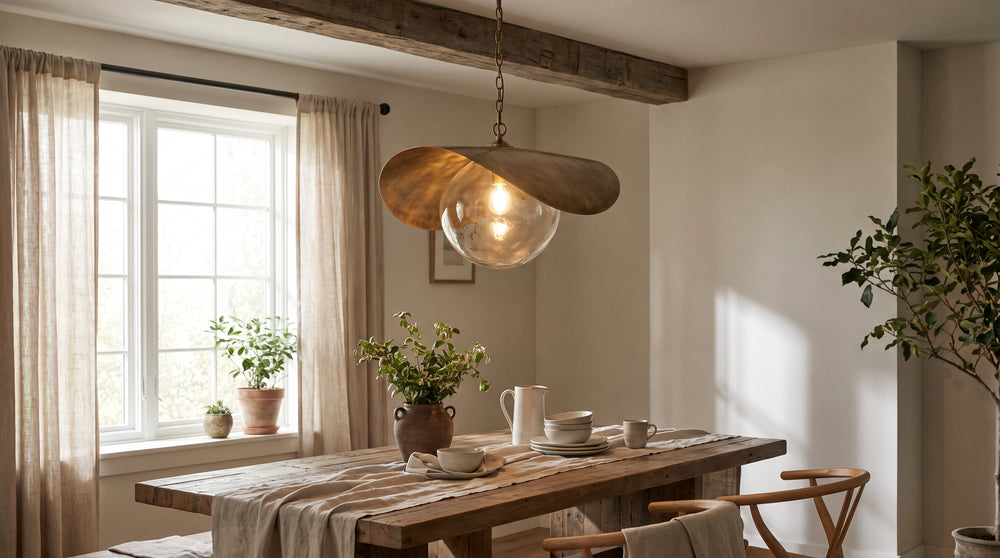
An interior that reflects who you are
Carefully selected pieces, shipped from our warehouses. Our team advises you before you buy, so you choose with confidence.
- Tracked delivery
- Pay in instalments, where available
- 14 days to change your mind
- Advice & showroom in Lyon, France
A japanese ceiling light comes down to three points: the material (mostly metal and glass, more rarely wood or paper), the socket (G9, E27, E14 or GU10) and the available cable height. Expect a warm white around 2700 to 3500 K for a soft light resting on the table, and a neutral white around 3500 to 4500 K above a worktop.
What is a japanese ceiling light and what light does it give?
A japanese ceiling light is a pendant with simple lines, often round or long, mostly in metal and glass in this selection, sometimes in wood or paper. It shines first in warm white, sends the light down onto the table or worktop and structures the room without cluttering it. No model in this collection is made of rattan or bamboo; natural materials here are limited to wood and paper.
Designer japanese ceiling light
Almost all models are fitted with LED, and a good number accept a wall dimmer: you move from dining light to ambient light without changing the fixture. The SUGURI A, in metal and glass, measures 90 cm long for 12 W and adjusts to 52, 82, 112 or 142 cm in height, depending on its product sheet. LED pendants avoid repeated bulb changes.
Wabi sabi japanese ceiling light
The wabi-sabi look comes from matte materials and restrained lines: brushed metal, slightly frosted glass, pale wood. A single low piece above the table is enough to set the mood. To stay in pale tones, white finishes sit well with wood and cream walls, where black marks the line at the ceiling more strongly.
| Socket | Possible light type | Where it appears | To remember |
|---|---|---|---|
| G9 | Warm white to neutral white depending on the bulb | SUGURI A and SUGURI C, KUUL F, LUOTI 3L | Small socket, often supplied in LED version; check dimmer compatibility |
| E27 | Warm white to cool white depending on the bulb | KUUL G | Classic socket, bulb easy to replace |
| E14 | Warm white or cool white depending on the bulb | Paper and brass pendant | Small screw socket, suited to compact volumes |
| GU10 | Beam directed at a precise point | SUPURU | Aims the light at a surface or an object |
Which materials and colours are found in a japanese ceiling light?
The selection is mostly metal and glass, with a few models in wood, aluminium or paper. The dominant finishes are black and white, more rarely red, green or blue. The look ranges from minimalist to wabi-sabi depending on material, shape and colour.
Paper japanese ceiling light
Paper remains rare here, but it gives the most diffuse light. The paper and brass pendant combines paper, wood, brass, glass and fabric, with an E14 socket, in volumes of 11, 15, 24 and 30 cm, in beige or brown. It suits the living room or the bedroom, in warm white as well as cool white depending on the chosen bulb.
Wood japanese ceiling light
Wood appears on some models and warms the light without yellowing it. It sits well with natural interiors and sparsely furnished rooms. When the room already has plenty of pale materials, black finishes on metal are a good alternative to wood and draw a cleaner line at the ceiling.
Which room should a japanese ceiling light go in?
In the kitchen, choose a long shape or several points above the worktop; in the living room, a ball or a large dome hung lower; in the bedroom, a discreet format placed near the bed. The collection also covers the dining room, the office, the hallway and the corridor.
Bedroom japanese ceiling light
In a bedroom, look for soft, low-glare light: a small diameter or a fine line, near the bed or at the centre of the room. The KUUL F IP44 is 15 cm in diameter, 12 W, and goes up to 130 cm in height in white, black or red. The models gathered for the adult bedroom help sort the most discreet formats.
Kitchen japanese ceiling light
Above a worktop, a long line lights the whole length without glaring. The SENKEI A, B and C series drop to 150 cm for only 15.4 cm in depth, in white, black, green or orange. The collection devoted to the kitchen and its worktop groups these straight formats.
| Room | What matters most | Recommended format | Examples from the collection |
|---|---|---|---|
| Kitchen | Light the worktop without glaring | Long line or small points in a row | SENKEI A, SENKEI B, SENKEI C, YOTTSU A |
| Office | Direct light on the surface, without reflection | Long linear line | SENKEI A, YOTTSU B |
| Living room | Fill the volume and light widely | Ball, dome or large diameter | KUUL G, KUUL F, SUPURU, SUGURI A |
| Bedroom | Soft light and low glare | Small diameter or fine line | KUUL F, SUPURU, SUGURI C |
| Dining room | Bring the light down onto the table | Long line or three points | LUOTI 3L, SUGURI A, KUUL G |
How to light a Japanese house or a traditional Japanese house?
In a Japanese house, light sources are layered: a low pendant above the table, finer hanging points in the kitchen, a warm, low-glare light in the bedrooms. Keep shapes simple, materials matte and tones black, white or wood, without accumulating objects.
Traditional Japanese house
Count on three to four sources at different heights rather than a single ceiling fixture: a low pendant over the table, two fine points above the worktop, a soft light in the bedroom. This layering removes harsh shadow areas and keeps the eye at the level of use. Our full range of lighting lets you build this gradation room by room.
Japanese-inspired house
In a simply Japanese-inspired interior, keep matte materials, black, white or wood tones and a light of 2700 to 3500 K. Ball shapes play this role without catching the eye, especially placed alone or in twos. It is best to avoid stacking several coloured pendants in the same room.
Japanese ceiling light in a wet room: what does IP44 change?
IP44 protects the fixture from water splashes, which allows it to be placed in a bathroom or near a water point. IP20 models are reserved for dry rooms. In this collection, IP44 versions exist in several formats and finishes.
Most models are IP20: living room, bedroom, dining room, office, corridor. IP44 concerns the bathroom, the kitchen near a sink and the hallway. The KUUL G IP44 (E27 socket, Ø 20 cm) and KUUL F IP44 (G9 socket, Ø 15 cm) hang between 130 and 135 cm in height, in white, black or red. The long versions SUGURI A IP44 and SUGURI C IP44 measure 90 cm. Glass pendants with a closed globe withstand humidity better than a fabric shade.
XXL ceiling light, high ceiling: which format and which cable length?
Under a high ceiling, choose a large diameter or a long line, and bring the fixture down to working height without blocking the way. Several models in the collection have an adjustable cable, with a maximum height of 130, 135, 142 or 150 cm depending on the reference.
XXL japanese ceiling light, high ceiling
What matters is not width alone, but the total volume in the room. The SENKEI C stretches 138.4 cm long for 15.4 cm in depth, the YOTTSU B 120 cm by 25 cm in depth, both with a cable that drops to 150 cm. Pieces with a strong design suit a hallway or a living area under a great height.
Original pendant light
For a more graphic effect, the SUPURU measures only 11 cm in diameter, with a 100 cm cable and a GU10 socket: the beam is aimed at a surface or a precise object rather than lighting widely. Modern pendants play this role of visual anchor, often placed in series of two or three.
Japanese ceiling light or Italian designer pendant: how to choose?
Japanese style favours low lines, matte materials and a warm, discreet light. Italian design plays on contrast, sculptural shapes and glossy finishes. The choice is made on the volume of the room and the light you want, not on the style label alone.
Decide on three concrete criteria: ceiling height, wall colour and the number of sources already in place. A low ceiling and pale walls call for a fine, matte line; a large dark volume supports a wider, more contrasted piece. Pendants with a strong outline and the range of Italian designer pendants cover both directions, but rarely in the same room.
At what height should a japanese ceiling light be hung and how to care for it?
Hang it low enough to light the table without blocking the view of the guests, and higher in a corridor or hallway to leave the way clear. Care is limited to dusting the shade and changing the bulb; the warranty is two years on most models, five years on part of the selection.
At what height should a pendant be hung above a dining table?
As a rule, allow 70 to 80 cm between the tabletop and the bottom of the fixture, a little more if the room is a through room. In a corridor or hallway, raise the cable to let shoulders pass. On models with an adjustable cable, the adjustment is made at the time of installation, never before. Dining room pendants group the formats designed for the table.
How to care for a japanese ceiling light?
To care for it, dust the shade dry with a soft cloth. Check the socket and the bulb once a year, then replace the bulb if needed. On glass, avoid abrasive products: a mild cleaner is enough. Always cut the power before any handling.