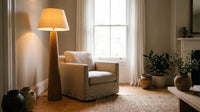
LED wall lights for kitchen
- Tracked delivery to your country Tracked delivery
- Secure payment at checkout Multiple payment methods
- 14 days to change your mind 14-day returns
- Secure payment Secure payment


Not sure of your style? Find it in 30 seconds
A few questions, and we will show you the pieces made for you.




Frequently asked questions
How do I choose the right product?
What are the delivery times?
Can I return an item?
Can I pay in instalments?
An interior that reflects who you are
Carefully selected pieces, shipped from our warehouses. Our team advises you before you buy, so you choose with confidence.
- Tracked delivery
- Pay in instalments, where available
- 14 days to change your mind
- Advice & showroom in Lyon, France
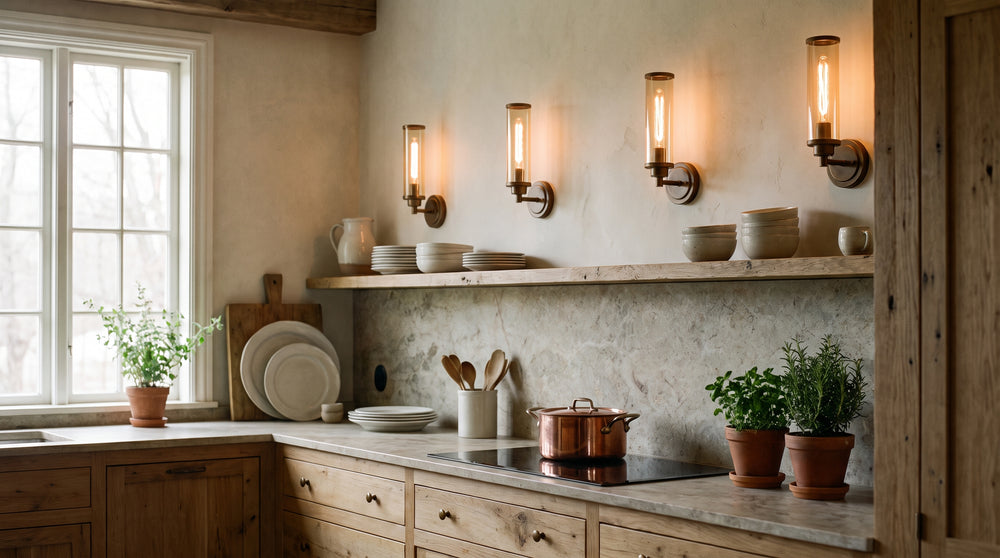
Allow one LED kitchen wall light every 60 to 80 cm along the worktop, fixed to the wall just above the splashback: the beam falls on the surfaces and the worktop stays clear. Then choose warm white 3000 K if you dine in the room, neutral white 4000 K if you mostly cook.
What LED lighting for a kitchen?
A kitchen is lit in two layers: general light to move around, then directed points on the preparation surfaces. The LED wall light takes this second role, mounts on the wall and leaves the walkway clear. This whole selection uses LED technology, in warm white or neutral white.
Why light a kitchen in several layers?
A single source on the ceiling casts your shadow on the chopping board. By bringing the light points lower, the light falls between you and the worktop, with no dark zone. Kitchen is mentioned in 87% of references, often with living room at 87%, because an open kitchen is lived in as a whole room. Browse our full range of light fixtures to build these layers.
What role does a wall light play next to an LED ceiling light?
The ceiling light covers circulation and the floor. The wall light brings the beam down where you cut and mix. It mounts without drilling the ceiling, which matters under a low slab. When the kitchen opens onto the living room, LED wall lights for the living room extend the same lighting language.
Which LED wall light to choose for a kitchen?
Three criteria are enough: the material (aluminium, steel or metal for a work wall, wood and rattan for a softer look), the type of source (integrated LED or replaceable E27, G9, GU10, GX53 socket) and the colour temperature, warm white for meals, neutral white for preparing.
Integrated LED or interchangeable socket?
Integrated LED dominates at 50% of references, ahead of G9 at 17%, E27 at 10%, then GU10 and GX53 at 7% each. An integrated LED gives a finer design and even light: the JORUN LED 3000K Wall Light fits in 5.5 cm of depth over 60 cm of length, at 8 W. A socket is replaced bulb by bulb, without changing the wall light. Cordless models even avoid running a power supply.
Which material for a kitchen wall light?
Aluminium leads at 63% of references, ahead of metal at 30% and steel at 20%: three materials that withstand steam and a wipe with a cloth. Brass at 13% and glass at 10% bring a warmer reflection, to keep on a wall away from splashes. As for shades, black covers 87% of references and white 77%. For a wall you look at as much as you light, aim for pieces with a stronger design.
Chandelier, pendant, LED ceiling light or wall light: which fixture for a kitchen?
The chandelier and the pendant sit in the centre, above a table or an island, and light from above. The wall light mounts on the wall and directs light towards the worktop, without dropping into your line of sight or blocking the walkway. The two complement each other rather than compete.
Kitchen chandelier or kitchen pendant: what to choose above the table?
The chandelier suits a large volume or a high ceiling, where it occupies the central axis without getting in the way. The pendant hangs lower over a table: usually allow 75 to 85 cm above the top, depending on the size of the guests. A large chandelier for a high ceiling is reserved for rooms with the height to host it. These families are grouped in our light fixture catalogue.
When does a wall light replace a pendant?
As soon as the walkway is narrow, a thoroughfare, or the ceiling is low, the pendant becomes a visual obstacle and a risk of bumping. The wall light frees the volume above the worktop and lights your hands better. It also takes over when there is no power point in the ceiling. For a stronger look, vintage kitchen wall lights play with metal and glass.
Where to place an LED wall light in a kitchen?
On the wall bordering the worktop and the splashback, usually 1.40 m or 1.60 m from the floor, to bring light down onto the surfaces. On either side of an island when a wall faces it, near the dining area for a softer halo, and on the side wall when the room opens onto the hallway.
| Zone to light | What is expected | Temperature | Format and power | Model |
|---|---|---|---|---|
| Worktop and splashback | beam coming down, without glare | 3000 K | 60 cm tube, 8 W | JORUN LED 3000K |
| Island, facing wall | broad light on preparation | 3000 or 4000 K | 150 cm, 38 W | PINNE 150 |
| Dining area | warm halo, source out of sight | 2700 to 3500 K | E27 socket, 28 x 10 cm | Corde Charme Rustique |
| Kitchen open to the living room | two moods in the same room | warm and cool | 21 x 3 cm, 7 to 9 W | Orientable Lueur Flexible |
| Colour wall, natural decor | visible material, subdued light | 2700 to 3500 K | E27 socket, 23 x 20 cm | Osier Liro |
| Kitchen and staircase passage | signal without lighting the room | 2700 to 3500 K | 34 x 17 cm, G4 socket | Escalier boule Pael |
How to light a central island with wall lights?
When a wall faces the island, two downward-facing wall lights cover the preparation zone. Over 150 cm wide, a linear model lights it in one piece, where a single point would leave two dark edges.
Which fixture for the dining area and adjoining rooms?
The dining area takes a softer light, with a shade that hides the source. In the rooms that extend the kitchen, bedroom is mentioned in 97% of references and hallway in 57%: models designed for the bedroom and those for lighting a hallway often share the same language. For a small separate space, a light for a WC settles the question, and wall lights for the entrance accompany the passage.
Which colour temperature for a kitchen: warm white or neutral white?
Warm white, from 2700 to 3500 K, dominates the selection at 40%: it creates a warm atmosphere over the dining area. Neutral white, from 3500 to 4500 K, covers 23% of references and renders food colours more faithfully. Cool white, rare at 3%, is best kept for very bright points.
3000 K or 4000 K: how to decide?
If you dine in the room, 3000 K. If you mainly prepare, 4000 K. The same wall light can offer both, like the Lueur Flexible adjustable wall light, listed at 7 and 9 W with a dimmer.
Can you mix two temperatures in the same kitchen?
Yes, provided you separate them: 3000 K over the dining area, 4000 K above the worktop. The eye accepts this shift if there is a distance or a piece of furniture between the two zones. On the same wall, two different temperatures are noticed immediately.
| Temperature | Kitchen mood | Where to use it | Share of the selection |
|---|---|---|---|
| Warm white 2700 - 3500 K | warm | dining area, wall open to the living room | 40% |