Garden wall lights
- Tracked delivery to your country Tracked delivery
- Secure payment at checkout Multiple payment methods
- 14 days to change your mind 14-day returns
- Secure payment Secure payment


Not sure of your style? Find it in 30 seconds
A few questions, and we will show you the pieces made for you.











Frequently asked questions
How do I choose the right product?
What are the delivery times?
Can I return an item?
Can I pay in instalments?
An interior that reflects who you are
Carefully selected pieces, shipped from our warehouses. Our team advises you before you buy, so you choose with confidence.
- Tracked delivery
- Pay in instalments, where available
- 14 days to change your mind
- Advice & showroom in Lyon, France
Start with the material and the IP rating: aluminium and metal for the structure, glass or acrylic for the diffuser, then IP65 on an exposed facade and IP44 under a canopy. Tube and square formats dominate, black is the most common finish, and integrated LED equips most models.
Which outdoor wall light should you choose?
For a garden, look first at the material and the IP rating: aluminium and metal dominate the selection, often combined with glass or acrylic. An IP65 model suits an exposed facade, IP44 is enough under a canopy. Tube and square formats are the most common, mostly in black.
Outdoor wall lights: material and finish
Aluminium comes first: it does not rust and stays light on a wall. Metal brings finer lines, glass diffuses the light and wipes clean in one stroke, acrylic gives even light without harsh glare. Black dresses most models and ages well on a facade. White and beige lighten a dark wall, bronze and gold warm up an entrance. Also check the screws and the bracket: that is what holds the fixture against the wind.
Outdoor wall light: tube, square or round?
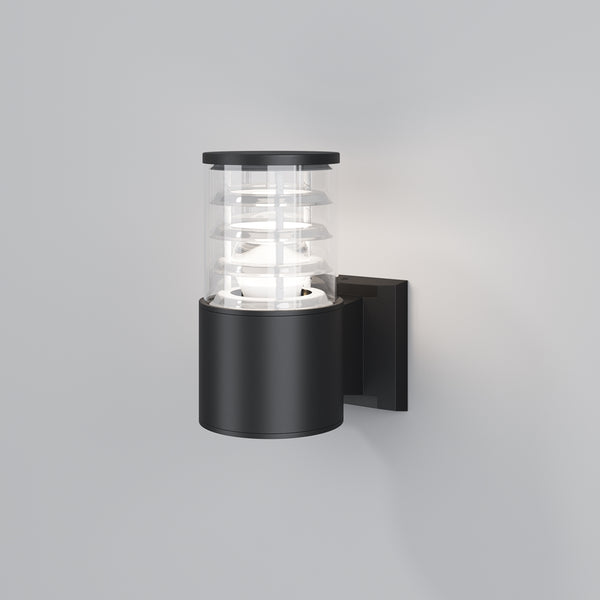
A tube throws grazing light up and down, ideal for outlining a stone wall or highlighting a hedge. A square frames a crisp halo, more graphic near a door. A round shape softens, with a more enveloping shadow. Think about the space needed: a 26 x 12 cm wall light such as LuminMotion needs more clearance than a small 10 x 10 cm square. For a refined result, compare with our design models for outdoor use.
| Area | Main criterion | Common technology or socket |
|---|---|---|
| Garden, facade | High IP rating, aluminium | Integrated LED |
| Terrace | Tube or square shape, non-glare light | Integrated LED or GU10 |
| Entrance | Sensor or manual switch | Integrated LED or E27 |
| Damp room | IP44 minimum, compact format | Integrated LED or GU10 |
| Living room, bedroom, hallway | Warm rendering, decorative shape | E27 or integrated LED |
Which IP rating for an outdoor wall light?
The IP rating indicates resistance to dust and water. IP44 protects against splashes and suits a sheltered spot; IP45 and IP54 withstand fine rain; IP65 and IP67 resist water jets and bad weather, including on a highly exposed facade. Most models in the selection are IP65.
IP44, IP54 or IP65: what does the rating really protect?
The first digit covers dust, the second water. An IP44 handles splashes, nothing more: under a canopy, above a water point or in a damp room, that is enough. An IP65 takes jets and driving rain, it targets an unprotected facade. An IP67 goes further still, useful near a pond. A high rating does not replace careful installation: a badly fitted seal lets water through.
| IP rating | What it protects against | Where to install it |
|---|---|---|
| IP44 | Water splashes and limited dust | Under a canopy, a sheltered entrance, a damp room |
| IP45 | Splashes and fine dust | Partially sheltered wall |
| IP54 | Dust and fine rain | Covered terrace, entrance wall |
| IP65 | Water jets and dust | Exposed facade, garden, uncovered terrace |
| IP67 | Powerful jets and temporary immersion | Highly exposed wall, poolside |
Outdoor wall light for a terrace: how high should the rating go?
On an uncovered terrace, aim for IP65: that is the level of the round Halo wall light and of Sentinel. A terrace under a canopy is fine with IP54, enough for fine rain. If the wall gets sea spray or runs along a pool, go up to IP67. Find these models in our IP65-rated wall lights, whose sealing logic also applies outdoors.
Warm white or cool white: which light colour for a garden?
Warm white, from 2700 to 3500 K, dominates the selection and gives light close to a classic bulb, pleasant near a terrace, an entrance or a flowerbed. Cool white, from 4500 to 6500 K, lights more sharply and secures a passage, but hardens the plant setting in the evening.
Light colour for living room and garden: the same principle?
Yes, colour temperature is chosen the same way indoors and outdoors: the lower the value, the more golden the light. Near foliage, a bench or a table, a warm white of 2700 to 3500 K stays comfortable all evening. Indoors, the same register suits LED wall lights for living rooms as well as LED wall lights for bedrooms.
Neutral white: for which outdoor use?
Neutral white, around 3500 to 4500 K, fits a hallway, a staircase or a passage: the light is balanced, without a marked yellow tint, and the eye adapts quickly. Some models offer all three temperatures, such as Eclat, rated IP67. Cool white, from 4500 to 6500 K, stays reserved for a facade to secure or a driveway.
LED, E27 or GU10: what is the difference on an outdoor wall light?
Models with integrated LED have no bulb to change and often show 18 W, 10 W or 6 W. E27 and GU10 versions take a bulb: you choose the power and the light temperature yourself, and you easily replace the source at the end of its life.
Powerful outdoor wall light for a terrace: which socket to choose?
The useful power comes from the source. Integrated LED models commonly reach 18 W; an E27 version accepts a bulb up to 60 W, which leaves room if the wall light must cover a large section of wall. GU10 offers a tighter beam, handy for framing a door or a house number. Check the socket first: it decides your everyday comfort. Bronx, in E27, was designed with that in mind.
Will the bulb ever be changed?
With an integrated LED, the source lasts and is not replaceable: if it ages, the whole fixture is affected. With E27, GU10, G9 or G4, a bulb is changed in minutes, and you can change the light temperature without buying a new wall light. Dimmable versions add control over brightness, handy on a terrace where you stay late.
With or without a motion sensor: which wall light for an entrance?
A wall light with a sensor turns on as you pass, which suits an entrance, a gate or a rarely used wall. Without a sensor, switching stays manual and some models accept a dimmer. The selection offers both approaches, in IP65 as well as IP44.
Integrated sensor: what it changes day to day
The sensor saves you hunting for the switch with full hands and only lights when useful. Sentinel and its sensor measures 26 x 12.5 cm with an IP65 rating; SécuriLuxe, Ondra and Mirka follow the same idea in more compact formats. On a very busy passage, a sensor can on the contrary become annoying: manual switching is then better.
Lighting an entrance or a gate
At an entrance, place the fixture on either side of the door, at shoulder height, aimed downwards to avoid dazzling whoever arrives. A gate is handled with a single point, on the lock side. To refine your choice, compare with our wall lights for entrances and our terrace selection, which share the same exposure constraints.
How to install and maintain an outdoor wall light?
Mount the wall light above a passage or a water point, high enough not to dazzle, keeping the space needed for its format. Aluminium and glass are cleaned with soapy water, without abrasive products, and the screws are checked once a year on an exposed facade.
At what height should a garden wall light be mounted?
Allow generally between 1.80 m and 2.20 m for facade lighting, lower for an ambient wall light near a bench. Aim the beam downwards or towards the wall: light that goes towards the eyes dazzles and lights nothing. Plan for the dimensions: formats in the selection range from 9 to 32 cm high, with 10 x 10 cm squares, 17 x 10 cm and 26 x 12 cm sets. Always fix to a sound support. For a WC or a toilet, choose a compact model, at least IP44 and a warm light.
Maintaining aluminium and glass
A soft cloth, soapy water, then a rinse: that is enough on aluminium as well as glass. Avoid abrasives and scouring pads. Check the seals after a windy winter and tighten the screws. Wooden models, such as Ayle, in wood and metal, need shelter and more regular checks of the finishes.
How to match an outdoor wall light with the rest of the house?
Black appears on most models and matches a contemporary facade; white and beige lighten a dark wall, bronze and gold warm up an entrance. Keep the same colour family between the outside and the rooms you pass through.
Black, white or gold: which finish on which wall?
Black disappears on a dark facade and stands out on a light wall: it is a contrast choice. White blends into an old render. Gold and bronze bring a more dressed touch, to be reserved for a neat entrance. Contemporary style dominates by far, minimalist and vintage remain in the minority. Think about the wall receiving the fixture more than about trends.
The same style outside and inside
A connecting door links two atmospheres: repeating the same colour family on both sides avoids a break. Black outside, warm white inside, and continuity holds. The same reflex applies to your bathroom wall lights, your modern wall lights for hallways and even in the modern kitchen decor, where the same matte black as on the terrace often appears. For a living room, also see our wooden wall lights for living rooms and our design wall lights for staircases.
What a wall light changes in a garden in the evening
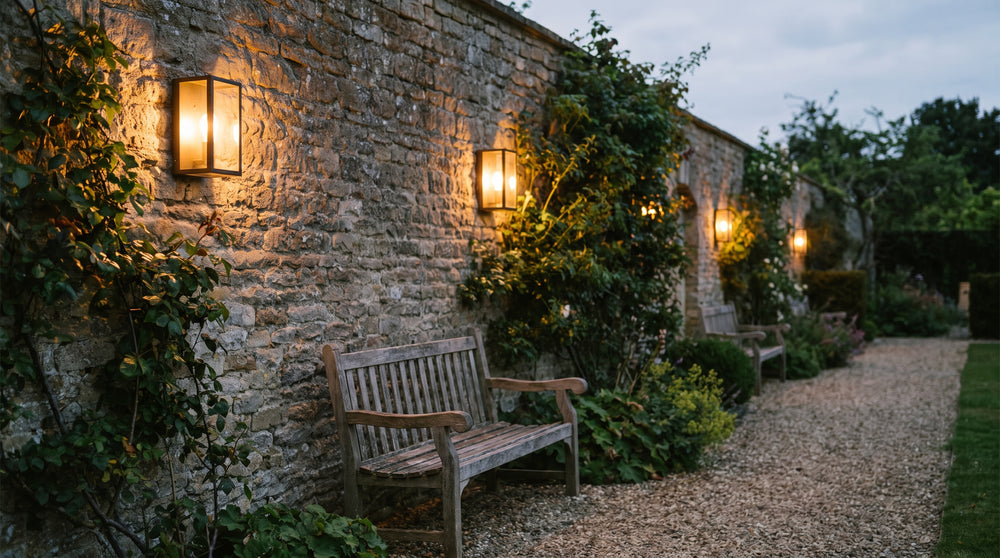
A wall light draws a halo on the wall rather than lighting the whole garden: a stone wall, a hedge or a bench reveal themselves through grazing light, whereas a wide-beam model lights further but flattens materials. A square sets a crisp, graphic shadow, a round one softens it. That is what turns a terrace into an extension of the house at nightfall, without a spotlight aimed at the neighbours.
Browse the rest of the range in our entire lighting range, and the sets designed for outdoor use in our outdoor lighting for terraces. For a damp room, a toilet light follows the same logic of compact format and sealing rating.
Frequently asked questions
What is the best outdoor wall light?
For a highly exposed facade, aim for an IP65 or IP67 model in aluminium, with integrated LED: it fears neither rain nor splashes. On a sheltered wall, an IP44 in glass and metal is enough. Add a sensor if the wall light illuminates an entrance or a rarely lit passage.
What is the most efficient outdoor lighting?
Efficiency depends less on power than on direction and IP rating. An integrated LED wall light of 10 to 18 W, rated IP65, lights an entrance or a section of terrace without dazzling the neighbours. Warm white stays comfortable, cool white is sharper for security.
A powerful outdoor wall light for a terrace, how to choose it?
The useful power is that of the source: integrated LED models of 18 W, or E27 versions that reach 60 W with the chosen bulb. Look above all for light directed downwards or towards the wall, an IP65 rating and a material such as aluminium.
Is a solar outdoor wall light for a terrace possible?
This selection gathers mains-powered wall lights, with integrated LED, E27 or GU10. A solar version works with a panel and an integrated battery: it installs without a cable, depends on sunlight and offers more modest power. It suits places where a connection is not possible.
Can you install an outdoor wooden wall light?
Wood patinas and needs shelter: it belongs under a canopy, a conservatory or a covered entrance, in IP45 for example. On a facade beaten by rain, aluminium, metal and glass hold up better over time. Wood brings a warmth that black metal does not have.
Order with confidence: secure payment, tracked delivery, possible returns and Designix customer service to support you before and after purchase. For a complete project, browse the full lighting collection and the design models for outdoor use, then compare formats before making your choice.