
Black ceiling light for the living room: how to choose the right one
This article is also available in French: Comment choisir le Plafonnier noir Parfait pour Votre salon
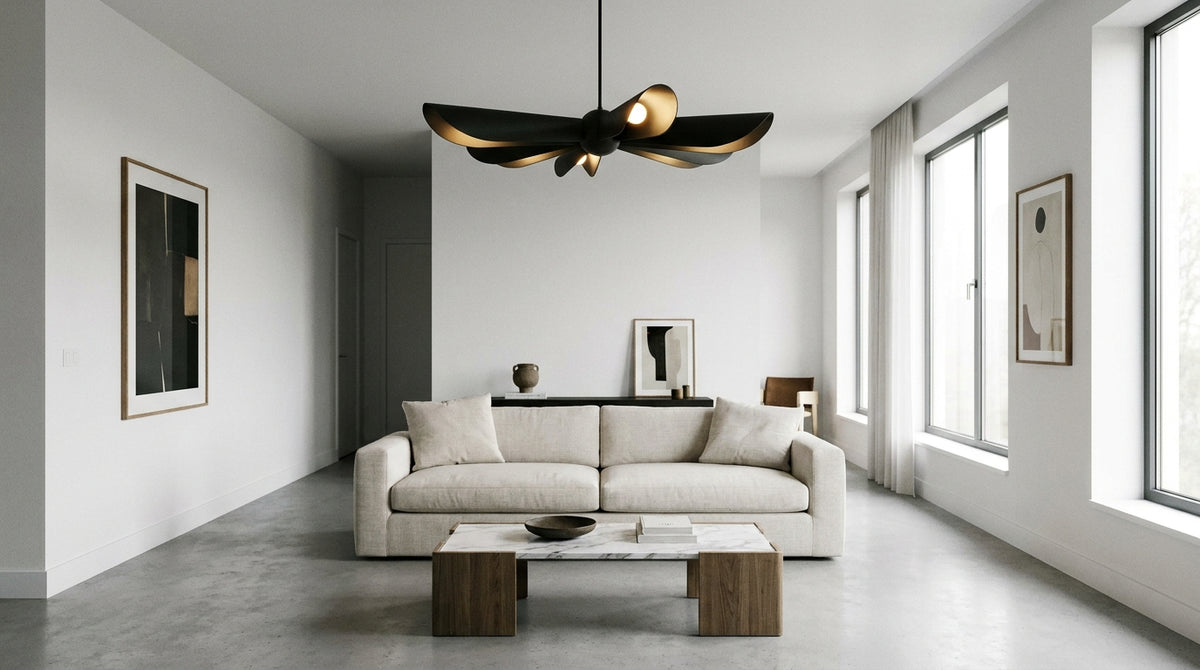
Have you set your heart on a black ceiling light but are afraid of darkening your living room? The concern is valid: unlike a white model, black absorbs part of the light instead of reflecting it.
With identical power, the room therefore appears cozier and the halo on the ceiling is less noticeable. Used well, this effect creates an enveloping atmosphere; anticipated poorly, it veers into dimness. An entire collection of black ceiling lights is chosen based on this compromise between style and light output.
Here is how to decide, from format to finish, without making a mistake.
Which black ceiling light matches your living room?
What type of ceiling light for a living room?
Three families work in the living room: the flush-mount or semi-flush mount ceiling light for low ceilings (less than 2.50 m), the pendant light hanging above a table or sofa, and the multi-source model with adjustable spotlights. In black, the choice mainly depends on the room's style.
A matte black metal model extends an industrial decor in the living room, with exposed cables and raw shapes. Sleek geometric lines match a contemporary interior.
For a Japandi vibe, prefer a lampshade with soft curves that breaks the harshness of black. The style dictates the format as much as the material: it decides whether the fixture should fade away or become the centerpiece of the living room.
What size ceiling light is suitable for a living room?
Add the living room's length and width in meters, then convert this total into centimeters: you get a consistent diameter. A 4m by 5m living room therefore calls for about 90 cm of lighting, to be distributed over one or more sources rather than a single disk.
This method complements the usual benchmarks and avoids the pitfall of a model that is too small, floating in the middle of a large ceiling. For a large volume, two light points balance the room better; the selection of ceiling lights for the living room can be filtered precisely by dimension.
The installation height counts just as much as the diameter. This guide for correctly sizing your lighting details the distances to respect under the ceiling and above furniture.
Doubts about the diameter or number of sources to plan for your room? The Designix team helps you decide with personalized advice before purchasing.
Matte, glossy, or brushed metal: does the finish change everything?
Yes. A matte black absorbs light and diffuses little; a glossy black or brushed metal sends back reflections that soften the dark effect. A closed black lampshade directs the beam downward like a spotlight, whereas an openwork model or one with a visible source distributes light more broadly.
Watch out for the "black hole" effect: placed on a white ceiling, a black disk creates a strong contrast that draws the eye to the fixture instead of the light. On a dark ceiling, it blends in and appears lighter. This choice should be considered alongside the color of the ceiling.
Hence a simple rule for black: step up one level in lumens and favor a visible source or a light-colored diffuser inside. To adjust the power to your surface area, learn to calculate the number of lumens required.
Regarding attachment, a black ceiling light requires no special installation, but does need a clean junction box and a support with good weight capacity. The steps are detailed in this step-by-step guide to installing a black ceiling light.
Which light color is ideal for a living room?
A warm white light, under 3,300 Kelvin, remains the most comfortable in the living room: it warms the atmosphere and enhances textures. With a black ceiling light, choose a clear glass bulb or a slightly warmer tint, as the dark structure eats into a portion of the perceived intensity.
The debate between cool and warm tones is worth stopping for room by room: this comparison of white or yellow light helps set the right temperature.
A ceiling light alone is rarely enough to cover an entire living area. Layer accent sources to eliminate shadows, as explained in this guide for effectively lighting your living room.
What lighting should you put in a living room?
A successful living room combines three levels: general lighting on the ceiling, accent lighting (floor lamp, table lamp), and soft lighting for evenings. The black ceiling light plays the lead role; other sources correct the absorption and add depth.
This layered approach avoids the "flat room" effect of a single light point. You can compose the set from the same range of living room light fixtures, keeping a consistency of finish between the ceiling and accent pieces.
On the same topic
In stock · shipping costs shown at checkout · up to 30% off in your cart

Ready to turn inspiration into reality?
Tell us about your room, your style and your budget, and we will show you the pieces that truly suit your project.
Get guidance in 30 seconds →


